Extreme wide shot
Also calledExtreme long shot, EWS, ELS
An extreme wide shot places the subject as a tiny, often barely recognizable element within a much larger frame, prioritizing the surrounding environment over the human figure. It tells the viewer, at a glance, how small a person is against the scale of their world.
What it tells
Directors reach for the extreme wide shot when the story needs to feel bigger than the character in it. It sells isolation, awe, danger, or the sheer size of a setting before intimacy takes over. Used at the start of a scene it orients the audience; used mid-scene it can suddenly shrink a character's importance, turning triumph into vulnerability or reminding the viewer that the environment, not the person, is in control.
How it is shot
The camera sits far from the subject, often 20 meters or more, and stays wide or ultra-wide, typically 14mm to 24mm, so the whole environment stays in frame and mostly in focus. The subject should occupy roughly 5 to 15 percent of the frame height. Lighting is set to reveal architecture or landscape (practicals down a corridor, sun raking across a dune) rather than to flatter a face. Camera movement, if any, is slow: a static lockoff, a slow push, or a controlled drone or crane move. On set this often means clearing a large space, using longer lenses on a crane, or shooting on location rather than a built set.
When to use it
- Opening a scene to establish the scale and mood of a new location before cutting closer
- Showing a character isolated or overwhelmed by a hostile or indifferent environment
- Revealing the true size of a set, ship, or landscape that dialogue alone cannot convey
- Creating a beat of silence or dread by letting empty space dominate the frame
Not to be confused with
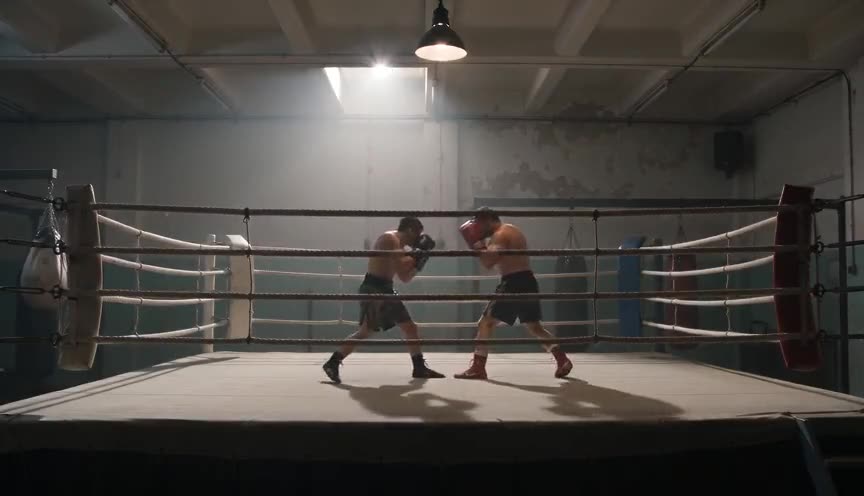
A wide shot keeps the full body of the subject clearly readable and dominant enough to carry action or expression. An extreme wide shot pushes further back until the subject becomes a small detail inside the environment.
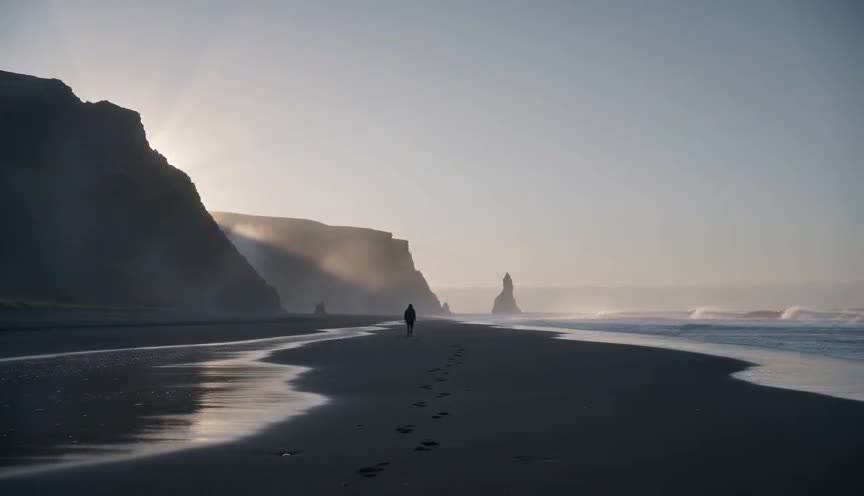
An establishing shot is defined by its narrative job of orienting the viewer to a new location, and it can be any size. An extreme wide shot is defined by its scale relationship, and it often serves as the establishing shot but is not required to.
In film
Lawrence of Arabia (1962)
Tiny riders cross vast desert horizons, using extreme wide shots to make the landscape itself a dominant character.
The Shining (1980)
Opening aerial shots place the tiny car within vast mountain landscapes, stressing isolation long before the Overlook Hotel becomes visible.
Interstellar (2014)
Spacecraft and crew appear as tiny shapes against the enormity of space, reinforcing isolation and scale.
The prompt
Name the lens (14mm to 24mm equivalent), state the camera distance in meters, and describe the environment in more detail than the subject, since the environment is the real point of the shot. Say explicitly that the subject occupies a small fraction of the frame. Avoid crowding the composition with multiple large foreground elements, and avoid asking for facial detail, since the model may compensate by pushing the camera in closer than intended.
The exact prompt that rendered the video on this page. Keep the description of the move, change the subject and the setting.
Extreme wide shot: a long, curved space station corridor stretching into the distance, lined with rows of small ceiling lights and metal support ribs. A single figure in a gray flight suit walks slowly near the far end, occupying only a small fraction of the frame against the vast, repeating architecture. The camera is static, positioned far down the corridor at the opposite end, wide angle lens, everything in sharp focus from near wall to distant figure, cool white light with faint blue reflections on the metal floor. No text.
Common mistakes
Subject too large
If the figure fills more than about 15 percent of the frame height, the shot reads as a wide shot, not extreme wide, and loses the intended sense of scale.
Cluttered foreground
Stacking large objects near the lens competes with the environment for attention and defeats the purpose of showing vast, open space.
Relying on it for emotion
Faces are unreadable at this distance, so pairing it with a close-up or reaction shot is necessary if the scene needs emotional detail.
Frequently asked questions
What is an extreme wide shot?
It is a framing where the subject is small within the frame and the surrounding environment, landscape, or architecture dominates. It is used to establish scale, isolation, or the sheer size of a location.
How far should the subject be from the camera?
There is no fixed number, but as a rule of thumb the subject should occupy roughly 5 to 15 percent of the frame height, which usually means a camera distance of 15 meters or more depending on the lens.
Is extreme wide shot the same as establishing shot?
Not quite. Establishing shot describes the narrative function of orienting the viewer to a new location, while extreme wide shot describes the framing scale. Many establishing shots are extreme wide shots, but not all extreme wide shots are establishing shots.
Can AI video tools generate an extreme wide shot?
Yes, tools like the models available on Imaginode can produce convincing extreme wide shots if the prompt states the lens, the distance, and that the subject is small within a detailed environment, since vague prompts tend to default to closer framing.