Kicker light
Also calledkick light, edge kicker, separation light
A kicker light is a hard, low-placed light aimed at the edge of a subject from behind or to the side, opposite the key light, that highlights a shoulder, jaw, or limb without lighting the face. It gives the viewer a sense of physical presence and depth by carving a bright rim out of an otherwise dark surface.
What it tells
A kicker adds edge and danger without lighting the face, letting shadow do the emotional work. Directors reach for it when they want a character to feel dangerous, isolated, or physically present in near darkness, common in noir and sports films. It carves a rim of light across muscle or bone that separates the body from a black background, turning a flat silhouette into something sculptural and alive, while keeping mystery intact by leaving the eyes and most of the face unlit.
How it is shot
The fixture sits low, often at hip or knee height, positioned behind the subject on the side opposite the key light, roughly 120 to 150 degrees off the camera axis. It is usually a small hard source, a Fresnel, a focusable LED spot, or a bare bulb with a snoot, flagged and barn-doored so its beam only grazes one edge of the body: a shoulder, forearm, jawline, or spine. Intensity is set below the key, often one to two stops under, so it reads as an accent rather than a second light source. Gels can match or contrast the key's color temperature to add tension between the highlight and the shadow side.
When to use it
- Lighting a boxer or fighter to reveal muscle definition against a dark, featureless background.
- Adding danger or menace to a character who stands mostly in shadow during a thriller scene.
- Separating dark hair or a dark costume from an equally dark backdrop without raising overall exposure.
- Emphasizing sweat and muscle tension in a sports, dance, or workout sequence shot in low light.
Not to be confused with

Rim light wraps a full edge of light around the subject from directly behind, tracing the whole silhouette; a kicker is narrower, placed low to one side, and highlights just one area like a shoulder or jaw.
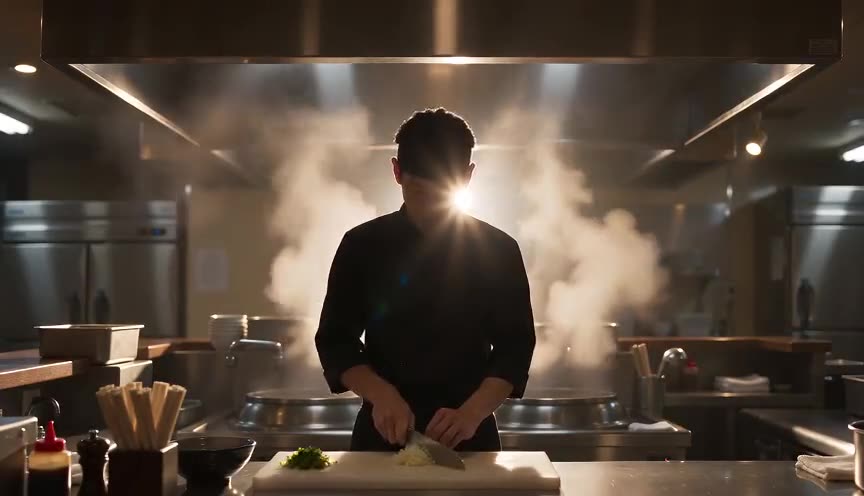
Backlight sits behind the subject at or above eye level and lights hair and shoulders evenly on both sides; a kicker comes from low and to one side only, creating a single hard-edged accent rather than an even glow.
In film
Raging Bull (1980)
Boxing ring scenes use hard kicker lights from low angles to carve sweat and muscle out of near-black backgrounds.
Fight Club (1999)
Low-key interiors use kicker lights to edge-light bruised bodies and faces, keeping most of the frame in shadow.
The prompt
Name the kicker explicitly and describe its physical placement: low, behind, opposite the key light, hitting one specific edge like a shoulder or ribcage. State that the rest of the body or face stays in shadow, and give the key light a separate, dimmer description so the model does not flatten both into one soft light. Avoid words like 'bright' or 'well lit' for the overall scene, they cancel the low-key effect the kicker depends on.
The exact prompt that rendered the video on this page. Keep the description of the move, change the subject and the setting.
Kicker light: a shirtless boxer stands in a dark gym, his face and chest lit only by a dim blue key light from the front, while a hard white kicker light placed low behind his right side skims a sharp edge of light along his shoulder, arm, and ribs. As he shifts his weight and raises his gloves, the kicker highlight moves with him across his skin, the rest of his body and the background staying in deep shadow. Static camera, close medium shot. No text.
Common mistakes
Kicker too bright
If the kicker matches or exceeds the key light's intensity, it stops reading as an accent and starts looking like a second key, flattening the shadow side the technique depends on.
Wrong side placement
Placing the kicker on the same side as the key light cancels the separation effect; it needs to sit opposite the key so it grazes the unlit side of the subject.
No control on spill
Without flags, barn doors, or a snoot, the kicker spreads across the whole body instead of skimming one edge, turning a precise accent into generic extra light.
Frequently asked questions
What is a kicker light?
A kicker light is a hard, low-placed light aimed at the edge of a subject from behind or to the side, opposite the key light, used to highlight a shoulder, jaw, or limb without lighting the face.
How is a kicker light different from a rim light?
A rim light circles the whole silhouette from directly behind at head height; a kicker sits lower and to one side, producing a single, localized edge highlight rather than a full halo around the subject.
Where do you place a kicker light on set?
Typically low, around hip or knee height, behind the subject and on the side opposite the key light, at roughly 120 to 150 degrees from the camera, flagged so it only grazes one part of the body.
Can AI video tools generate a kicker light effect?
Yes. Tools like the ones on Imaginode can render a kicker if you describe its position, hardness, and the specific edge it hits, along with a separate, dimmer key light so the two do not merge into flat lighting.