Fisheye lens
Also calledFisheye shot, Ultra-wide fisheye, Bug-eye lens
A fisheye lens is an ultra-wide optic (typically 8mm to 16mm) that bends straight lines into curves and bulges the center of the frame outward, producing a circular or heavily distorted spherical image. It disorients the viewer, turning ordinary space into something warped, claustrophobic or comic, depending on how it is used.
What it tells
Directors reach for a fisheye when they want to break the polite realism of normal optics and put the viewer inside a subjective, unstable point of view. It signals altered perception: drug trips, panic, dreams, surveillance, or the skewed logic of a character's mind. The curved horizon and swollen center also work for comedy and music videos, where exaggeration and energy matter more than accuracy. It is a lens that announces itself, so it is used sparingly, at a moment the story needs a jolt.
How it is shot
A fisheye lens has an extremely short focal length, often 8mm to 16mm on full frame, with a field of view from 100 to 180 degrees. Rectilinear correction is deliberately absent, so straight lines near the frame edges bow outward while the center stays relatively true, creating barrel distortion. Because depth of field is naturally deep at these focal lengths, most of the scene stays in focus even at wide apertures. Camera height and distance to subject matter enormously: moving the lens a few inches closer exaggerates the bulge. Operators often shoot handheld or on a short pole to keep the distortion active and organic rather than locked on a tripod.
When to use it
- A character experiences a drug trip, dizziness, or a psychotic break and needs a warped point of view
- Security camera or peephole footage inside the story world, real or simulated
- A comedic close-up where exaggerated facial distortion sells the joke
- An establishing shot of a small, tight interior that needs to feel bigger and more disorienting than it is
Not to be confused with
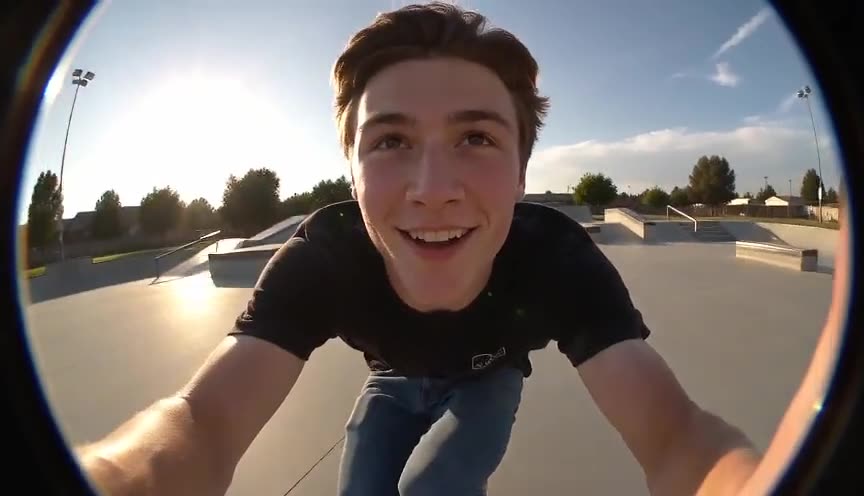
An ultra-wide lens (14mm) widens the frame but keeps straight lines straight through rectilinear correction; a fisheye lets those lines bow, which is the whole point of the distortion.
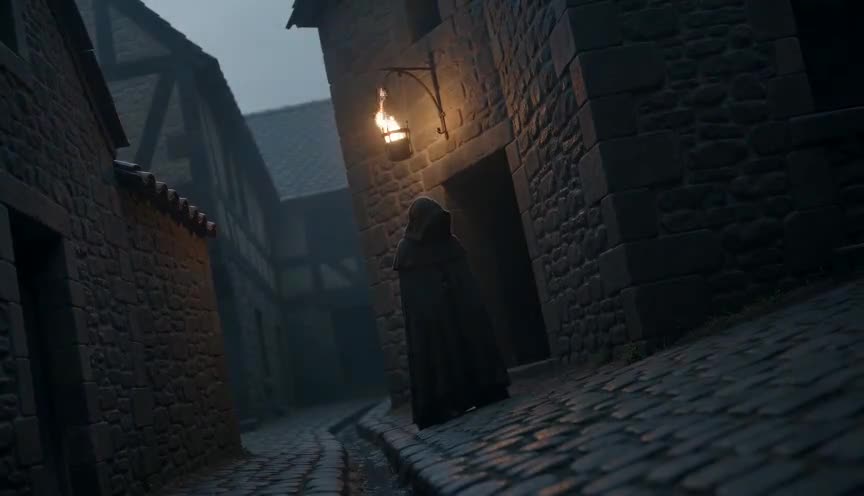
A Dutch angle tilts the whole frame on its axis to unsettle the viewer, while a fisheye keeps the horizon level but bulges the image outward from the center, a different kind of distortion.
In film
Requiem for a Dream (2000)
Uses fisheye and Snorricam shots to make drug-altered perception feel physically warped and claustrophobic during addiction spirals.
Seconds (1966)
Uses a fisheye lens in Saul Bass's opening close-ups and James Wong Howe's distorted interiors, making faces and corridors feel nightmarishly warped.
The Favourite (2018)
Robbie Ryan repeatedly uses fisheye views of palace rooms and corridors, curving the royal space into a comic, predatory arena.
The prompt
Name the lens explicitly (fisheye lens, 8mm, 180 degree field of view) since AI models default to normal perspective otherwise. Describe the visible curvature: bowed walls, a swollen center, a rounded horizon, and keep the camera close to the subject since distortion weakens with distance. Avoid asking for a perfectly flat or symmetrical composition, it fights the effect; instead let edges bend and let one element (a face, a doorway) stay near the true center.
The exact prompt that rendered the video on this page. Keep the description of the move, change the subject and the setting.
Fisheye lens shot, 8mm focal length, inside a Moroccan riad courtyard with tiled arches and a central fountain. The camera is handheld, held low and close to a middle-aged woman in a caftan spinning slowly near the fountain, her face swelling toward the lens as the surrounding archways and tiled walls bow outward into a circular distortion. The horizon curves visibly at the frame edges while the center stays sharp, warm afternoon light bouncing off the water. The camera stays static in position while she rotates, the bulge and curvature constant throughout the four seconds. No text.
Common mistakes
Shooting too far from the subject
Fisheye distortion depends on proximity; stand back and the lens starts looking like an ordinary wide angle with barely any bulge.
Overusing it across a scene
A fisheye is a jolt, not a resting state; holding it for dialogue or continuity work exhausts the viewer and breaks spatial trust.
Ignoring the curved horizon in framing
Straight horizontal lines like door frames or tabletops will bow at the edges; composing as if they stay straight leads to accidental, distracting warps.
Frequently asked questions
What is a fisheye lens?
It is an ultra-wide camera lens, usually 8mm to 16mm, that intentionally keeps its optical distortion instead of correcting it, so straight lines curve and the frame center bulges outward, common for POV, surveillance and disorientation shots.
Why do fisheye shots look round or bubble-like?
Because the lens covers a field of view up to 180 degrees without rectilinear correction, projecting the scene onto a curved, spherical-looking image where the edges compress and bend more than the center.
Is a fisheye lens the same as a GoPro look?
Action cameras often use a fisheye-style wide lens for a similar bulging effect, but true cinema fisheyes are interchangeable optics chosen deliberately for specific shots rather than a fixed camera characteristic.
Can AI video tools generate a convincing fisheye effect?
Yes, tools on platforms like Imaginode can render fisheye distortion if the prompt names the lens and describes the bowed lines and swollen center explicitly, since the model will default to a normal lens otherwise.