Sandstorm
Also calledDust storm, Sand blow, Haboob shot
Sandstorm is a technique where dense blowing sand or dust fills the frame, cutting visibility and wrapping the scene in a warm, gritty haze. It disorients the viewer, isolates the characters from their surroundings, and turns the environment itself into an active threat.
What it tells
Directors reach for a sandstorm when they need the world to turn against the characters without a villain in sight. It strips away landmarks and horizon lines, so a hero can be lost in plain daylight, and it compresses a scene down to a single fight: staying upright, staying together, staying seen. The grit in the light also gives an emotional texture, harsh and unforgiving, that a clean sky cannot.
How it is shot
On set, crews rig large fans or turbine blowers loaded with fuller's earth, ground cork, or fine sand substitute, aimed across the frame at chest height. A strong backlight or bounced sun catches the particles and turns them into a glowing wall, while a warm amber gel pushes the color toward ochre. Shutter speed stays close to the 180-degree rule so grains streak slightly rather than freeze into dots. Actors squint, turn their backs to the wind, and shield their faces, which sells the force of the storm more than the sand itself. Wide lenses (24 to 35mm) hold scale; a slight haze filter or diffusion on the lens softens edges further.
When to use it
- A character is lost, exposed or overwhelmed by a hostile, uncontrollable environment.
- You need to isolate two people from a crowd or from their usual setting instantly.
- The story turns on limited visibility: someone is searching, hiding, or about to be surprised.
- You want an interior space to feel suddenly invaded by an outside, natural force.
Not to be confused with
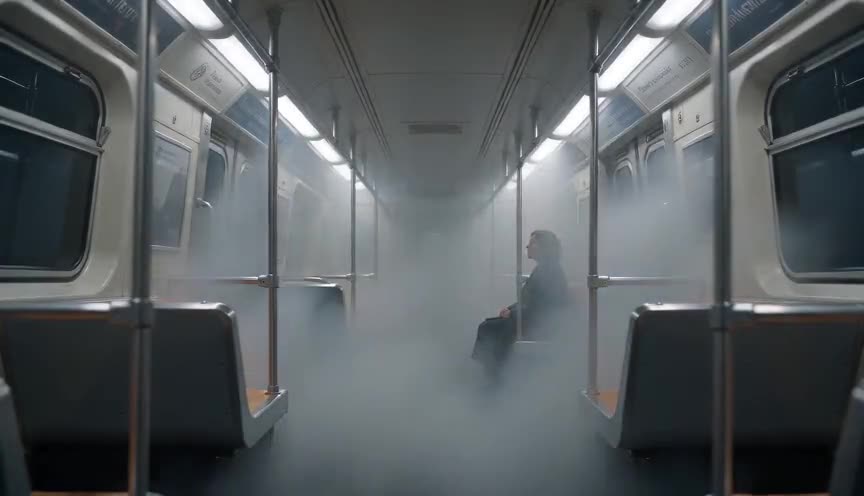
Fog is soft, cool and even, and it sits still in the air. Sandstorm is warm, harsh and always in motion, driven by visible wind that pushes debris and clothing.
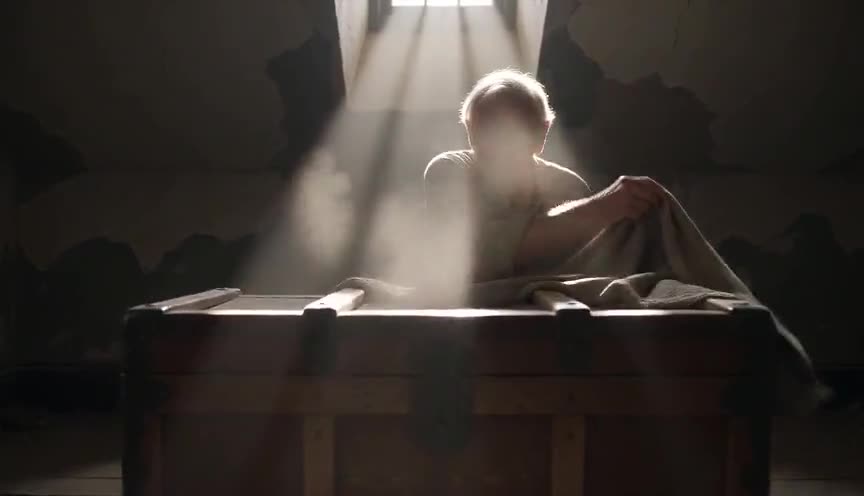
Dust motes are a quiet, small-scale detail drifting in a light beam. Sandstorm is a violent, room-filling or landscape-filling event that obscures the whole frame, not a texture in one shaft of light.
In film
Mad Max: Fury Road (2015)
A towering red sandstorm engulfs the war rig convoy, staged with practical dust and wind machines for scale and menace.
Dune (2021)
Blowing sand repeatedly reduces visibility on Arrakis, reinforcing the planet's danger through atmosphere rather than dialogue.
The prompt
Name the sand explicitly (fine, orange, blowing) and describe what stays still versus what moves: floor and walls locked, sand and hair whipped by wind. Add a light source the sand can catch (backlit, hazy beam) so the model renders density instead of a flat overlay. Keep the shot to one setup and avoid vague words like 'stormy' alone; specify particle size, color and direction of the wind to prevent a generic fog result.
The exact prompt that rendered the video on this page. Keep the description of the move, change the subject and the setting.
Sandstorm. In a vast desert, a huge wall of orange sand rolls across the dunes toward a lone camel rider wrapped in a scarf; the wind whips sand across the frame, the sun turns into a pale disc behind the dust and visibility drops as the storm swallows the rider. Wide shot, epic, realistic. No text.
Common mistakes
Sand that looks like fog
Using a flat, even haze instead of directional, textured particles makes the shot read as mist, not sand. Add motion, color and grain to the debris itself.
No wind on the actors
If clothing, hair and eyes do not react to the storm, the effect looks pasted over the scene instead of physically present in it.
Overexposing the particles
Too much backlight blows the sand out to white and erases its grit and color, turning a sandstorm into an unreadable bright fog.
Frequently asked questions
What is a sandstorm shot in filmmaking?
It is a shot where dense, moving sand or dust fills the frame, cutting visibility and giving the scene a warm, gritty haze. It is used to isolate characters and make the environment feel dangerous.
How do filmmakers create sandstorm effects without a real desert?
Crews use industrial fans or wind turbines to blow fuller's earth, ground cork, or fine sand substitute across the set, combined with backlight and amber gels to make the particles glow and read as sand.
Can AI video tools generate a convincing sandstorm?
Yes, if the prompt specifies particle color, size and direction plus a light source the sand can catch. Tools like those on Imaginode handle this well when the physical description is precise rather than a vague 'sandstorm' keyword.
What lens works best for a sandstorm scene?
Wide lenses around 24 to 35mm are common because they keep enough scale and background visible through the haze, letting the sand read as an environment rather than a close texture.