Smoke
Also calledPractical smoke, Smoke atmosphere, Haze effect
Smoke is an atmospheric effect created by burning, chemical fog machines or practical sources that fills the air with visible haze, scattering light and adding depth to a shot. It softens edges, reveals beams of light and gives a scene a tactile, textured mood the viewer can almost feel.
What it tells
Smoke tells the audience that something has changed in the air before a single word is spoken: danger, ritual, exhaustion, the passage of time. It turns empty space into a visible medium, so light itself becomes part of the story. Directors reach for smoke when they want a scene to feel thick with consequence, whether that means a battlefield, a jazz club or a quiet room where someone has just put out a cigarette.
How it is shot
On set, smoke comes from theatrical foggers, smoke pellets, incense or controlled burns, released upwind of the frame so it drifts naturally across the action. A backlight or hard side light is placed to rake through the particles, since smoke is invisible without light hitting it at the right angle; front-lit smoke often just looks like fog. Density is tuned with fan speed and machine output, thin wisps for a lingering mood, heavy banks for a fire or explosion aftermath. Timing matters: crews often let a burst settle for a few seconds so the smoke moves in slow, readable curls instead of a flat cloud, and continuity teams track its thickness across takes since it dissipates over time.
When to use it
- A character just extinguished a fire, a cigarette or a candle and the air should still show it
- You want to reveal a light source or shaft of light that would otherwise be invisible
- The scene needs a sense of danger, industry or ritual without dialogue explaining it
- You want to soften a hard-edged set or add depth between foreground and background planes
Not to be confused with
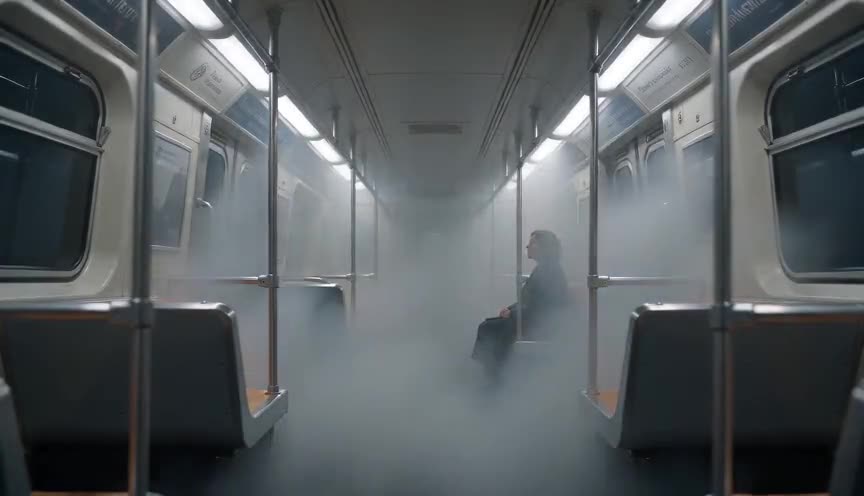
Fog is a broad, low-lying atmospheric condition that behaves like weather, covering a wide area evenly. Smoke is usually tied to a visible source (fire, a machine, incense) and drifts, thins and disperses unevenly from that point.
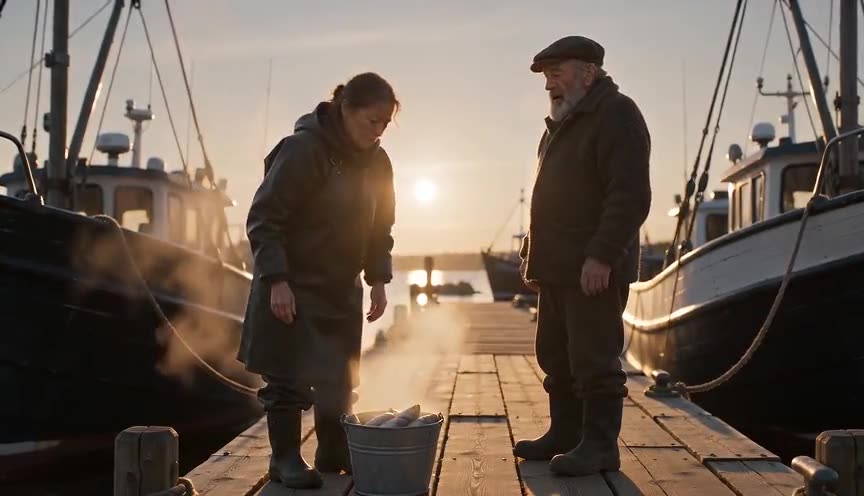
Steam is hot water vapor that rises quickly, reads white and thin, and comes from kettles, engines or skin meeting cold air. Smoke is often thicker, can carry color and odor cues, and drifts laterally more than it rises.
In film
Blade Runner (1982)
Smoke and haze fill nearly every interior and exterior, giving the city a thick, decaying atmosphere lit by hard shafts of light.
The Godfather (1972)
Gordon Willis lets cigarette and cigar smoke hang in low light to give interior scenes weight and secrecy.
Apocalypse Now (1979)
Smoke from fires and flares drifts across the frame in the jungle sequences, turning the battlefield air into a visible character.
The prompt
Name the smoke source (kiln, incense, fire, machine) so the model gives it a believable origin and behavior, and specify density (thin wisps, heavy bank) and direction of drift. Mention the light raking through it (backlight, window light, a single beam) since that is what makes smoke read on screen rather than looking like a flat gray filter. Avoid vague words like 'smoky atmosphere' alone; describe how the smoke moves and thins over the four seconds, and keep the light source and camera fixed so the change in the air is the only variable.
The exact prompt that rendered the video on this page. Keep the description of the move, change the subject and the setting.
Smoke drifts in slow curling ribbons across a dim pottery workshop as pale kiln smoke rises from a vent beside a potter's wheel. Backlit by a single window, the smoke turns silver white, swirling and thinning as it climbs and catching shafts of light, while a middle-aged man in a clay-streaked apron shapes a bowl in the foreground, unaffected by the haze. The camera holds completely static, the smoke thickens briefly then disperses, texture and depth shifting while the framing and light never move. No text.
Common mistakes
Flat, unlit smoke
Smoke with no backlight or side light just looks like a gray filter over the lens instead of a dimensional, moving element in the air.
No plausible source
Smoke that appears from nowhere reads as an effect rather than a story detail; tie it to a fire, a machine, incense or a recent action.
Too thick, too fast
A sudden wall of smoke that fills the frame in one beat looks like an accident on set rather than a controlled mood; let it build and drift gradually.
Frequently asked questions
What is smoke as a cinematic technique?
It is the deliberate use of visible haze, from fire, machines or practical sources, to add atmosphere, reveal light and give a scene texture and depth. It is used for mood, danger, mystery or the simple aftermath of something burning.
How do filmmakers create smoke on a film set?
Most productions use theatrical fog or smoke machines, smoke pellets, or controlled small burns like incense, released just outside the frame so it drifts naturally into the shot. Crews adjust output and airflow to control density and speed.
What is the difference between smoke and fog on screen?
Fog is a broad, even atmospheric condition that covers a whole area like weather. Smoke usually comes from a specific source, drifts unevenly, and often carries a story meaning like fire, a cigarette or industry.
How do I get realistic smoke in an AI-generated video?
Describe the smoke's source, density and direction of drift, and specify a light source raking through it so the particles are visible. On a platform like Imaginode you can test different densities and light angles quickly to find the version that reads clearly in a short clip.