Trunk shot
Also calledTarantino trunk shot, trunk POV shot, boot shot
A trunk shot places the camera low inside the open trunk of a car, looking up at the faces of people gathered around it. It traps the viewer in a tight, low vantage point, turning ordinary characters into looming, powerful figures against the sky.
What it tells
Directors reach for the trunk shot when they want the audience to feel small, cornered, or complicit in a moment of menace or dark comedy. The low, boxed-in angle mimics the point of view of someone trapped in a car trunk, so faces looming overhead read as threatening even when the dialogue is casual. Quentin Tarantino made it a signature because it compresses power dynamics into one frame: the people above hold control, the camera below has none, and the audience shares that helplessness for a beat before the trunk closes.
How it is shot
The camera sits physically inside the trunk, either handheld by an operator crouched in the well or rigged on a low mount after the spare tire and floor panel are pulled to make room. A wide lens, typically 18mm to 24mm, keeps the whole trunk opening and both edges of the lid in frame while letting nearby faces stay recognizable without close focus. The angle points almost straight up, so actors lean over the bumper and look down into the lens. Natural sky or a soft overhead source lights the faces from above, which flattens features and darkens eye sockets. The shot usually starts or ends with the lid opening or slamming, timed to a beat of dialogue or a reveal.
When to use it
- A character is held or hidden in a trunk and needs to see captors from below.
- You want a comedic or menacing group huddle shot from an unusual, powerless point of view.
- A reveal moment benefits from the trunk lid opening to expose or conceal the frame.
- You need a visual signature that instantly reads as tense, claustrophobic, or darkly funny.
Not to be confused with

An object POV shot can be any object's viewpoint, like a bottle or a drawer, while the trunk shot is specifically the car trunk, framed by its lid and bumper as a recognizable, recurring composition.
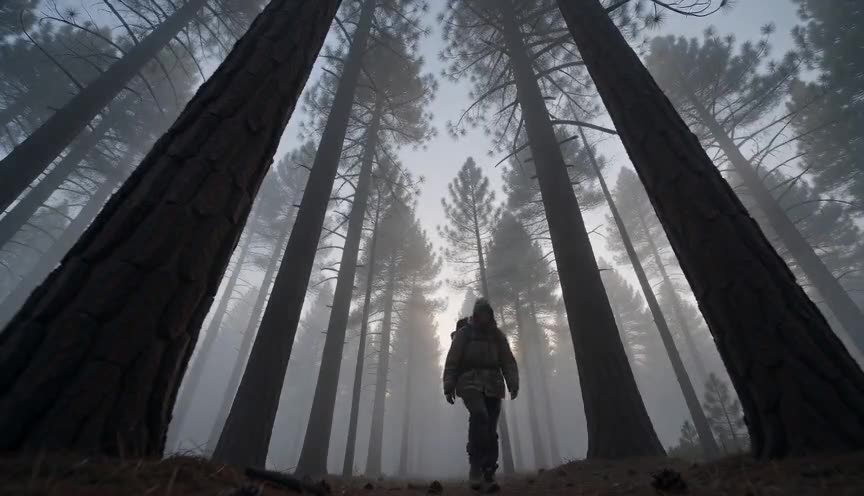
A low angle shot can be taken from any low position with open space around the lens, while the trunk shot is boxed in by the physical trunk opening, which crops the frame and limits camera movement.
In film
Reservoir Dogs (1992)
Quentin Tarantino frames Mr. Blonde and the others from inside a car trunk, a low, hemmed-in angle that became one of his recurring visual signatures.
Kill Bill: Volume 1 (2003)
Tarantino shoots from inside the trunk holding Sofie Fatale, making the Bride loom above her captive after the House of Blue Leaves massacre.
The prompt
Name the trunk explicitly and describe the lens as wide and low, looking straight up, so the model does not default to an ordinary low angle. Mention the trunk lid and bumper edges cutting into the top and sides of the frame, since that boxed crop is what sells the technique. Keep the shot mostly static with only slight handheld sway, and give the faces a reason to look down into the lens. Avoid camera movement that would leave the trunk, and avoid crowding the frame with more than two or three faces.
The exact prompt that rendered the video on this page. Keep the description of the move, change the subject and the setting.
Trunk shot: camera fixed low inside the open trunk of a sedan parked on a desert highway at dusk, looking straight up through the trunk opening. Two men lean over the frame from the sides, their faces backlit by the fading orange sky, the trunk lid's edge and a taillight cutting hard lines across the top of the frame. The men glance down at the camera, one reaches toward it, then straightens up as the trunk lid begins to swing shut, darkening the frame. Camera stays static, wide-angle, with only a slight handheld sway. No text.
Common mistakes
Shooting eye-level instead of low
Framing the actors at eye level defeats the point of the shot. The camera needs to sit low enough that faces are seen from below, looking up past the trunk lid.
Losing the trunk frame
Without the trunk lid and bumper visible at the edges of frame, the shot just reads as a generic low angle and loses its claustrophobic signature.
Using too long a lens
A long lens flattens the trunk opening and removes the sense of confinement. Stick to a wide lens that keeps the boxed edges sharp and close to the frame.
Frequently asked questions
What is a trunk shot?
It is a shot filmed from a low camera position inside the open trunk of a car, looking up at people standing around it. The trunk lid and bumper crop the frame, creating a boxed, low-angle view that feels trapped or exposed.
Why do directors use the trunk shot?
It puts the audience in a powerless, ground-level position while the characters above appear larger and in control. It works well for menace, captivity, or dark comedy, and reads instantly as a distinct visual beat rather than a plain low angle.
What lens is best for a trunk shot?
A wide lens, roughly 18mm to 24mm, works best because it keeps the whole trunk opening, the lid, and the surrounding faces in frame from a close, low position without needing to pull back.
Can I get a trunk shot from an AI video model?
Yes. Describe the camera as physically inside the open trunk, low and looking straight up, and mention the trunk lid and bumper cropping the frame. Tools like Imaginode let you preview and adjust the exact framing before committing to a full shot.