Worm's-eye view
Also calledground-up shot, extreme low angle, low worm's eye angle
A worm's-eye view is a camera angle shot from at or below ground level, with the lens tilted sharply upward at the subject. It makes people, buildings or objects appear towering and monumental, and puts the viewer in a small, vulnerable position looking up.
What it tells
Directors reach for the worm's-eye view when they want to shrink the viewer and inflate the subject: a hero becomes a giant, a building becomes a fortress, a villain becomes a threat. The angle borrows the physical experience of a child looking up at an adult, or a person looking up at a wall, and turns it into raw psychological weight. It photographs power, awe, dread or wonder without a single line of dialogue, because the geometry itself makes one figure dominant and the other small.
How it is shot
The camera sits on the ground, sometimes in a dug-out pit or a low-mount rig, with the lens tilted up anywhere from 45 to nearly 90 degrees. Wide lenses (14mm to 24mm) exaggerate the effect, stretching verticals so the subject's edges seem to lean inward toward a vanishing point overhead. Crews use a low-hanging skateboard dolly, a ground-level slider, or simply set the camera on a sandbag or plate to get the lens as close to the floor as possible. Because the horizon disappears from frame, exposure and focus are set for the subject against open sky or ceiling, and a narrow aperture keeps the converging verticals sharp from base to top.
When to use it
- To make a character, statue or building read as physically dominant, powerful or intimidating within the frame.
- When introducing a villain, a monument or a machine that needs to feel larger than the audience.
- To disorient the viewer briefly before a reveal, since the extreme angle hides normal spatial cues.
- In wide open spaces like a salt flat or desert, where a low angle isolates a single figure against empty sky.
Not to be confused with
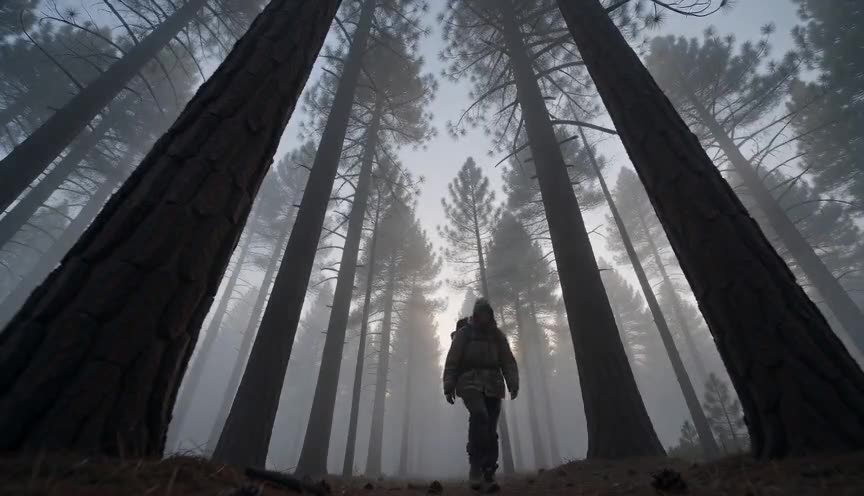
A low-angle shot tilts up from below eye level but usually stays at hip or knee height; worm's-eye view goes further, placing the lens at or below ground level for a more extreme, near-vertical look up.
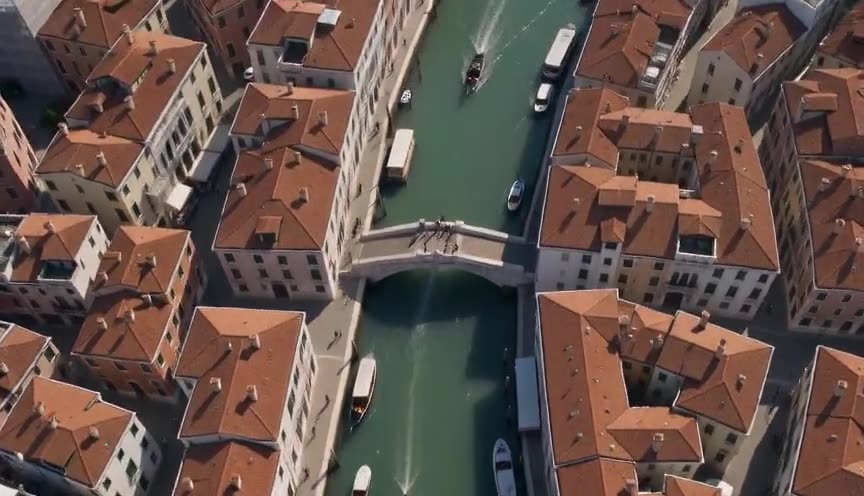
Bird's-eye view looks straight down from far above, flattening the subject into a shape on the ground; worm's-eye view does the opposite, looking straight up from the ground so the subject looms over the lens.
In film
Citizen Kane (1941)
Orson Welles shoots Kane from near floor level in several scenes, using the extreme low angle to make him loom over other characters and the camera itself.
Full Metal Jacket (1987)
Stanley Kubrick films the drill instructor from worm's-eye angles in the barracks, making him tower over the recruits and the viewer.
The prompt
State the camera position explicitly: lens at ground level, tilted straight up, so the model does not default to a normal eye-level shot. Name the lens (14mm or 24mm) to push the perspective distortion and vertical convergence. Describe what fills the top of the frame, since that becomes the main visual information. Avoid asking for a horizon line or a wide landscape, both of which fight the angle, and keep the subject's motion simple since extreme angles read best in a clean frame.
The exact prompt that rendered the video on this page. Keep the description of the move, change the subject and the setting.
Worm's-eye view: the camera lies flat on the cracked white surface of a salt flat, lens tilted straight up at a middle-aged man standing directly overhead, his boots and legs filling the top of the frame and stretching upward into a pale, cloudless sky. The 14mm wide lens exaggerates his height, his body leaning inward toward the edges of the frame as he takes one slow step forward, and the camera stays locked at ground level. No text.
Common mistakes
Using a normal lens
A 50mm or 85mm lens flattens the vertical exaggeration that makes the angle work, so the subject reads as merely tilted rather than towering.
Leaving the horizon in frame
Including a horizon line breaks the illusion of pure verticality and reminds the viewer of normal ground-level geography, weakening the effect.
Tilting only slightly
A shallow 20 to 30 degree tilt looks like an ordinary low-angle shot; worm's-eye view needs the lens close to vertical, near 80 to 90 degrees.
Frequently asked questions
What is worm's-eye view?
It is a camera angle filmed from at or below ground level with the lens tilted sharply upward, so the subject appears to tower over the viewer. It is the visual opposite of a bird's-eye view.
How low does the camera need to be for a worm's-eye view?
The lens should sit at or near the ground, often resting on a plate, sandbag or dug-out pit, so the shot reads as coming from insect or worm height rather than a normal low angle.
Why do directors use worm's-eye view for villains and monuments?
The angle mimics how a small child or a person on the ground looks up at something much larger, which the brain reads instinctively as power, dominance or threat, without needing dialogue to explain it.
Can an AI video model generate a worm's-eye view accurately?
Yes, if the prompt names the ground-level lens position, the upward tilt and a wide lens explicitly; tools like Imaginode render this angle reliably when the camera placement is stated rather than implied.