Snorricam
Also calledbody-mounted rig, chest cam, body cam
The Snorricam is a rig that straps the camera directly to an actor's chest or back, so the actor's face and body stay locked in frame while everything behind them sways, spins, or rushes past. It puts the viewer inside a disoriented, subjective state, watching the world destabilize around a performer who never moves relative to the lens.
What it tells
Directors reach for the Snorricam when a character's inner state matters more than their surroundings: a drug high, a panic attack, a breakdown, a dissociative episode. Because the face stays perfectly still while the background convulses, the shot reads as pure subjective experience rather than observed action. It removes the audience's usual spatial anchor and replaces it with the character's own unstable perception, which makes it far more visceral than a normal reaction shot.
How it is shot
A rigid harness straps to the actor's torso, holding a lightweight camera on a short arm 12 to 18 inches in front of the face. The actor becomes their own dolly grip, walking, running, or spinning through the set while the camera stays fixed relative to their body. A wide lens, 14mm to 24mm, keeps the face sharp and exaggerates how fast the background streaks or wobbles. No traditional operator pans or tracks; a second crew member often walks alongside for safety since the performer cannot see obstacles well. The result is a locked medium close-up that ignores gravity, floors, and horizon lines entirely.
When to use it
- A character is on drugs, drunk, or otherwise losing control of their perception of space
- A panic attack or dissociative break needs to feel physically destabilizing to the viewer
- A chase or fall should read as chaotic from inside the character's body, not observed from outside
- A single beat of psychological rupture needs more intensity than a handheld shot can give
Not to be confused with
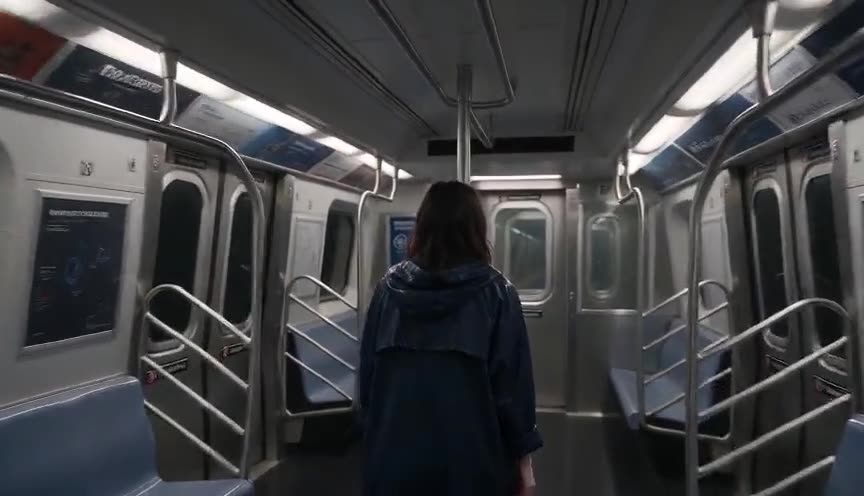
Steadicam keeps the frame steady while the operator moves through a stable world; Snorricam keeps the subject steady while the world around them becomes unstable. They produce opposite visual effects from a similar goal of smooth subject tracking.

A POV shot shows what the character sees, so we never see their face. Snorricam keeps the face locked in frame instead, showing the character's reaction while the environment does the moving.
In film
Requiem for a Dream (2000)
Uses the rig repeatedly during drug sequences, keeping the actors' faces static while streets and rooms blur violently behind them.
Mean Streets (1973)
During Charlie's drunken stumble through the bar, a body-mounted camera fixes Harvey Keitel in place while the room tilts around him.
The prompt
Say the framing stays locked on the face and shoulders no matter what the body does, and describe the background as blurring, swinging, or streaking behind the still subject. Name a wide lens (14mm to 24mm) so the model exaggerates background distortion rather than flattening it. Avoid words like handheld or shaky, which push the model toward camera-side wobble instead of subject-fixed, world-moving instability.
The exact prompt that rendered the video on this page. Keep the description of the move, change the subject and the setting.
Snorricam shot: a woman in her thirties jogs through a misty pine forest, filmed by a camera rigged to her chest so her face and shoulders stay perfectly locked and still in frame at all times. Behind her, tall pine trunks and drifting fog blur and sway wildly as she runs, the ground tilting with each stride. A wide-angle lens keeps her expression sharp while the forest streaks past in soft motion blur around her fixed silhouette. No text.
Common mistakes
Letting the frame drift
If the subject's face moves even slightly relative to the frame edges, the shot looks like ordinary handheld instead of a body-locked rig, and the whole effect collapses.
Using a long lens
A telephoto lens compresses and smooths the background, killing the wild swirl and blur that makes the technique read as disorienting rather than merely close.
Moving the subject too smoothly
A gliding, steady walk looks like a Steadicam with a tight frame. The subject needs real footsteps, stumbles, or spins so the background has something violent to react to.
Frequently asked questions
What is a Snorricam?
It is a rig that mounts a camera directly to an actor's body, usually the chest, so the actor's face stays fixed in frame while the background moves independently as they walk, run, or spin.
Who invented the Snorricam?
It is named after Einar Snorri, an Icelandic stuntman and actor credited with building the original rig, which spread through independent and horror cinema in the 1990s before Requiem for a Dream made it widely recognized.
Why does the background blur so much in a Snorricam shot?
Because the camera moves through space at the same speed and path as the actor's body, nearby objects and walls pass close to the lens fast, producing heavy motion blur while the subject stays perfectly sharp and static.
Can an AI video model generate a convincing Snorricam shot?
Yes, tools like the ones on Imaginode can approximate it well if you describe the face as locked in frame and the background as swinging or blurring independently, since the model needs that explicit contrast to render it correctly.