Golden ratio
Also calledGolden spiral, Fibonacci spiral, Phi grid
The golden ratio is a compositional guide based on the proportion 1.618:1, often drawn as a spiral of shrinking squares to show where the eye naturally settles in a frame. It places the subject at that focal point instead of dead center, giving the image a sense of organic balance rather than a rigid, mechanical layout.
What it tells
Directors reach for the golden ratio when they want a frame that feels inevitable, like the subject could not sit anywhere else, without looking staged or symmetrical. It softens hero shots, food close-ups, and portraits, letting the eye travel along a curve instead of jumping straight to a fixed point. It signals craft and patience, the kind of framing that rewards a second look and makes a single still feel worth pausing on.
How it is shot
On set, the frame is divided using a golden ratio grid or spiral, either drawn on the monitor overlay or estimated by eye, roughly at the 38/62 split rather than the 33/67 split of thirds. The subject's eye, hand, or main light source lands where the spiral tightens, usually one third to two fifths from a frame edge. Foreground elements (steam, tools, a doorway) are placed along the outer curve to lead the eye inward. Lens choice matters: a 35mm or 50mm keeps enough depth to stack layers along the spiral without distorting them. The camera is usually locked off or moves slowly so the composition has time to register.
When to use it
- Framing a single hero subject in a busy environment full of competing visual elements
- Building a painterly still-life or product shot that needs to feel composed, not centered
- Shooting a portrait where you want the face to feel discovered rather than presented
- Designing a key poster frame or thumbnail moment inside a longer take
Not to be confused with
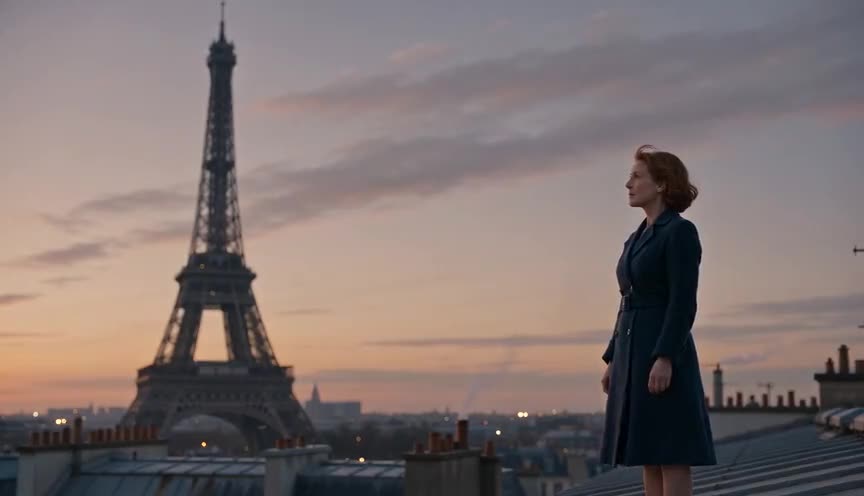
Rule of thirds uses an even 33/67 grid and is faster to apply on set. The golden ratio uses an uneven, tightening spiral that pulls the eye more gradually and feels less mechanical, but takes more planning to place correctly.

Triangular composition groups subjects into a stable geometric shape for balance among multiple figures. The golden ratio is about a single focal point and a directional flow, better for guiding the eye to one subject rather than balancing several.
In film
American Beauty (1999)
The famous rose petal dream sequence is frequently broken down in cinematography studies as following a golden spiral toward the actress's face.
There Will Be Blood (2007)
Cinematography lessons often use Robert Elswit's oil-field compositions to show phi-grid placement, with Plainview set off center against vast negative space.
The prompt
Describe where the subject sits in the frame using fractions, not the word 'centered': for example 'positioned slightly left of center, about two fifths from the left edge.' Mention a curving foreground element (steam, a counter edge, hanging tools) that leads toward the subject, since the model reads that as the spiral even without you naming it. Keep camera movement minimal or absent so the still composition can register, and avoid cluttered symmetrical framing, which fights the effect.
The exact prompt that rendered the video on this page. Keep the description of the move, change the subject and the setting.
Golden ratio composition in a busy ramen kitchen at night. A middle-aged Japanese woman chef stands slightly left of center, about two fifths from the frame's left edge, ladling broth into a bowl under warm hanging bulbs. Steam curls up from pots in the foreground right, tracing a soft curve that leads the eye toward her hands. Behind her, blurred cooks move past shelves of bowls, layered in depth. Camera is locked off on a low tripod, 50mm lens, shallow depth of field, no camera movement, only steam and background motion shift within the frame. No text.
Common mistakes
Treating it as a strict rule
The golden ratio is a guide for eye flow, not a formula to hit exactly. Forcing every element onto the spiral lines produces a stiff, overworked frame instead of a natural one.
Using it in every single shot
A film built entirely from golden spiral frames feels precious and slows down the edit's rhythm. Reserve it for key moments that deserve the extra visual weight.
Ignoring blocking and lens choice
The spiral only reads if depth and light support it. A flat wide lens or a static actor who never turns toward the focal point flattens the effect into a random offset.
Frequently asked questions
What is the golden ratio in filmmaking?
It is a compositional guide based on the 1.618:1 proportion, usually visualized as a spiral, used to place a subject where the eye naturally lands instead of dead center or on an even grid line.
Is the golden ratio better than the rule of thirds?
Neither is better, they solve different problems. Rule of thirds is quicker and more forgiving for everyday coverage, while the golden ratio suits deliberate, painterly frames with one clear focal point.
Do real cinematographers actually use a golden spiral overlay?
Some do, especially on stills-heavy or highly composed productions, but many arrive at similar results by eye through experience, then confirm it later in analysis rather than planning it with a grid.
Can AI video models compose using the golden ratio?
Yes, if you describe subject placement in fractions of the frame and add a leading foreground curve, tools like those on Imaginode's canvas will approximate the spiral convincingly within a short clip.