Rule of thirds
Also calledthirds grid, rule of three, grid composition
The rule of thirds is a composition guideline that divides the frame into a 3x3 grid and places key subjects along the grid lines or their four intersections rather than at the center. It creates a more balanced, dynamic image that guides the eye and leaves room for the subject to breathe.
What it tells
Centered subjects feel static and confrontational, almost like a passport photo. Placing a subject off-center on a third gives the frame air: room for a companion, a horizon, or the space a character is looking into. Directors use it to suggest imbalance, isolation, or anticipation, and to keep two elements, a face and a background detail, both legible at once. It reads as natural rather than composed, even though every inch of it is deliberate.
How it is shot
On set, the operator overlays a 3x3 grid in the viewfinder or monitor, dividing the frame into thirds both horizontally and vertically. The subject's eyes, face, or key object lands near one of the four intersections, commonly the upper third for headroom and the left or right third to leave lead room in the direction of gaze or movement. The horizon line sits on the upper or lower horizontal third rather than bisecting the frame. Focal length and framing are adjusted so the offset subject still reads clearly, often with a slightly wider lens (28 to 40mm) to keep background context in the remaining two-thirds. No special rig is needed, only careful reframing before the take.
When to use it
- Framing a single character against a wide backdrop that needs to stay visible and meaningful.
- Composing a shot where the subject is walking or looking toward open frame space.
- Establishing a location where both a person and an environmental detail must share the frame.
- Building a static or slow-moving shot that needs visual tension without feeling centered or dead.
Not to be confused with

The golden ratio uses a spiral or phi-based grid instead of even thirds, placing the subject at a point that feels more organic and less mechanical. Rule of thirds is simpler and faster to apply, golden ratio demands more precise measurement.
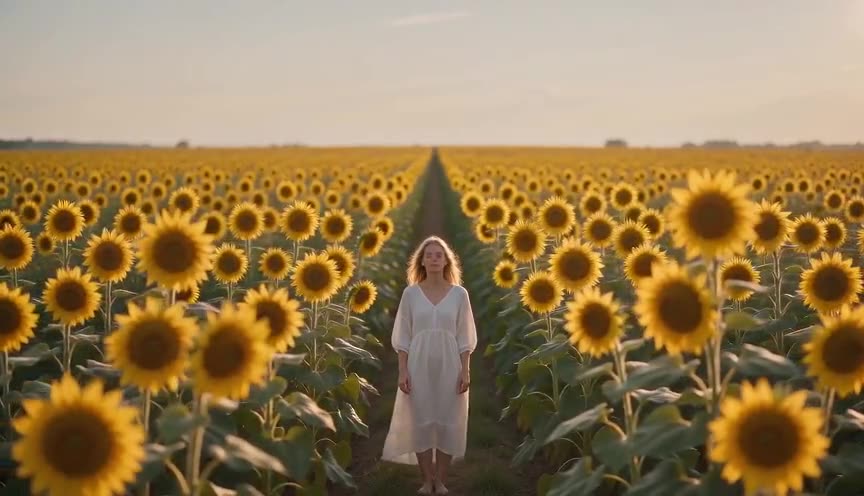
Centered composition puts the subject dead center for symmetry, stillness, or confrontation. Rule of thirds deliberately avoids the center to create asymmetry, movement, and negative space, producing a livelier, less formal image.
In film
Lawrence of Arabia (1962)
David Lean and cinematographer Freddie Young repeatedly place the lone figure on a third against the vast desert horizon to emphasize scale and isolation.
Blade Runner 2049 (2017)
Roger Deakins frequently frames characters off-center within thirds against towering environments, reinforcing their smallness inside a dystopian world.
The prompt
Describe the grid position explicitly: name where the subject sits (left third, right third, upper third) and what fills the remaining two-thirds (skyline, rooftop, negative space). Mention the horizon line's position relative to the frame height. Avoid vague words like nicely composed, instead give the model concrete placement and lens focal length. State that the camera stays static or moves slowly so the composition holds, since fast movement destroys a deliberate offset framing.
The exact prompt that rendered the video on this page. Keep the description of the move, change the subject and the setting.
Rule of thirds: a static wide shot on a Parisian rooftop at dusk, a woman in her fifties wearing a wool coat stands on the right third of the frame, facing left toward open sky, her body aligned with the vertical grid line and her eyes near the upper right intersection. The left two-thirds of the frame hold the Eiffel Tower silhouette and a soft orange sky, with zinc rooftops receding into the lower third. The camera does not move, the woman remains still, only a faint breeze stirs her coat and distant smoke rises from a chimney. No text.
Common mistakes
Centering by default
Framing every subject dead center out of habit, which kills the asymmetry and negative space that make the rule of thirds work.
Ignoring the intersections
Placing the subject on a grid line but not near an intersection point, so the eye still drifts to the center of the frame.
Wrong lead room direction
Leaving empty space behind a moving or looking subject instead of in front of them, which feels backward and cramped.
Frequently asked questions
What is the rule of thirds?
It is a composition guideline that splits the frame into a 3x3 grid and places the main subject near one of the four intersection points instead of the center, creating a more balanced and visually interesting image.
Why does the rule of thirds work?
It mirrors how the eye naturally scans a scene, avoiding the flat, static read of a centered subject while leaving room for context, movement, or a second point of interest in the frame.
Is the rule of thirds still useful for AI-generated video?
Yes. Naming the grid position and lens explicitly helps models like those on Imaginode hold a deliberate off-center composition instead of defaulting to a centered subject.
Should the rule of thirds always be followed?
No. It is a strong default, but centered composition, symmetry, or other layouts can be more effective for confrontation, stillness, or formal portraiture. Treat it as a starting point, not a law.