Layered depth
Also calledDepth staging, Foreground-midground-background, Dimensional composition
Layered depth is a composition technique that arranges distinct visual elements in the foreground, midground and background of the frame to build a sense of three-dimensional space. It gives the eye a path through the image and makes a flat screen read as a real, inhabited place.
What it tells
Directors use layered depth to make a scene feel lived in rather than staged for the camera. A frame with clear planes suggests a world that keeps going past the edges of the shot, which lets a story feel bigger than its budget. It also lets a director hide meaning in plain sight: a detail in the background can foreshadow or comment on the main action without a cut, rewarding viewers who look past the closest plane.
How it is shot
The frame is divided into at least three zones of distance from the lens: a close foreground element, a clear midground subject, and a background that continues the space. A lens in the 24mm to 50mm range keeps enough field of view to hold all three planes at once, and the aperture is chosen deliberately, often between f/5.6 and f/11, so focus falls where the story needs it, sharp throughout for deep focus or selectively soft for separation. Blocking places actors and props at different distances rather than side by side, and lighting or color contrast (a warmer key on the midground, cooler ambient behind it) keeps each plane visually distinct so the eye reads depth instantly rather than a flat wall of information.
When to use it
- Establishing a location where scale and depth matter more than a single subject.
- Building a scene that needs to feel crowded, layered or socially dense without cutting.
- Hinting at a second story or a threat in the background while the main action stays foreground.
- Shooting in a confined space like a car, room or transit vehicle where depth has to be manufactured.
Not to be confused with

Foreground interest is a single close object placed near the lens to frame the shot. Layered depth is the fuller arrangement of that foreground plus a distinct midground and background working together.
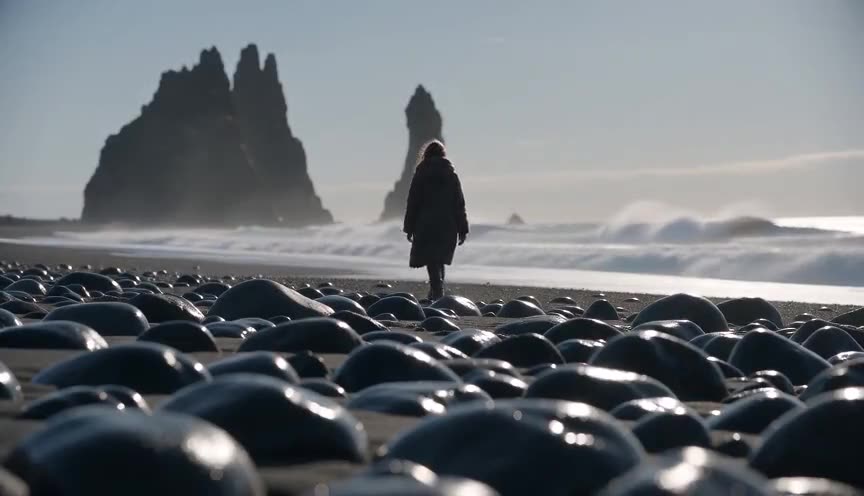
Deep focus is a lens and exposure choice that keeps every plane sharp at once. Layered depth is the staging itself, and it works with deep focus or with shallow focus that separates the planes instead.
In film
Citizen Kane (1941)
Gregg Toland's deep-focus staging places action in near, mid and far planes within a single frame, a benchmark for layered depth in cinematography.
Blade Runner 2049 (2017)
Roger Deakins uses fog, light shafts and staggered set pieces to stack foreground, midground and background into visible layers of depth.
The prompt
Name the three planes explicitly (foreground, midground, background) and say what occupies each one, since models often flatten a scene if depth is only implied. Give each plane a different light quality, color or sharpness so the model has a reason to separate them. Avoid vague words like 'depth' alone; describe distance, scale and focus for each layer, and keep the camera simple (static or a slow move) so the staging, not the motion, carries the effect.
The exact prompt that rendered the video on this page. Keep the description of the move, change the subject and the setting.
Layered depth: inside a night subway car, a static eye-level shot on a 35mm lens holds three distinct planes at once. In the foreground, close to the lens, a middle-aged man's hand grips a pole, slightly soft with cool fluorescent light. In the midground, sharply focused, a young woman in a red coat sits reading. In the background, blurred commuters stand near the sliding doors under flickering overhead light. The train rocks gently, window reflections slide past, nothing changes position, the three layers stay fixed and distinct. No text.
Common mistakes
Everything at one distance
Placing all subjects on roughly the same plane cancels the depth effect no matter how good the lighting is, since the eye has nothing to travel through.
No contrast between layers
When foreground, midground and background share the same tone, color and sharpness, they merge visually and the frame reads as flat instead of layered.
Skipping the midground
Using only a close foreground and a distant background leaves a gap the eye cannot bridge, so the staged depth feels like two separate images instead of one space.
Frequently asked questions
What is layered depth?
It is a way of composing a shot so distinct elements sit in the foreground, midground and background, giving a flat frame the illusion of real three-dimensional space that the eye can travel through.
Do I need a wide lens for layered depth?
A moderately wide lens, roughly 24mm to 50mm, usually helps because it keeps enough field of view to hold three planes at once, but the technique is really about staging and light, not the lens alone.
Is layered depth the same as deep focus?
No. Deep focus is an exposure and lens choice that keeps every plane sharp. Layered depth is the staging of distinct planes, which can be shot with deep focus or with shallow focus that separates them instead.
Can AI video tools generate layered depth reliably?
Yes, if you describe each plane separately with its own distance, focus and light. On a platform like Imaginode, naming the foreground, midground and background explicitly gets far more consistent results than asking for 'depth' in general terms.