One-point perspective
Also calledcentral perspective, vanishing point composition, linear perspective
One-point perspective is a composition where every straight line in the frame, from architecture, roads, or rows of objects, converges toward a single vanishing point, usually placed near the center of the image. It flattens depth cues into a strong funnel shape that pulls the viewer's eye straight into the frame.
What it tells
Directors reach for one-point perspective when they want the frame itself to feel like a destination or a trap. The converging lines suggest order, fate, or an inevitable path forward, so the technique works for corridors of dread, roads of no return, or moments of quiet awe. Because the eye has nowhere else to go but the vanishing point, it also isolates a character standing there, making them feel small, chosen, or cornered.
How it is shot
Place the camera exactly on the axis of the receding lines (a hallway, road, tunnel, or row of trees) and keep it level, ideally on a tripod, so the vanishing point sits at or near the center of frame. A 24mm to 35mm lens keeps enough width to show the converging edges without warping them like an ultra-wide would. Stop down to f/8 or f/11 for deep focus so the lines stay sharp from foreground to the vanishing point. Add atmosphere (haze, mist, or backlight) to separate planes and make the depth read even in flat light, and avoid any camera roll or tilt that would break the symmetry.
When to use it
- A character walks toward a decision point, and you want the frame to feel like it is choosing for them
- An interior corridor, tunnel, or arcade needs to feel ordered, institutional, or subtly threatening
- You want instant depth in a static shot without relying on camera movement
- A reveal at the far end of the frame needs maximum visual pull toward it
Not to be confused with
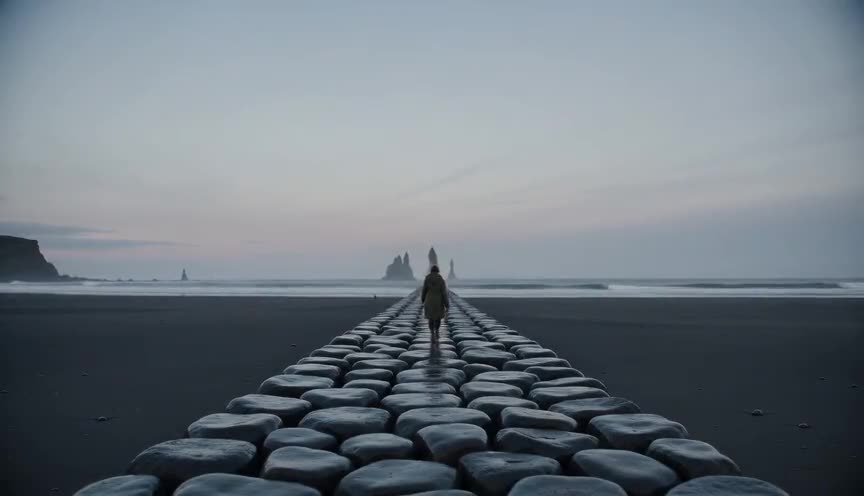
Leading lines can converge anywhere in the frame and often sit off to one side to guide the eye toward a subject. One-point perspective is the strict, centered case where the lines meet at a single point, usually mid-frame.

Symmetry mirrors the frame left to right regardless of depth. One-point perspective is about depth, lines receding toward one point, and the two often overlap but symmetry can exist with no vanishing point at all.
In film
The Shining (1980)
Kubrick's hallway tracking shots lock the camera on the corridor's axis so the vanishing point sits dead center, making the hotel feel like a machine with no exit.
2001: A Space Odyssey (1968)
Kubrick centers the Discovery's bright corridors so wall seams and ceiling lights recede to a single vanishing point, making space travel feel sterile and predetermined.
The prompt
Name the converging structure explicitly (road, hallway, rows of trees, tunnel) and say the vanishing point sits at the center of frame. Specify a locked-off or slow, axis-aligned camera, a level horizon, and a normal to wide lens (24 to 35mm) so the model does not default to a handheld or off-axis angle. Add haze, mist, or backlight to sell depth, and avoid words like dutch angle, tilted, or wide-angle distortion, which fight the straight, centered geometry this technique needs.
The exact prompt that rendered the video on this page. Keep the description of the move, change the subject and the setting.
One-point perspective, static locked-off shot at eye level, 28mm lens, centered on a straight dirt trail running dead center through a misty pine forest, rows of tall pines receding symmetrically on both sides toward a single vanishing point where the trail disappears into pale fog. A lone adult hiker in a dark jacket walks away from camera along the exact center of the trail, shrinking steadily toward the vanishing point. The camera does not move at all; only drifting mist and the hiker's distance change across the four seconds. No text.
Common mistakes
Off-center vanishing point
Placing the camera even slightly off the axis of the receding lines skews the convergence and the frame stops reading as true one-point perspective, it becomes ordinary leading lines instead.
Camera movement that breaks the axis
Any pan, tilt, or handheld drift shifts the vanishing point around the frame and destroys the funnel effect that makes the composition feel deliberate and controlled.
No depth separation
Without haze, light falloff, or foreground objects, the converging lines can look flat and graphic rather than three-dimensional, especially in evenly lit interiors.
Frequently asked questions
What is one-point perspective?
It is a composition technique where every straight line in the shot, like the edges of a road, hallway, or row of trees, converges toward a single vanishing point placed near the center of the frame, creating a strong, symmetrical sense of depth.
Does one-point perspective require a wide lens?
No. A normal or slightly wide lens (24mm to 50mm) usually reads better than an ultra-wide, which can bow the converging lines and distort the symmetry that makes this composition feel controlled.
Why does one-point perspective feel so ominous in horror films?
Because the eye has only one place to go, the vanishing point, the composition removes escape routes visually, so a figure standing there feels trapped, watched, or singled out by the geometry of the space itself.
Can AI video tools like Imaginode generate one-point perspective reliably?
Yes, if you name the converging structure (hallway, road, tree rows) and state that the vanishing point is centered and the camera is locked and level, models like Seedance, Kling, and Veo can hold the geometry across the clip.