Symmetry
Also calledsymmetrical composition, mirror composition, symmetrical framing
Symmetry is a composition technique that places the subject on the frame's central vertical axis so the left and right halves mirror each other. It reads to the viewer as balanced, orderly and often formal, and it can also feel controlled, artificial or unsettling when pushed too far.
What it tells
Directors reach for symmetry when they want the frame itself to speak before any character does. A perfectly balanced shot suggests order, ritual, power or obsession, and it primes the audience to notice the moment that order breaks. Because the eye settles instead of scanning, symmetry slows perception and gives a scene a held, almost ceremonial quality. It also flatters institutions, villains and grand spaces, turning architecture into a statement about control, while a single figure off that axis instantly reads as vulnerable or out of place.
How it is shot
Build the shot around a fixed central axis: a hallway, ring, doorway or mirror that splits the frame in two matching halves. Lock the camera on a tripod, level the horizon and the vertical lines with a bubble level or the viewfinder grid, and center the lens exactly on that axis, often at chest or eye height. A normal to slightly wide lens, 28mm to 40mm, keeps both sides reading evenly without heavy distortion. Light both halves to matching exposure and color temperature so nothing pulls the eye left or right. Place the subject dead center and let secondary elements (pillars, windows, ropes, crowd) repeat identically on each side. Any shift in framing, focus or light instantly reads as a broken symmetry.
When to use it
- Introducing a character, institution or space that runs on rigid order, rules or hierarchy.
- Building tension before a rule or balance is about to be broken by a single action.
- Framing a ritual, ceremony or confrontation where formality matters more than spontaneity.
- Shooting corridors, doorways, rings or mirrored interiors where the architecture already offers a natural axis.
Not to be confused with

Centered composition puts the subject in the middle of the frame but doesn't require the two halves to mirror each other; symmetry adds that strict left-right balance around the subject.
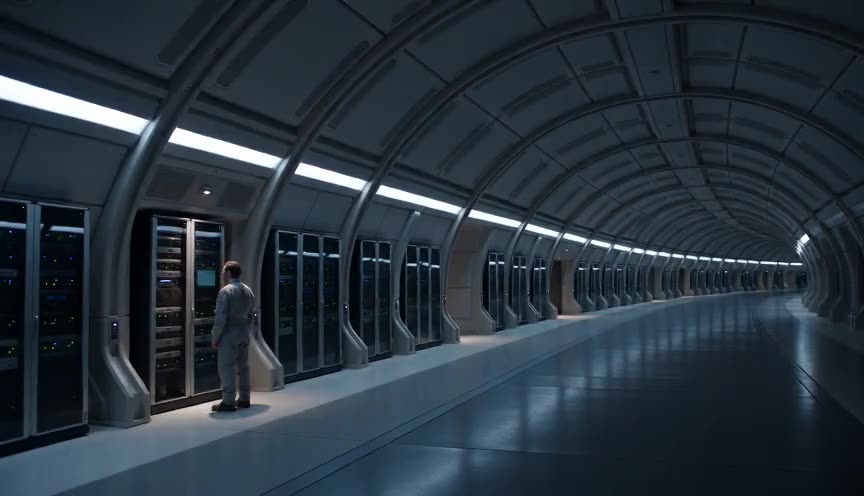
Asymmetry deliberately unbalances the frame to create tension or dynamism, the opposite instinct of symmetry, which calms the eye by matching both halves of the image.
In film
The Grand Budapest Hotel (2014)
Wes Anderson uses rigorous symmetrical framing throughout to build a controlled, storybook world around its characters.
The Shining (1980)
Kubrick's centered hallway and Overlook Hotel shots use precise symmetry to make the space feel sterile and unsettling.
2001: A Space Odyssey (1968)
Kubrick frames spacecraft interiors and corridors symmetrically to give the technology a cold, orderly authority.
The prompt
Tell the model exactly what sits on the axis: a doorway, ring post, mirror or corridor, and say the camera is locked and centered, level, on a tripod. Name the lens (28mm to 35mm) and specify that both sides carry matching light, color and objects, since AI models often drift or duplicate unevenly. Avoid vague words like 'balanced shot'; instead describe the mirrored elements explicitly (two identical windows, two ropes, two fighters) so the system has something concrete to repeat on each side of the frame.
The exact prompt that rendered the video on this page. Keep the description of the move, change the subject and the setting.
Symmetry: a locked-off camera faces a boxing ring dead center, its four ropes and corner posts mirrored perfectly on the left and right of the frame. A boxer in gray shorts stands motionless at the exact center of the ring, arms raised, while two identical hanging heavy bags sway in matching rhythm on either side of the background. Even fluorescent light from overhead fixtures spreads evenly across both halves of the gym, casting matching shadows. The camera stays completely static for the full shot, level and centered, holding the mirrored composition without a single cut. No text.
Common mistakes
Off-axis subject
Placing the subject slightly left or right of the true center breaks the mirror effect and just looks like a badly framed shot, not a stylistic choice.
Uneven lighting
Lighting one side brighter or warmer than the other kills the balance even if the geometry lines up, since the eye reads light before it reads lines.
Handheld drift
Any small camera movement or tilt during the shot destroys the precision symmetry depends on; the frame must stay locked to hold the illusion of perfect balance.
Frequently asked questions
What is symmetry in cinematography?
It's a composition technique that centers the subject on an axis so both halves of the frame mirror each other, creating a sense of order, formality or, when pushed too far, unease.
Why do directors like symmetry so much?
Because a balanced frame calms the viewer's eye and lets any single element that breaks the pattern, a raised hand, a tilted head, immediately carry weight and meaning.
Does symmetry always feel calm or formal?
Not always; when used with cold light, empty space or an odd detail, the same precise balance can feel sterile, controlled or quietly threatening rather than reassuring.
Can AI video models generate symmetrical shots reliably?
Reasonably well if you describe the axis and mirrored elements explicitly; tools like those on Imaginode respond better to concrete pairs (two doors, two lights) than to the word 'symmetrical' alone.