35mm lens
Also calledStandard wide lens, Documentary lens
A 35mm lens is a moderately wide focal length that shows a natural, slightly expanded field of view without visible distortion. It lets the viewer see a subject and their surroundings in one frame, close to how the human eye reads a room or a street.
What it tells
Directors reach for 35mm when a character cannot be separated from their world. It keeps a person and their environment in the same breath, so a kitchen, a car, or a cabin carries as much weight as the face in it. The lens feels observational rather than composed, which is why it became the default for walk-and-talks, dialogue in real locations, and scenes where place is part of the emotion.
How it is shot
On a full-frame sensor, 35mm gives a diagonal field of view of roughly 54 to 63 degrees, wider than the human eye's tight focus but not wide enough to bend straight lines. Operators usually stand 5 to 8 feet from the subject to fill a medium shot, close enough for intimacy, far enough to keep the background legible. Shooting at f/2.8 to f/5.6 keeps foreground and midground both readable, which is why it pairs well with practical or window light rather than heavy bokeh setups. It works handheld, on a gimbal, or locked off, and needs no special rigging beyond a standard prime or a zoom set to 35mm.
When to use it
- Filming a walk-and-talk where the location must stay identifiable behind the actors.
- Shooting a character alone in a defined space, like a cabin or an office, to show isolation.
- Covering dialogue on a real set where you want context, not a flattened background.
- Building a documentary or verite feel where the camera seems to simply be present.
Not to be confused with
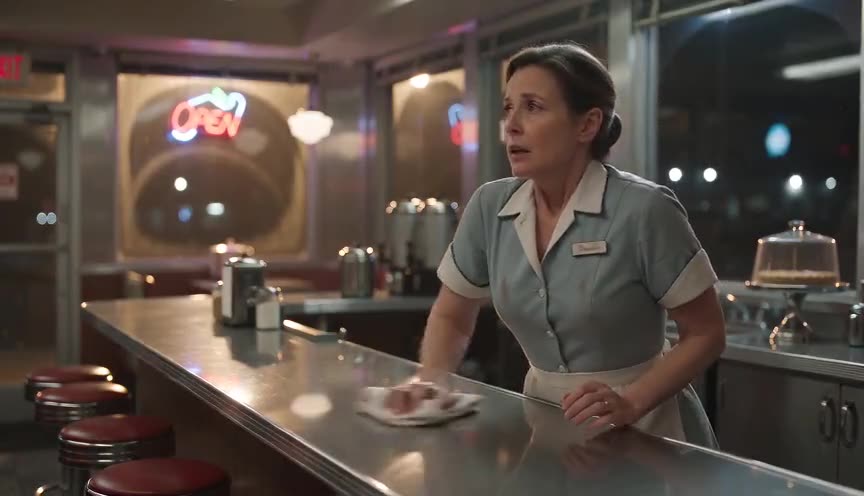
50mm sits closer to natural human vision and compresses the background slightly more, isolating the subject; 35mm keeps more environment visible around the frame edges.

24mm shows a much wider field and starts bending straight lines near the frame edge; 35mm stays neutral and is safer for faces at close range.
In film
Fish Tank (2009)
Robbie Ryan keeps Andrea Arnold's handheld camera mostly on a 35mm lens, staying close to Mia while retaining the estate around her.
American Honey (2016)
Andrea Arnold and Robbie Ryan used a single 35mm prime for much of the 4 by 3 road film, holding Star within real locations.
The prompt
Say '35mm lens' explicitly and describe a medium or medium-wide shot that keeps both a person and their setting in frame. Mention a working distance of a few meters rather than a close face fill, and moderate depth of field so the background stays readable, not blurred to abstraction. Avoid words like 'extreme wide' or 'fisheye', which push the model toward bent lines and exaggerated perspective the 35mm look does not have.
The exact prompt that rendered the video on this page. Keep the description of the move, change the subject and the setting.
35mm lens: inside a wooden mountain cabin, a man in his forties stands by a frost-covered window, a mug in his hand, snow falling steadily outside past visible pine trees. The camera holds a static medium shot from about six feet away, the 35mm lens keeping his figure and the cabin's log walls, woodstove, and window both in sharp, natural perspective with no distortion. He slowly turns his head toward the window as steam rises faintly from the mug, light staying soft and even throughout. No text.
Common mistakes
Standing too close for the focal length
Getting within a few feet to fill the frame with a face starts to widen the nose and jaw slightly; back up and let the environment share the shot instead.
Confusing it with a wide lens
35mm is a mild wide angle, not a distortion tool; if the shot needs bent lines or a stretched room, that calls for 24mm or wider, not 35mm.
Shallow depth of field that erases context
Shooting wide open at f/1.4 defeats the point of the focal length, since 35mm is chosen precisely to keep the background legible.
Frequently asked questions
What is a 35mm lens?
It is a moderately wide focal length, on a full-frame camera giving roughly a 54 to 63 degree field of view, that shows a subject together with their surroundings without visibly distorting faces or straight lines.
Why is 35mm called a documentary lens?
Because its field of view is close to natural human attention, letting handheld operators follow real action in real spaces without the camera calling attention to itself the way a very wide or very long lens would.
Is 35mm the same on every camera?
No. The field of view given here assumes a full-frame sensor; on a crop sensor camera, a 35mm lens behaves closer to a 50mm on full frame, so the actual angle of view depends on the sensor size.
Can an AI video model reproduce a 35mm look?
Yes, if the prompt names the focal length and describes a shot distance and depth of field that match it. On a platform like Imaginode, pairing '35mm lens' with a clear working distance gives more reliable results than the focal length alone.