Anamorphic flare
Also calledBlue streak flare, Horizontal lens flare, Anamorphic streak
Anamorphic flare is the horizontal blue streak that shoots across the frame when a bright light hits an anamorphic lens, along with oval-shaped bokeh in the out-of-focus areas. It gives footage an immediate sense of scale and a specific glassy, widescreen texture that round spherical lenses do not produce.
What it tells
Directors reach for anamorphic flare when they want a shot to feel big, expensive and slightly larger than life. The streak reads as cinematic shorthand because audiences associate it with widescreen epics, and it can turn a plain practical light, a sun break through trees or a reflection off water into a moment of visual punctuation without adding any new content to the frame.
How it is shot
The effect comes from the cylindrical lens elements inside true anamorphic glass (Panavision C or E series, Hawk V-Lite, and similar), which squeeze the image horizontally and refract bright points of light into a horizontal line instead of a circular halo. A hard source between roughly 500 and 2000 lux, placed at a shallow angle to the lens axis, triggers the strongest streak; shooting near wide open (T2 to T2.8) also produces the signature oval bokeh. On set, gaffers often add small practicals or bounce a hard light into the lens on purpose. In post, the image is desqueezed and the streak color, usually cyan or blue depending on coating, is preserved or enhanced.
When to use it
- Opening a scene with a sun flare through foliage to establish scale and location instantly
- Marking a character's turning point when they walk into or past a strong practical light
- Giving a chase or action sequence a blockbuster texture without changing the blocking
- Adding romantic or nostalgic warmth to a memory or flashback sequence
Not to be confused with

Ordinary lens flare from spherical glass scatters into round rainbow-colored ghosts and haze in any direction; anamorphic flare is specifically a horizontal blue streak caused by cylindrical lens elements.
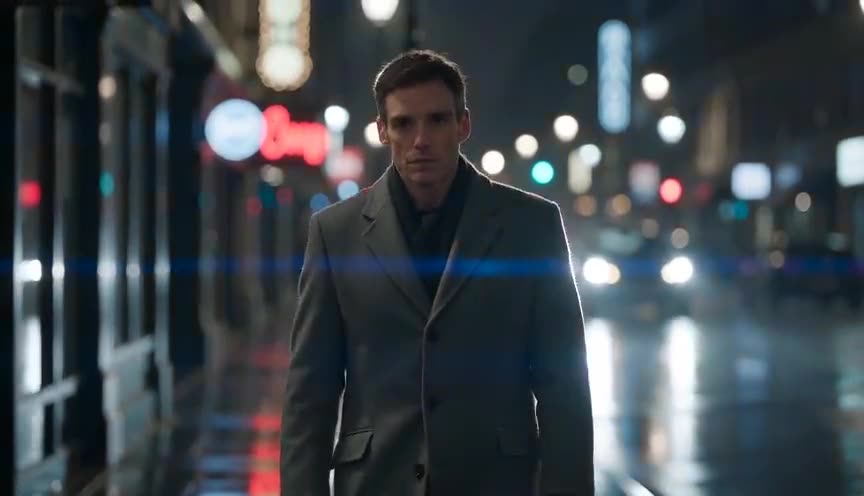
Anamorphic lens is the optical tool itself, the squeeze and the widescreen format; anamorphic flare is one visible signature that tool produces when a bright source hits the front element.
In film
Star Trek (2009)
J.J. Abrams pushed anamorphic streaks into nearly every bright scene, making the effect a signature of the film's energetic look.
Super 8 (2011)
Larry Fong and J.J. Abrams use blue anamorphic streaks from flashlights, train wreck lights, and industrial lamps as a deliberate Spielbergian texture.
Star Trek Into Darkness (2013)
Dan Mindel again fills spacecraft interiors and bright backlights with pronounced blue anamorphic streaks, extending the visual signature established in the 2009 film.
The prompt
Name the light source explicitly (sun through leaves, a flashlight, a neon sign) and say it hits the lens directly, then describe the result as a horizontal blue streak stretching across the frame, plus oval bokeh in the background. Mention anamorphic lens, shallow depth of field and a wide aspect ratio. Avoid vague words like cinematic look alone; without a named strong light source the model has nothing to flare off of.
The exact prompt that rendered the video on this page. Keep the description of the move, change the subject and the setting.
Anamorphic flare: a static wide shot of a rainforest river at midday, sunlight breaking through a gap in the dense canopy directly behind a kayaker paddling downstream. As the kayak drifts into the light gap, a horizontal blue-cyan streak stretches across the frame from the sun, background foliage turns into soft oval bokeh, water surface ripples stay sharp in the foreground. Shot on an anamorphic lens, wide 2.39:1 framing, shallow depth of field, humid haze in the air. No text.
Common mistakes
Using a soft source
Diffused or overcast light rarely produces a visible streak; the effect needs a hard, small, bright point of light to catch the cylindrical elements.
Centering the flare on every shot
A streak in the same spot in every frame reads as a filter slapped on top rather than a real optical reaction to changing light.
Ignoring the squeeze ratio
Forgetting that anamorphic footage is captured squeezed and needs desqueezing distorts faces and horizons, making the flare look pasted onto a broken image.
Frequently asked questions
What is anamorphic flare?
It is the horizontal blue streak and oval bokeh produced when a bright light hits an anamorphic lens, caused by the lens's cylindrical elements. It is a distinct visual signature from the round flares of spherical lenses.
Why is the streak usually blue?
Most anamorphic lenses use coatings tuned to produce cyan or blue streaks because that color reads as clean and cool against skin tones, though some vintage glass produces amber or warm streaks instead.
Can I get anamorphic flare without real anamorphic glass?
Yes, many filmmakers add it digitally in post or with clip-on adapters, though the streak shape and bokeh quality will differ slightly from true cylindrical-element lenses.
How do I get this effect from an AI video model like the ones on Imaginode?
Name the exact light source, state that it hits the lens directly, and describe the result as a horizontal blue streak with oval background bokeh rather than just asking for a cinematic or anamorphic look.