Forced perspective
Also calledPerspective trick shot, Camera trickery, Optical scale illusion
Forced perspective is an in-camera illusion that places subjects at carefully chosen distances from the lens so a smaller or farther object appears the same size as, larger than, or smaller than a closer one. It lets a single shot fake dramatic scale differences without any digital compositing.
What it tells
Forced perspective lets a director create wonder without asking the audience to suspend disbelief about visual effects: the scale is real, achieved on set, so it reads as trustworthy even when it defies physics. It compresses story information into a single unbroken shot, letting two characters of impossible relative size share a frame and interact without a cut, which keeps performances intact and timing natural. Directors reach for it when a scene needs the intimacy of a two-shot but the story demands a giant, a miniature, or an architectural distortion that camera trickery alone can sell to the eye.
How it is shot
To build forced perspective, place the camera on a locked tripod and align two subjects along the same optical axis, one close to the lens and one far away, so their apparent sizes trade off with distance rather than actual size. Use a moderate wide lens, often 24mm to 35mm, and stop down to f/11 or smaller to hold both planes in deep focus so neither figure looks soft and gives away the trick. Match key light intensity and color temperature across both distances, since a visible falloff exposes the separation. Rehearse blocking with marks on the floor, sometimes on a raked or tapered set, and keep the camera static: any movement shifts the parallax and breaks the illusion instantly.
When to use it
- To show a giant or a miniature character interacting with a normal-sized one without visual effects work.
- When a practical, in-camera trick will read more convincingly on screen than a composited effect.
- To make a small set piece or model appear enormous within a single continuous shot.
- When budget or schedule rules out CGI compositing but the scene still needs an impossible scale contrast.
Not to be confused with
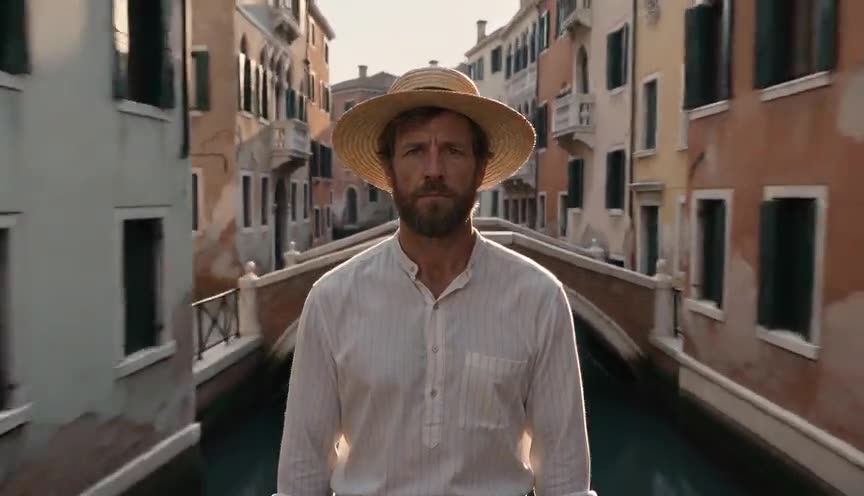
Dolly zoom distorts perspective over time by moving the camera while zooming the lens, changing the background-to-foreground relationship. Forced perspective is static, built once through blocking and distance, not through camera or lens movement.

Tilt-shift fakes miniature scale through selective lens blur on a normal-sized real scene. Forced perspective achieves scale illusions by physically positioning subjects at different distances, with everything held in sharp focus.
In film
The Lord of the Rings: The Fellowship of the Ring (2001)
Used sliding rigs, raked floors and precise camera alignment to make hobbits and dwarves appear shorter than humans in shared shots.
Elf (2003)
Used split sets and carefully spaced actors so Buddy appears giant-sized among the North Pole elves without digital compositing.
The prompt
Describe the physical staging explicitly: a static or locked camera, one subject close to the lens, another far away on the same sightline, and a lens and aperture that keep both in sharp focus. Words like aligned, same axis, matched lighting, and deep focus help the model understand the illusion is optical, not digital. Avoid mentioning green screen, CGI, or compositing, since those cues push the model toward a different kind of effect entirely.
The exact prompt that rendered the video on this page. Keep the description of the move, change the subject and the setting.
Forced perspective. On a beach at sunset, a woman in the foreground holds her hand up, and a man standing far away in the background looks tiny, so she seems to hold him between her thumb and finger. The camera is static and the illusion lines up perfectly, then she laughs and lowers her hand. Realistic, playful. No text.
Common mistakes
Mismatched lighting
Different light intensity or color temperature on the near and far subject reveals they occupy separate spaces, immediately breaking the illusion of shared scale.
Moving the camera
Any pan, dolly, or handheld drift shifts the parallax between the two subjects and exposes the actual distance between them, ruining the trick.
Uneven focus
Shallow depth of field that blurs one subject while the other stays sharp tells the eye they are not actually close in apparent size.
Frequently asked questions
What is forced perspective?
Forced perspective is a practical camera technique that uses precise positioning of subjects at different distances from the lens to make them appear larger, smaller, or the same size as each other, all achieved in a single shot without digital effects.
How is forced perspective different from CGI scaling?
Forced perspective is built physically on set through blocking, distance, and camera alignment during filming, while CGI scaling changes apparent size afterward in post-production through digital compositing and visual effects.
Does forced perspective work in AI-generated video?
Yes, if you describe the physical setup clearly, near subject, far subject, same sightline, fixed camera, deep focus. Tools like Imaginode can render this convincingly when the prompt specifies the staging rather than just naming the effect.
What lens is best for forced perspective?
A moderate wide to normal lens, roughly 24mm to 35mm, works well because it holds a large depth of field without the extreme distortion of an ultra-wide, letting both near and far subjects stay sharp and believable.