Slit-scan
Also calledStar gate effect, Stretch printing, Slit-scan photography
Slit-scan is an in-camera optical technique in which a moving artwork or light source is photographed one frame at a time through a narrow slit, stretching each exposure into long directional streaks. It gives the viewer a sensation of hurtling through space, time, or consciousness, as solid shapes dissolve into rushing lines of color.
What it tells
Directors reach for slit-scan when a scene needs to feel bigger than the story, a passage into another state rather than another place. It suits births, deaths, hallucinations, and cosmic leaps, moments where ordinary continuity breaks down and the image itself seems to warp under the pressure of what the character is experiencing. The streaking light reads as awe, disorientation, or transcendence almost instantly, without a line of dialogue.
How it is shot
Classic slit-scan uses an animation stand: a backlit piece of artwork or a strip of colored gels is mounted on a motorized track and moved past a narrow horizontal slit while the camera exposes a single frame over several seconds. Small increments of movement between exposures, combined with the camera itself dollying toward or away from the slit, stretch each point of light into a radiating streak. Douglas Trumbull's rig for the Stargate sequence used a computer-controlled track for repeatable multi-pass exposures. Digitally, the same look is built by shifting pixels over time per row or column and compositing the trails, then adding a converging vanishing point so the streaks read as forward motion rather than random blur.
When to use it
- A character crosses into a dream, death, or altered state and needs a visual threshold.
- A title sequence must announce scale and wonder before the story even starts.
- A montage compresses a journey through space or time into a few seconds.
- A hallucination or drug sequence needs the frame itself to feel unstable.
Not to be confused with

Zoom into the eye pushes the camera into a character to signal an internal shift, while slit-scan stretches the outside world itself into streaks, putting the transformation in the environment rather than on the actor's face.
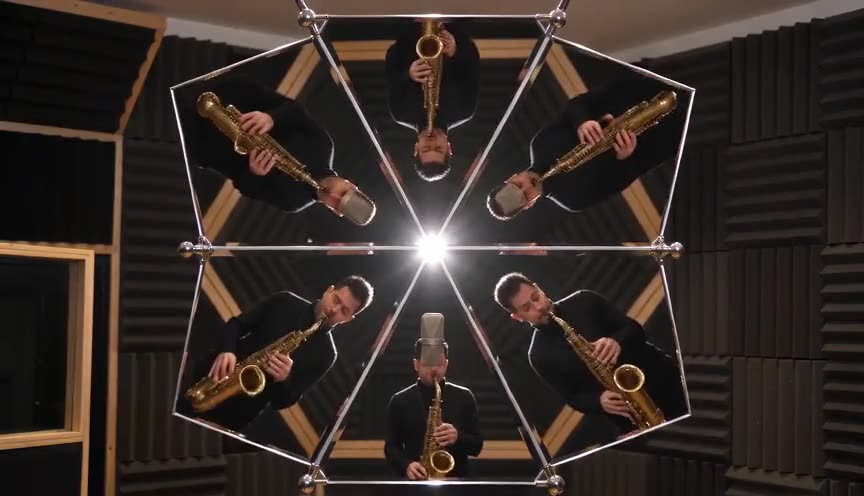
Kaleidoscope fragments the image into repeating mirrored panels for a decorative, symmetrical distortion. Slit-scan instead elongates light along a single axis into a tunnel, which reads as travel and speed rather than pattern.
In film
2001: A Space Odyssey (1968)
The Stargate sequence used Douglas Trumbull's slit-scan rig to turn colored artwork into rushing tunnels of light for the astronaut's journey.
Superman (1978)
The opening title sequence uses slit-scan to stretch the credits into streaking starfields, a technique borrowed directly from 2001.
Star Trek: The Motion Picture (1979)
The wormhole sequence uses slit-scan photography to render the ship's passage through space as radiating streaks of color.
The prompt
Describe the physical mechanics, not the abstract idea: streaks of light stretching along a single direction, a tunnel that narrows toward a vanishing point, one sharp anchor (a face, a boat, a doorway) staying still while everything else smears. Use words like radiating, converging, streaking, elongating. Avoid vague terms like psychedelic or trippy, which push models toward random kaleidoscope patterns instead of the directional stretch that defines slit-scan.
The exact prompt that rendered the video on this page. Keep the description of the move, change the subject and the setting.
Slit-scan effect: the camera pushes straight toward a fishing harbor at dawn as the lanterns on moored boats and the reflections on the wet dock elongate into long radiating streaks of amber and blue light, stretching into a bright tunnel that narrows toward the horizon. The boats themselves stay sharp and still while every light source smears into thin converging lines that pulse outward past the lens. The motion accelerates smoothly, the tunnel of streaked light widening as the camera speeds forward, then holds steady in the final second. No text.
Common mistakes
No vanishing point
Streaks that drift randomly instead of converging toward a single point read as generic motion blur, not slit-scan, and lose the tunnel sensation entirely.
Nothing stays sharp
Without one still, legible anchor in the frame, the whole image dissolves into abstract color and the audience loses any sense of scale or direction.
Using it without narrative weight
Slit-scan is a heavy, unmistakable gesture. Dropping it into an ordinary scene without a birth, death, or transcendent beat feels decorative and unearned.
Frequently asked questions
What is slit-scan?
Slit-scan is an optical technique that photographs a moving subject or artwork frame by frame through a narrow slit, stretching light into long directional streaks that read as speed, travel, or transformation.
How was slit-scan created for 2001: A Space Odyssey?
Douglas Trumbull built a motorized animation stand that moved backlit artwork past a narrow slit in precise increments while the camera exposed each frame for several seconds, then dollied for the final Stargate sequence.
Can slit-scan be done digitally today?
Yes. Compositors shift pixel rows or columns over time and build the streak and vanishing point digitally. AI video tools like those on Imaginode can approximate the look directly from a written prompt without any rig.
Is slit-scan the same as a light streak or star field effect?
No. A light streak effect is usually a simple motion blur on a moving light. Slit-scan specifically elongates the entire frame along one axis into a converging tunnel, which is a more structured and dramatic distortion.