Morphing
Also calledFace morph, Shape-shift transition, Warp dissolve
Morphing is a visual effect that warps and blends one image, face or object into another across a sequence of frames, so the change reads as continuous transformation rather than a cut. It makes the viewer accept an impossible metamorphosis as something that physically happened in front of the camera.
What it tells
Morphing lets a filmmaker collapse two ideas into one image without ever cutting away. It says these two things are the same thing, or one is becoming the other, whether that is a hero turning into a monster, a stranger's face resolving into a memory, or a seed becoming a flower. Because the transformation is gradual and unbroken, it carries a dreamlike, almost magical authority that a hard cut or a simple dissolve cannot match.
How it is shot
Two source images are aligned using control points placed on matching features (eyes, jawline, leaf edges, petal tips). The software warps the geometry of the first image toward the second while cross-dissolving the color and texture at the same rate, so the shift in shape and the shift in surface happen together instead of one lagging behind the other. Classic optical morphs (Willow, 1988) took weeks of frame-by-frame work; digital tools like Elastic Reality made it common in the 1990s. On set you shoot both end states locked-off, on the same focal length and lighting, so the warp has nothing to compensate for but the subject itself. AI video models now generate the whole transition from a text description instead of two photographed plates.
When to use it
- Show a character's identity or emotional state changing without breaking the shot.
- Suggest kinship or transformation between two subjects, like age progression or species change.
- Build a magical, dreamlike or hallucinatory moment inside an otherwise realistic scene.
- Compress a long natural process, like growth or decay, into a few readable seconds.
Not to be confused with

A dissolve simply cross-fades two unrelated shots with no attempt to align their shapes. Morphing warps the geometry of one subject to match the other first, so features line up and the change feels physical, not just an edit.
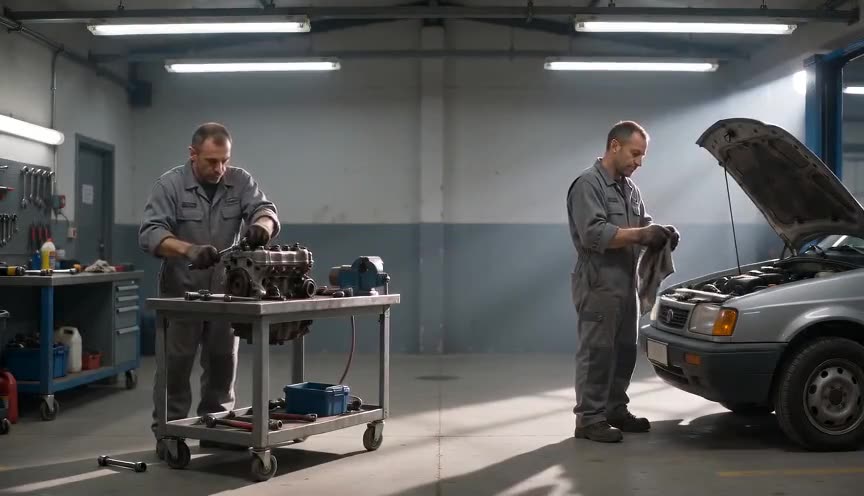
Duplication clones the same subject into multiple copies within one frame. Morphing keeps a single subject but transforms its shape and identity over time, so there is one figure changing, not several existing at once.
In film
Willow (1988)
One of the first feature films to use digital morphing, transforming a series of animals into a woman in one continuous sequence.
Terminator 2: Judgment Day (1991)
The T-1000 morphs between human forms and liquid metal, using the effect to express a body with no fixed shape.
Black or White (Michael Jackson music video) (1991)
A widely cited sequence morphs faces of different people into one another to argue for a shared humanity.
The prompt
Name both the starting subject and the ending subject explicitly, since the model needs a clear target for the warp. Use words like 'smoothly morphs into,' 'transforms without a cut,' or 'seamlessly warps and blends,' and specify what stays fixed (camera position, lighting, framing) so the transformation reads against a stable background. Avoid vague requests like 'morph effect' alone, and avoid asking for unrelated subjects with no shared shape logic, which tends to produce a plain dissolve instead of a true morph.
The exact prompt that rendered the video on this page. Keep the description of the move, change the subject and the setting.
Morphing: a locked-off macro shot inside a sunlit greenhouse shows a small green seedling in a clay pot at the center of frame. Over four seconds the seedling's stem and leaves smoothly warp and bloom, surfaces blending and reshaping without any cut, into a fully open red flower on the same stem. The camera, framing, soft diffused daylight through the glass roof, and background rows of plants stay completely fixed throughout, so only the plant's form visibly transforms. No text.
Common mistakes
Unrelated end states
Morphing two subjects with no shared geometry, like a face into a car, tends to produce mush instead of a readable transformation. Pick subjects with a visual logic connecting their shapes.
Too fast to register
Compressing the warp into a single second reads as a glitch, not a metamorphosis. Give the transformation enough duration for the eye to track the change happening.
Moving camera during the warp
Panning, zooming or shaking the shot while the subject morphs hides the transformation in noise. Keep the frame locked so the only movement the viewer sees is the shape itself changing.
Frequently asked questions
What is morphing in film?
It is a visual effect that gradually warps and blends one image into another across a run of frames, so a face, body or object appears to physically transform on screen instead of being replaced by a cut.
How is morphing different from a simple dissolve?
A dissolve cross-fades two shots without aligning their shapes, so both images briefly overlap. Morphing first warps the geometry of the subject to match the target, so features like eyes or edges line up during the change.
Do filmmakers still use optical morphing today?
Practical optical morphing is rare now. Most transformations are done digitally with dedicated compositing software, or generated directly from a text prompt on an AI video platform like Imaginode.
What makes a morph look convincing?
Matching lighting and framing between the start and end states, aligning key features before warping, and giving the transformation enough time on screen, usually one to three seconds, for the eye to follow the change.