Group shot
Also calledEnsemble shot, Crowd shot
A group shot is a wide or full shot that frames three or more subjects together in a single composition, showing how they occupy space relative to one another. It lets the viewer read the dynamics of a crowd, team or family at a glance, without cutting to individuals.
What it tells
A group shot exists to show relationship, not detail. Directors use it to establish who belongs together, who stands apart, and how power is distributed across a room before the scene breaks the group into pairs and singles. It reads as an ensemble statement: this is the unit the story is about right now. Held at the start or end of a scene, it lets the audience take stock of everyone present in one glance, setting up the emotional math that later close-ups and reaction shots will pay off.
How it is shot
The camera pulls back far enough, or uses a wide lens (usually 24mm to 35mm), to keep every head and set of shoulders inside the frame with some headroom to spare. Actors are staggered in depth and offset laterally so faces do not overlap, often on a rehearsed mark for each body. Focus is stopped down to f/5.6 or f/8 so nobody at the back goes soft, and lighting is kept even across the group rather than favoring one face. Camera height sits near eye level or slightly raised so all faces read clearly. The camera itself usually stays static or moves slowly, since any fast movement pulls attention to one subject and breaks the ensemble read.
When to use it
- Introduce an ensemble cast or team so the audience registers everyone before the story splits them up.
- Show a family, crowd or crew reacting together to news, danger or a decision in the same frame.
- Close a scene by pulling back to the whole group after the story has isolated individuals.
- Establish social hierarchy or division by how members of the group are spaced and positioned.
Not to be confused with
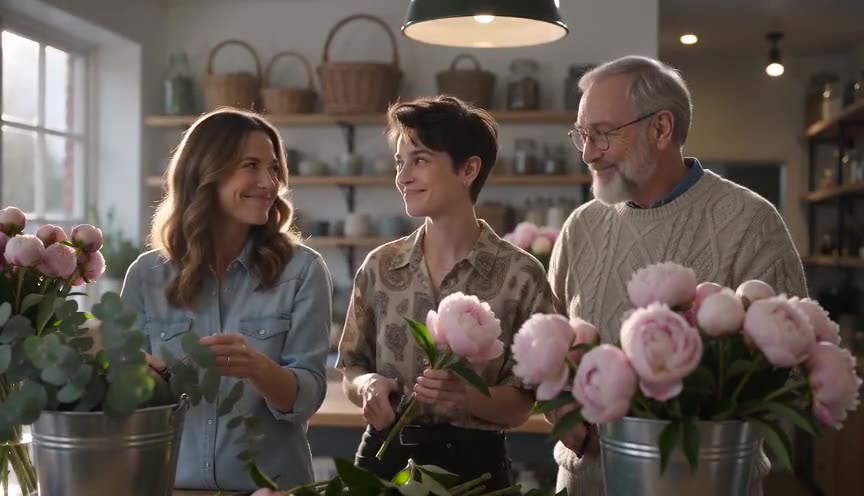
A three-shot is a group shot capped at exactly three subjects, tight enough to still read individual expressions. A group shot goes beyond three and trades facial detail for scale and social geometry.
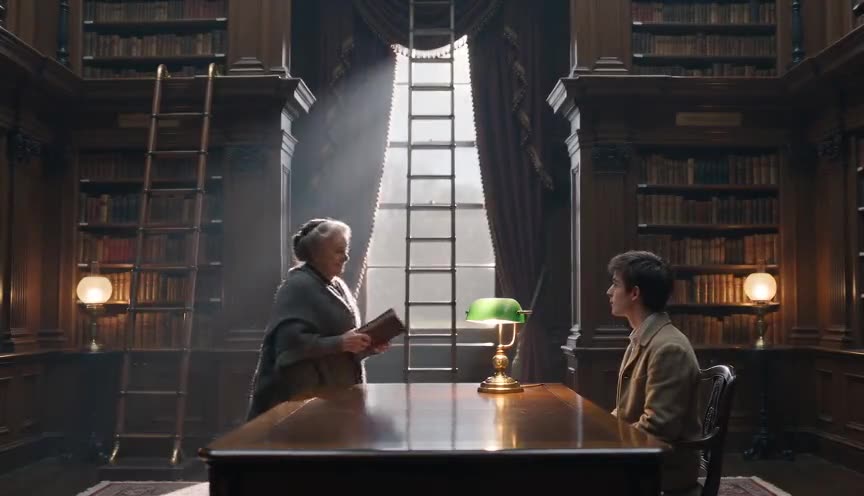
A master shot covers an entire scene's blocking and dialogue in one continuous take, often as a wide group shot. A group shot is the framing choice itself, and can appear as a single cut inside coverage, not the whole scene.
In film
Reservoir Dogs (1992)
The opening walk holds the criminal crew together in one wide frame, establishing them as a unit before the story fractures their loyalty.
The Avengers (2012)
The circular group shot in the final battle gathers the whole team in frame at once, paying off the ensemble setup of the entire film.
The prompt
Name the exact number of subjects and describe their spacing so the model does not merge or overlap faces. Specify a wide or full shot, a lens in the 24mm to 35mm range, and even lighting across the group rather than a single highlighted face. State that the camera stays static or moves slowly, since motion pulls focus toward one person and undercuts the ensemble read. Avoid vague words like several or many; give a precise headcount and describe where each cluster of people stands.
The exact prompt that rendered the video on this page. Keep the description of the move, change the subject and the setting.
Group shot inside a moving subway car at night, wide 28mm lens locked off at eye level, framing six passengers spaced along both sides of the aisle under flickering overhead light. Two stand gripping the pole, three sit on the bench seats, one leans against the door, all kept sharp and evenly lit with no single face favored. The car sways gently, dark tunnel walls streak past the windows, and the camera holds completely still for the full four seconds. No text.
Common mistakes
Overlapping faces
Placing subjects on the same depth plane without offset causes faces to block each other, so part of the group becomes unreadable in the final frame.
Framing too tight
Cropping heads or shoulders at the edges to fit more people defeats the purpose of the shot, since the audience can no longer read who belongs and who does not.
Uneven lighting across the group
Lighting only the center of the frame leaves subjects at the edges in shadow, so part of the ensemble effectively disappears from the composition.
Frequently asked questions
What is a group shot?
A group shot is a wide or full shot that keeps three or more subjects visible together in one frame, showing their positions and relationships without cutting between individuals.
How many people does a group shot need?
There is no fixed number, but the term usually applies once a scene has more subjects than a two-shot or three-shot can comfortably hold, often four or more.
What lens works best for a group shot?
A wide to normal lens, roughly 24mm to 35mm, is the most common choice because it covers enough horizontal space to include everyone without severe distortion at the edges.
Can AI video tools generate a convincing group shot?
Yes, models like the ones on Imaginode can render a group shot well if the prompt states the exact headcount, their spacing, and even lighting across the frame rather than leaving the composition vague.