The genre short film
A low budget fantasy or horror film settles its creature on a photo before ordering a prosthetic, and avoids sculpting the same mask twice.
An actor's photo becomes two film makeup tests, an injury and a creature prosthetic, without losing their face. Workflow visible here, no account needed.
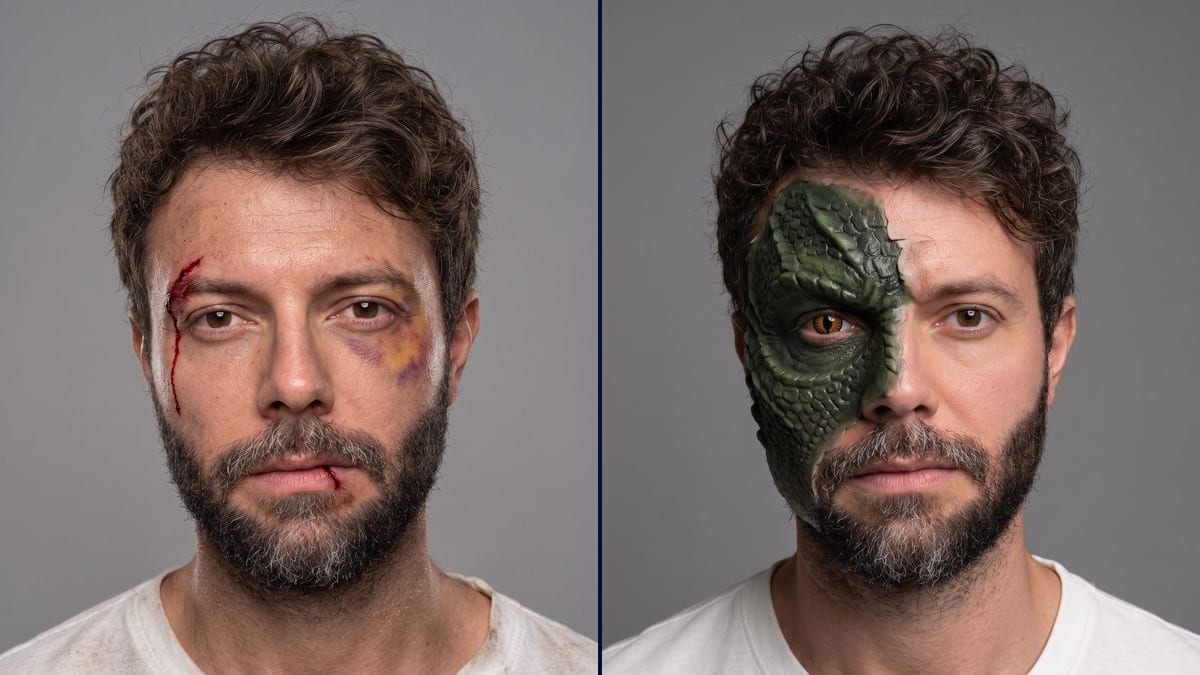
Real workflow: a photo from the front, then two makeup room tests on a grey backdrop, a stunt injury and a reptile prosthetic on half the face. The actor is the same in all three images.
At a glance
In film, special effects makeup is prepared long before the shoot: sketches, tests, sign off by the director. A real test ties up a makeup artist and an actor for hours. This workflow gives two tests on the actor's photo, a stunt injury and a creature prosthetic, to decide before sculpting anything.
The hard part is keeping the actor. An image model asked for a creature happily replaces the whole face. The prompts therefore describe makeup applied on that face, keep eyes, nose, beard and hair, and leave half the face natural for the prosthetic.
The photo is a makeup room test, grey backdrop and frontal light, to judge the material and not the mood. It extends the casting test, and the creature behind you is its video counterpart. Both tests cost thirty-eight credits.
These are the files of the workflow above, exactly as the models produced them, unretouched. The starting point is shown when there is one.
Starting point
Render
Directors, special effects makeup artists, theatre companies and genre film makers who want to try a makeup before fabricating it.
A sharp photo of the actor from the front, without makeup, plus a description of the makeup elements to try.
Give a front photo, bare skin
A sharp photo, even light, no makeup or glasses: the makeup goes on that face, and the model has to see the features to keep them.
Describe the material, not the monster
Cut, dried fake blood, bruise, silicone prosthetic, contact lens: those are makeup elements. "A monster" invites the model to draw someone else.
Leave part of the face untouched
For a prosthetic, keep half the face natural with a clean blend edge: that proves the actor is underneath, and it is what the crew wants to judge.
Ask for a real makeup room test
Grey backdrop, frontal light, facing the lens. A film mood would hide the blend edges and the materials, which are exactly what you check.
The same canvas, tuned for different needs: each variation is two or three lines of prompt away.
A low budget fantasy or horror film settles its creature on a photo before ordering a prosthetic, and avoids sculpting the same mask twice.
The after fight injuries, tried on the actor, fix continuity: which cut, which bruise, where, so they stay identical from one shot to the next.
A special effects makeup artist shows the director three options for a character, on the real actor's face, before quoting for fabrication.
A company tests stage makeup on each actor's photo, and checks it reads from a distance before the first dress rehearsal.
Creature makeup tried on your own photo before buying latex and fake blood: you see at once whether half a face of scales is a good idea.
The injured character and the transformed character, on the same face, complete the character sheets of a game or a series.
The model then draws a monster, not an actor in makeup. Describe the makeup elements applied to their face, and require that they stay recognisable.
A prosthetic that covers everything erases the actor and makes the test impossible to check. A natural half and a clean edge show the material and the blend.
Smoke, backlight and a film set hide exactly what you came to judge. A makeup test is done on a grey backdrop, in frontal light.
A realistic injury on a real person's face must not leave the project: it is a working document for the crew, not a public image.
For natural ageing over decades, age your face is made for that. Here you try set makeup: injuries, prosthetics, creatures, scars.
The tests look like makeup room photos. That is their value for a crew, and why they remain working documents, not images to circulate outside the project.
Yes: wire the chosen test into a Wan 3.0 Video node as the start image, with a slow movement prompt, and the makeup turns with the head.
Thirty-eight credits, nineteen per test on Nano Banana Pro. A third makeup on the same photo costs nineteen more credits.
Because it keeps the face of a reference photo in a measured way, on character sheets, casting and the trading card, and renders skin materials precisely.
On the demo, yes, in both tests: same eyes, same nose, same beard, same hair. That is the criterion to check before showing the test to anyone.
3:4 in 2K, the framing of a makeup room photo, head and shoulders. A full length shot for a complete costume can be asked for at 2:3 in the prompt.
With their consent and for a project, yes. A realistic injury makeup on the face of someone who did not ask for it, no.
Try special effects makeup on a photo with AI
Use this workflowFree account, no card required. The workflow opens pre-filled in your canvas.
 Nano Banana Pro
 GPT Image 2.5 Flare
 Seedream 5 Pro