The tenant moving in
He gets the keys to an empty flat with bare windows and needs to order fast. Two photos of his living room with different curtains, and he knows whether to go for light linen or something heavier.
A photo of your room with light linen curtains, then green velvet ones on a brass rod, both down to the floor. Pick before you order. Workflow visible here, no account needed.
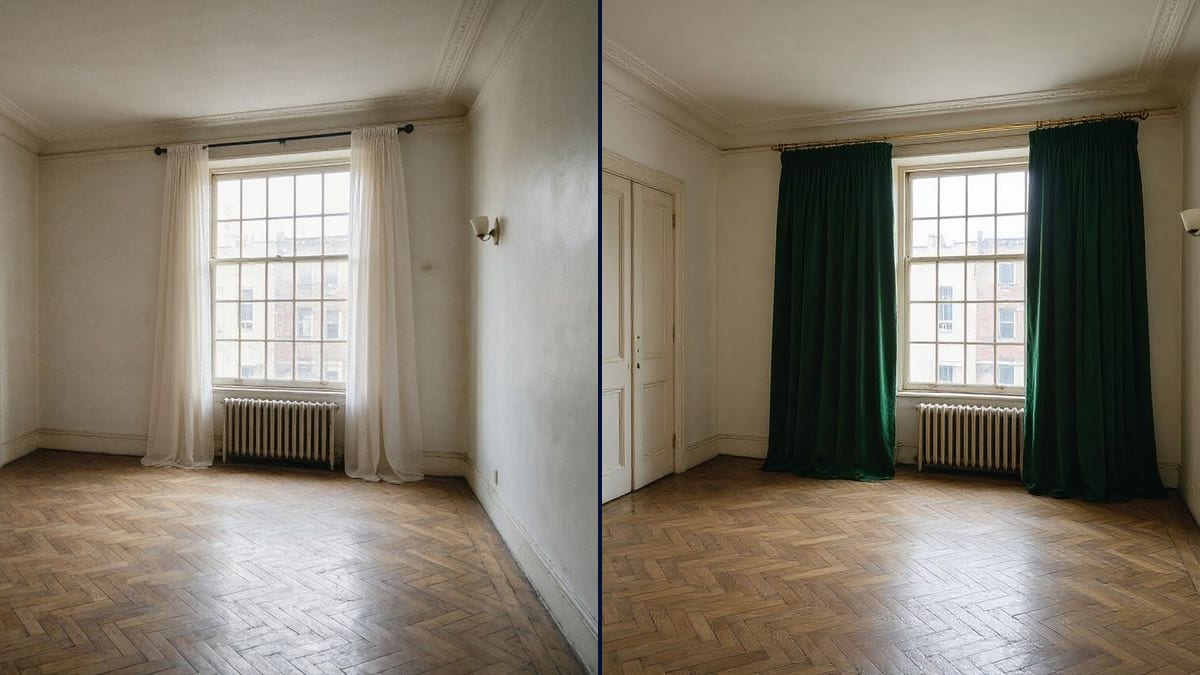
Real workflow: an empty room with white walls, herringbone parquet and a tall sash window, then the same room with off-white linen curtains on a black rod and with forest green velvet curtains on a brass rod.
At a glance
Curtains get chosen from a ten-centimetre swatch under shop lighting. Once they're up at home, the green looks too dark, the linen too see-through, and made-to-measure curtains can't go back. This workflow starts from a photo of YOUR window and dresses it two ways: light off-white linen, then a more formal forest green velvet.
The hard part is the drape. An image model left alone draws curtains that stop at the sill, folds that look rigid, or slips in a sofa and a rug. The prompt sets the rod, the floor-length drop, the fabric and what has to stay put. Flux Kontext adds the curtains without touching the rest of the room.
To test a wall colour in the same room, follow up with the paint colour test; to furnish it, with the empty room furnisher. Both curtain renders cost twelve credits.
These are the files of the workflow above, exactly as the models produced them, unretouched. The starting point is shown when there is one.
Starting point
Render
People choosing curtains, decorators who show a fabric in place, made-to-measure curtain shops.
A photo of the window with the floor and the top of the wall, plus the fabric, colour, rod and length you want.
Photograph the window
Straight on or slightly to the side, in daylight, with the top of the wall and the floor in frame: curtain length is judged over the full height.
Name the fabric and colour
Off-white linen, forest green velvet, striped cotton, white voile. A precise shade beats "green": otherwise the model goes for the blandest one.
Describe the rod and the drop
Black, brass or wooden rod, floor-length or sill-length, held back with tiebacks or hanging free. Anything you leave out is left to chance.
Compare before you order
Put the two pictures side by side, show them to the household, then take your measurements with the chosen version in mind.
The same canvas, tuned for different needs: each variation is two or three lines of prompt away.
He gets the keys to an empty flat with bare windows and needs to order fast. Two photos of his living room with different curtains, and he knows whether to go for light linen or something heavier.
She photographs the window during the appointment and sends two fabrics in place that evening. The client picks from a picture of their own home, not from a binder of twenty swatches.
The shop invites customers to send a photo of their window and replies with two tries before the quote. The customer sees the colour in their own light before signing an order that can't be returned.
The parents can't decide between a navy blackout curtain and a pale sheer. Two pictures of the actual bedroom window settle it before anything gets bought.
The owner is replacing the curtains in her guest rooms. She tries velvet and linen on a photo of each room, then uses real photos for the listing once the curtains are up.
The estate agent dresses the bare windows of a vacant property with simple linen curtains for the listing photos, and labels them clearly as a simulation.
Without "to the floor", the model often stops at the sill or halfway down the radiator. Write the length you want: floor, just above the floor, sill.
If the rod or the top of the window is out of frame, the model makes up the fixing. Keep the ceiling or the top of the wall in the shot.
In the demo, the brass tiebacks asked for on the velvet never showed up. Look at every render and run it again if a detail matters to you.
A photo taken in the evening or against the light throws the fabric colour off. Shoot in daylight, then check the shade against a real swatch.
No: same walls, same window, same radiator, same floor. Only the curtains and their rod are added. In the demo the framing widened slightly, with nothing added to the room.
Yes: write "replace the current curtains with" instead of "hang". Keep the rest of the prompt as it is.
Yes: linen Roman blind, wooden Venetian blind, a plain white sheer. Describe it in place of the curtains, one node per try.
Twelve credits, six per render on Flux Kontext. A third fabric on the same photo costs six more.
Because it adds an element to a photo and leaves everything else in place: the room stays empty, the herringbone floor and the radiator don't move. It follows named fabrics and colours well.
They are at a believable scale for the window, not accurate to the centimetre. Measure the width and drop on site, rod included, before ordering.
Yes: write "curtains drawn across the window" instead of "open on both sides". Handy for judging a blackout fabric or a sheer.
The format of your photo, here 4:3. A full window with the floor in view works best in landscape.
Try curtains on a photo of your window with AI
Use this workflowFree account, no card required. The workflow opens pre-filled in your canvas.
 Flux Kontext
 Nano Banana 2.1
 GPT Image 2.5 Sunburst