Wet-down
Also calledWetdown, Water-down, Street wetting
Wet-down is the practice of soaking a set, street or surface with water before filming so that it holds reflections, deepens color and reads as freshly rained on. It adds gloss and depth to the image and gives the audience a subtle sense of atmosphere without ever changing the actual weather.
What it tells
A wet surface turns flat concrete or tile into a mirror, doubling every light source and every silhouette that crosses it. Directors reach for wet-down to make ordinary locations feel charged, moody or cinematic, especially at night, and to give color and practical lights something to bounce off. It is invisible as a technique but felt instantly: the world looks richer, heavier, a little more dangerous or a little more alive.
How it is shot
A water truck, fire hose or hand-pumped sprayers lay down a thin, even film of water on the ground, glass or foliage just before the shot. Crews sometimes add a small amount of glycerin or a wetting agent so the water beads and holds its sheen longer under hot lights instead of drying or pooling unevenly. Grips angle practical and unit lights low and to the side so they streak across the wet surface toward the lens. Because water evaporates, the area is refreshed between takes to keep the reflections matching from shot to shot, and a polarizing filter can tame or exaggerate the glare as needed.
When to use it
- Night exteriors where you want streetlights and neon to smear into reflections on the ground.
- Interior sets with hard floors or glass that need extra depth and shine under key light.
- Scenes set right after rain, without shooting in actual rainfall or waiting for weather.
- Product or beauty shots that need a wet, glossy surface for controlled highlight bounce.
Not to be confused with
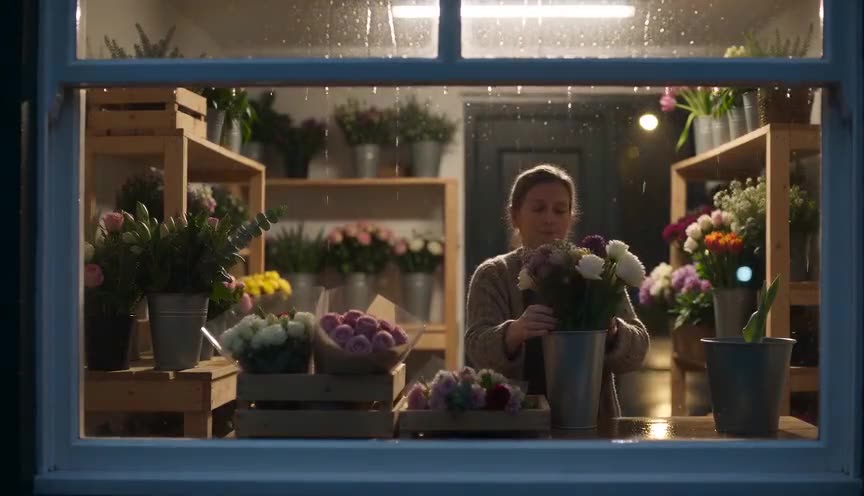
Rain shows water falling on camera and hitting the world in real time. Wet-down only prepares surfaces beforehand, giving you the reflective, just-rained-on look without any rain rig or continuity of falling water.
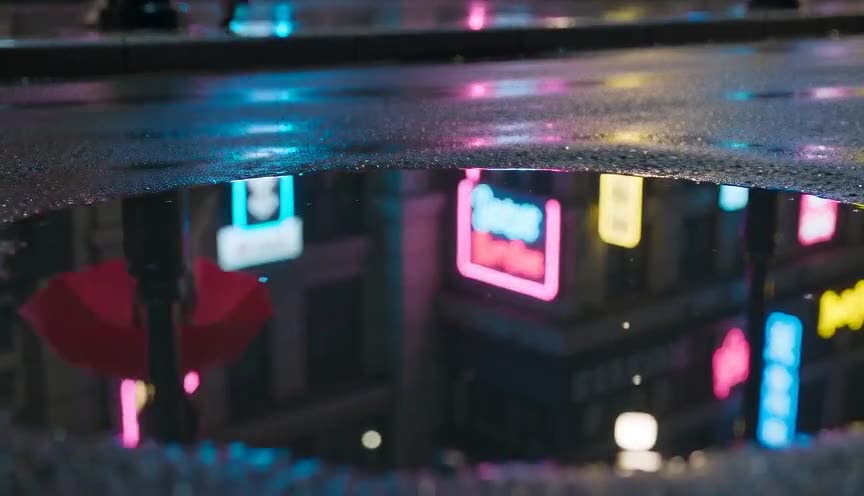
A reflection shot is a compositional choice built around an existing mirror-like surface. Wet-down is the preparation step that creates that surface in the first place, on ground that would otherwise stay dull and non-reflective.
In film
Blade Runner (1982)
Streets and alleys are constantly wet-down so neon and headlights smear into long reflections across the pavement, a signature of the film's look.
Se7en (1995)
Nearly every exterior is wet-down to keep the city looking grimy and rain-soaked, reinforcing the film's oppressive, waterlogged atmosphere.
The prompt
Describe the wet surface directly: wet stone, sheen on glass, beaded water on leaves, reflected light streaks. Mention the light source that is bouncing off the water (grow lights, streetlights, a lamp) so the model connects the shine to a source. Avoid words like rain or drizzle unless you actually want falling water, since that pulls the model toward a rain shot instead of a static wet-down look. Keep camera movement slow so the reflections read clearly.
The exact prompt that rendered the video on this page. Keep the description of the move, change the subject and the setting.
Wet-down: a slow push-in through a greenhouse at dusk, the stone floor and glass panels freshly hosed down so they hold a wet sheen that mirrors the warm overhead grow lights in long orange streaks. Water droplets bead on broad leaves and slide slowly down them, and the lower edges of the glass panes are still faintly misted. The camera moves forward at a steady, even pace on a slider, staying level, while the wet floor keeps shifting reflections as the light rakes across it. Background foliage stays soft and slightly out of focus. No text.
Common mistakes
Too many visible droplets
Piling on falling water or heavy drips reads as rain, not wet-down. Keep the water settled and reflective on the surface rather than actively falling.
Wrong light angle
A wet floor only shows its sheen when light rakes across it at a low angle. Lighting straight down kills the reflection and wastes the whole setup.
Letting it dry mid-scene
Water evaporates fast under hot lights, so a surface that is glossy in one take and dull in the next breaks continuity. Refresh the wet-down between takes.
Frequently asked questions
What is a wet-down in filmmaking?
It is the practice of wetting a set, street or surface with water before shooting so it picks up reflections and reads as freshly rained on, without any actual rainfall in the shot.
Why do filmmakers wet down streets before a night shoot?
Wet asphalt turns streetlights, headlights and neon into long, doubled reflections that make a night exterior look richer and more dimensional than dry, matte pavement ever could.
Can wet-down be used indoors?
Yes, it works on any hard floor, tile or glass. Interior wet-downs are common in kitchens, factories and greenhouses where a glossy surface adds shine and depth to practical lighting.
How do I get a wet-down look with an AI video generator?
Describe the wet surface and its light source explicitly, such as wet stone reflecting warm lamps, rather than saying rain. On a canvas like Imaginode, naming the material, the sheen and the light angle gets a cleaner result than a generic weather word.