Reflection shot
Also calledMirror shot, Reflective framing, Mirror composition
A reflection shot composes the frame so the audience sees a subject or scene through a mirror, window, puddle or other reflective surface rather than directly. It doubles the image, adds depth and often signals a psychological split, a watching presence or a moment of self-examination.
What it tells
Directors reach for the reflection shot when they want the audience to feel that a character is being watched, including by themselves. A mirror can expose vanity, doubt or a hidden identity, while a window or puddle folds two worlds into one frame, the interior and the exterior, the present and a memory. The device slows the viewer down: it asks them to read the image twice, once for what is real and once for what is reflected, which makes ordinary rooms feel loaded with meaning and quiet dread.
How it is shot
Place the camera so a mirror, window, glass door or wet surface sits inside the frame, then compose so the reflection carries real information, a face, an action, a second character, not just a blur. Use a longer lens, 50mm to 85mm, to compress the distance between the reflective surface and the subject and to keep both planes readable. Control reflections with polarizing filters, flags and negative fill so unwanted glare from windows or overhead lamps does not wash out the mirrored image. Light the reflected subject slightly brighter or with a distinct color temperature so the eye can separate the two layers. On set, a flagged practical or a bounce card near the mirror keeps the reflection crisp without adding a second visible light source in frame.
When to use it
- Use it to show a character confronting their own image, doubt or a hidden truth about themselves.
- Use it when a window or glass door can merge two spaces, the street and the interior, into one composed frame.
- Use it to suggest surveillance or a hidden observer without cutting to a separate point of view shot.
- Use it in a quiet transition scene where you want the audience to slow down and read the frame twice.
Not to be confused with
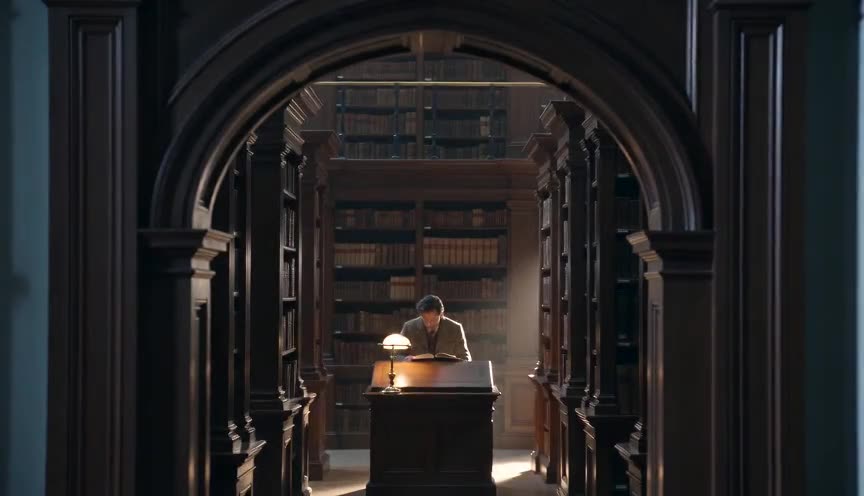
Both add depth by nesting one image inside another. A reflection shot always uses a real reflective surface such as glass or water, while frame within a frame can use any doorway, arch or window frame with no mirrored image involved.

Both layer two images in one frame. A reflection shot captures both layers optically and live, through an actual mirror or window, while double exposure blends two separately exposed images, often shot at different times or places.
In film
Taxi Driver (1976)
Travis Bickle addresses his own reflection in a mirror, turning the frame into a confrontation between the character and his fractured self-image.
Black Swan (2010)
Mirrors recur throughout the apartment and studio, doubling Nina's image again and again to externalize her collapsing sense of identity.
Blade Runner (1982)
Reflections in eyes, rain-streaked glass and neon windows layer human and replicant imagery, reinforcing the film's questions about identity.
The prompt
Name the reflective surface explicitly (mirror, glass window, wet floor, steel counter) and state what it shows, since AI video models need concrete nouns to render a believable reflection rather than a generic bright patch. Specify the camera position relative to the surface, describe both the real subject and the mirrored image in one sentence, and use a fixed or slow-moving camera so the geometry does not break. Avoid vague terms like reflective aesthetic, and avoid asking the reflection to show something logically impossible, since models struggle with inconsistent mirror physics.
The exact prompt that rendered the video on this page. Keep the description of the move, change the subject and the setting.
Reflection shot. After the rain, a large puddle on a city street at night reflects, upside down and perfectly clear, a woman with a red umbrella walking past under neon signs. The camera sees only the puddle and the reflection; a drop falls into the water and ripples the image. Low angle close to the ground, cinematic, realistic. No text.
Common mistakes
Reflection reads as noise
If the mirrored surface is too small, too dark or too busy, viewers miss it entirely and the shot just looks like a cluttered background instead of a doubled image.
Lighting the reflection flat
Matching the light on the real subject and the reflection one to one removes the layered feeling; give the reflected plane a slightly different intensity or color so the eye can tell them apart.
Ignoring mirror geometry
Placing the camera at the wrong angle can put the camera operator or crew in the reflection, or make the mirrored image physically impossible, which breaks the illusion instantly.
Frequently asked questions
What is a reflection shot?
A reflection shot frames a subject through a mirror, window, puddle or other reflective surface so the audience sees both the real subject and its doubled image in one composition. Cinematographers use it to add depth or hint that a character is being watched, including by themselves.
Why do directors use mirrors in film?
Mirrors let a director show a character's inner state, vanity, doubt or a hidden identity, without a single word of dialogue. Because the reflection sits inside the same frame as the real subject, the audience reads both images at once, which makes internal conflict visible on screen.
How do you avoid showing the camera in a mirror shot?
Angle the mirror or window a few degrees off a straight perpendicular line to the lens, position the camera slightly to one side, and use a longer lens from farther back so the crew and rig fall outside the reflected field of view.
Can AI video generators create realistic reflection shots?
Yes, if you name the exact reflective surface and describe both the real subject and the reflected image in the same sentence. Imaginode's models handle simple flat surfaces like mirrors and windows well; curved or moving water reflections take more careful prompting and may need a few tries.