Hip level shot
Also calledWaist level shot, Belt level shot
A hip level shot places the camera at the height of a standing adult's waist, roughly 90 to 100 centimeters off the ground. It gives the viewer a grounded, slightly diminishing view of the subject, often centering the hands and hips instead of the face.
What it tells
Directors reach for hip level when the story lives in the hands rather than the eyes: a gun being drawn, a tool being gripped, a fist clenching. The low, steady vantage removes the psychological read of the face and replaces it with physical tension. It also carries a subtle power imbalance, since the viewer looks slightly up at anyone standing, which can feel childlike, submissive, or coiled with threat depending on context.
How it is shot
Set the camera on a low tripod, apple box, or a crouching operator so the lens sits at 90 to 100 cm, level with an adult's belt line. A 35mm or 50mm lens keeps the framing natural and avoids the distortion of a wider lens shot this close. Frame from mid-thigh to chest or shoulder, letting the hands, holster, tool belt, or pockets sit near the center. The horizon stays level (this is not a low angle looking up), so the camera does not tilt, it simply sits lower than eye level. Lock it off or use a slow, controlled push to keep attention on the hands.
When to use it
- A standoff or duel where the story is in the hands reaching for a weapon or tool
- A child's physical vantage point of the adults surrounding them
- A tense pocket or holster reveal before a confrontation escalates
- A grounded, documentary-style walk where you want to feel the terrain and gait
Not to be confused with
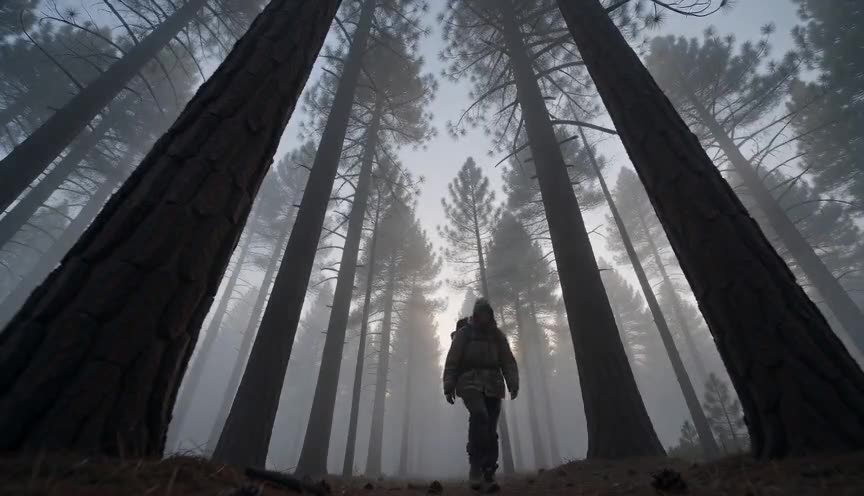
Low angle tilts the camera upward from below to make the subject look powerful or towering. Hip level stays level with the horizon and simply sits lower, focusing on the hands rather than dramatizing scale.
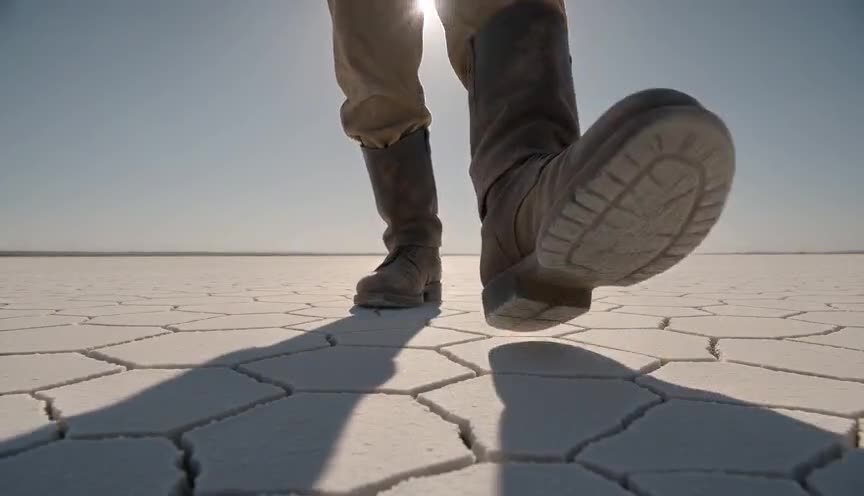
Worm's-eye view puts the camera at ground level looking almost straight up, an extreme and disorienting vantage. Hip level is far more moderate, closer to a natural but lowered human viewpoint.
In film
The Good, the Bad and the Ugly (1966)
Sergio Leone cuts to hip level during the final duel, framing the holsters and hands before the eye level close-ups of the standoff.
Once Upon a Time in the West (1968)
Leone's final duel keeps the camera near the gun belts, isolating Harmonica's and Frank's hands before the guns are drawn.
The prompt
Tell the model explicitly that the camera height is fixed at hip or waist level, level with the horizon, not tilted up. Name the framing you want (mid-thigh to shoulder) and what should sit at center, usually hands, a belt, or a tool. Avoid words like low angle or looking up, which push the model toward a tilted, dramatic angle instead of this neutral, lowered vantage.
The exact prompt that rendered the video on this page. Keep the description of the move, change the subject and the setting.
Hip level shot: camera fixed at waist height, about 95 centimeters above the ground, level with the horizon, on a rain-slicked lighthouse platform during a storm. A weathered lighthouse keeper in a yellow raincoat strides toward the lighthouse door, one gloved hand brushing a coiled rope hanging from his belt, as rain lashes sideways and waves explode against the rocks behind him. The camera stays static, framing him from mid-thigh to shoulder, keeping his hands and hip at the center of the frame while the storm rages in the background. No text.
Common mistakes
Tilting the camera up
Angling the lens upward turns this into a low angle shot and adds dramatic power to the subject, which defeats the neutral, grounded read of a true hip level framing.
Framing the face instead of the hands
If the composition centers on the face with the hip line at the bottom edge, the shot loses its point. Keep the hands, belt, or pockets in the middle of frame.
Using it for every line of dialogue
Hip level is a specialty shot for tension or physical detail, not a conversation angle. Overusing it flattens its impact and confuses viewers about whose perspective they are sharing.
Frequently asked questions
What is a hip level shot?
It is a camera angle where the lens sits at the height of a standing adult's waist, roughly 90 to 100 centimeters off the ground, framing the subject from mid-thigh to shoulder with the horizon kept level rather than tilted.
How is hip level different from low angle?
Hip level keeps the camera parallel to the horizon at a lowered height. Low angle tilts the lens upward from below the subject, which exaggerates size and power. Hip level is more neutral and focused on the hands.
Why do westerns use hip level shots so often?
Gunfights are decided by the draw, so directors cut to hip level to show the hand reaching for the holster before revealing the outcome on the faces, building suspense through the hands rather than the eyes.
Can AI video tools generate a hip level shot?
Yes, if you specify the exact camera height and tell the model to keep the horizon level rather than tilted. Imaginode's models respond well to explicit height cues like waist height or 90 centimeters combined with a clear description of what sits at frame center.