Eye level shot
Also calledNeutral angle shot, Normal angle, Straight-on shot
An eye level shot places the camera at the same height as the subject's eyes, so the framing feels neutral and non-judgmental. It puts the viewer on equal footing with the subject, without the psychological weight of looking up or down.
What it tells
Because the eye level shot carries no built-in power dynamic, directors reach for it whenever they want the audience to meet a character as an equal, not as a superior or a subordinate. It is the default grammar of naturalistic dialogue and observational drama: the camera disappears, and the moment speaks for itself. When a scene needs the audience to simply watch and listen, without a directorial thumb on the emotional scale, the eye level shot lets the performance and the blocking carry all the meaning.
How it is shot
To build a true eye level shot, set the lens height to match the subject's eyes, roughly 55 to 65 inches for a standing adult and lower for a seated one. Mount the camera on a tripod, a slider, or a low dolly so the horizon stays level through the take. Use a standard focal length, 35mm to 50mm on full frame, since wide lenses distort and long lenses compress, both of which undercut the neutrality. Check height on a monitor rather than by eye: a few inches up or down already reads as a mild high or low angle.
When to use it
- Dialogue scenes where you want the audience to feel equal to the characters, not superior or inferior.
- Documentary interviews and observational footage where neutrality builds trust in the subject.
- Establishing a character as ordinary and relatable before a story gives them power or vulnerability.
- Rehearsal or process footage where the camera should observe without commentary on status.
Not to be confused with

A high angle shot looks down on the subject, often making them look small, vulnerable, or observed, while eye level keeps the camera neutral and equal to the subject's gaze.
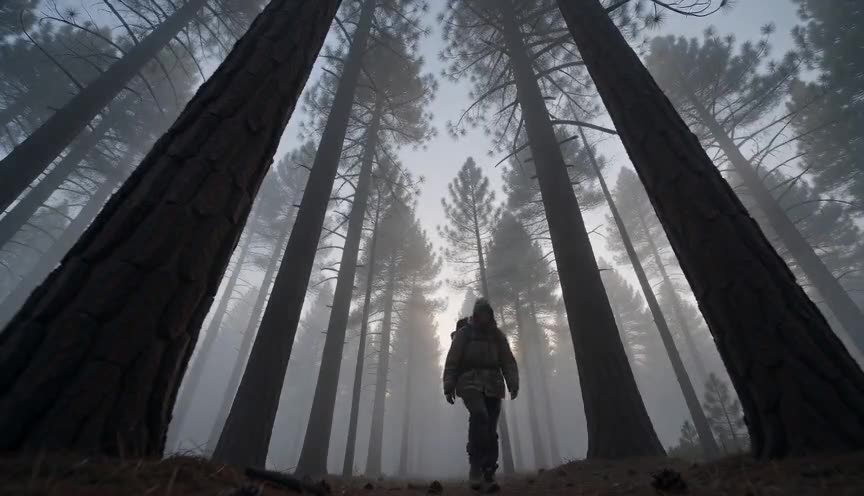
A low angle shot looks up at the subject, adding power, dominance, or menace, while eye level shows the same subject without any hierarchy or added weight.
In film
Tokyo Story (1953)
Ozu holds the camera at the eye level of seated characters, creating a quiet, respectful neutrality that defines the film's contemplative tone.
Before Sunrise (1995)
Linklater shoots most conversations at eye level, keeping the audience beside the couple as a companion rather than a judge of their choices.
The prompt
Specify the camera height explicitly: say the camera is at eye level with the subject, matching their standing or seated eye line, and add level horizon or locked-off tripod to prevent the model from drifting into a slight high or low angle. Avoid words like dramatic, looking up, or looking down, which push the model toward a power angle. Naming a focal length such as 35mm or 50mm and a static or slow tracking movement helps keep the frame neutral instead of stylized.
The exact prompt that rendered the video on this page. Keep the description of the move, change the subject and the setting.
Eye level shot of a ballet rehearsal room, camera locked at the exact eye height of a standing adult dancer, framing her in a medium shot as she stretches at the barre under flat daylight from tall windows. The lens stays level and static, a 50mm focal length with no tilt or pan, while other dancers move softly out of focus in the background. Her eyes meet the lens directly for a moment, then she looks away and continues stretching, the horizon line staying perfectly parallel to the frame edges throughout. No text.
Common mistakes
Camera height not matched to subject
Placing the tripod at a generic height instead of measuring the subject's actual eye line quietly turns the shot into a mild high or low angle.
Tilting to reframe mid-shot
A small tilt up or down to adjust framing during the take breaks the neutral angle and reintroduces a power dynamic the shot was meant to avoid.
Using a wide or long lens
Switching to a wide lens or a heavy telephoto adds distortion or compression that makes the eye level angle feel stylized instead of neutral and observational.
Frequently asked questions
What is an eye level shot?
An eye level shot is a camera angle where the lens sits at the same height as the subject's eyes, giving the audience a neutral, non-judgmental point of view. It is the most common angle in narrative film because it feels natural and does not signal power or weakness.
Why do most films use eye level shots by default?
Because eye level carries no built-in emotional charge, it lets dialogue, performance, and blocking do the work instead of the camera angle. Editors also cut it more easily with other eye level shots, which keeps continuity smooth across a scene.
How high should the camera be for an eye level shot?
For a standing adult, the lens usually sits between 55 and 65 inches, matched to that specific person's eye height rather than a fixed number. For a seated subject, lower the camera to their seated eye line, which is often 40 to 45 inches.
Can AI video tools generate a true eye level shot?
Yes, tools such as those on Imaginode follow explicit camera height and angle language well, especially when the prompt names eye level, a level horizon, and a standard focal length rather than leaving the angle to guess.