Overhead top-down shot
Also calledtop shot, flat lay shot, God's-eye shot, top-down shot
An overhead top-down shot places the camera directly above the subject, looking straight down at 90 degrees, so the scene reads as pattern and geometry rather than depth. It flattens the frame, turns people and objects into shapes, and gives the viewer a detached, almost diagrammatic view of the action.
What it tells
An overhead shot removes intimacy on purpose. By looking straight down, the director erases eye contact, hierarchy and depth, so the audience reads bodies as pieces in a system rather than as people with feelings. Directors reach for it to show choreography, ritual or fate: a body outlined in chalk, dancers forming a pattern, a city grid seen from above. It can feel clinical, playful or god-like depending on the light and the subject, but it always creates distance, turning a scene into a diagram the viewer studies rather than lives inside.
How it is shot
The camera sits on a rig mounted directly above the set: a ceiling mount, an overhead dolly, a Russian arm, or a drone hovering indoors, aimed straight down at 90 degrees to the floor. A 24mm to 35mm lens keeps distortion low across a wide table or room; anything wider bends the edges. Because the camera occupies the space where a key light would normally sit, gaffers light from the sides or use practicals built into the set, like table lamps or window light, to avoid flat, shadowless footage. The shot is usually locked off or moves on a slow slider, timed to action that has been blocked and rehearsed to read clearly from above, since faces and gestures lose their normal cues at this angle.
When to use it
- To reveal a pattern, formation or choreography that only makes sense seen from directly above.
- To show a process laid out on a table or floor, like cooking, crafting or crime scenes.
- To create emotional distance from a character, framing them as small, exposed or observed.
- To open or close a scene with a graphic, almost abstract image before returning to eye level.
Not to be confused with
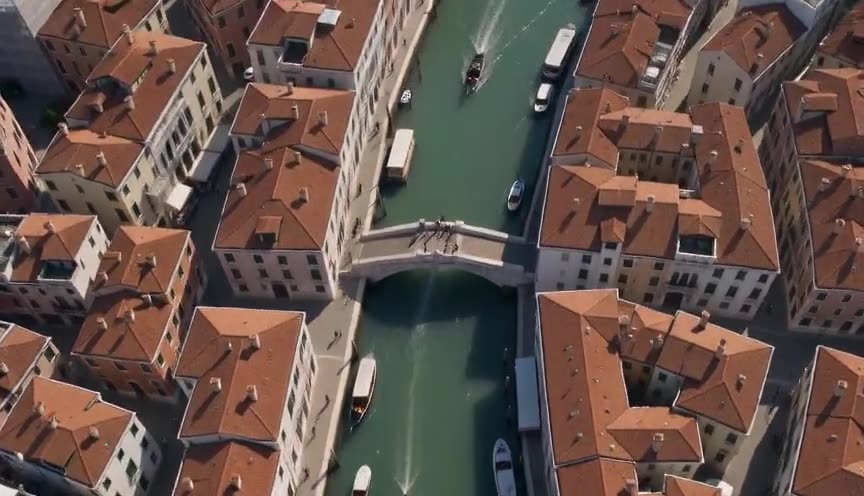
A bird's-eye view can be any high, distant angle looking down at an incline, while an overhead shot is strictly vertical, 90 degrees, directly above the subject, flattening depth completely.
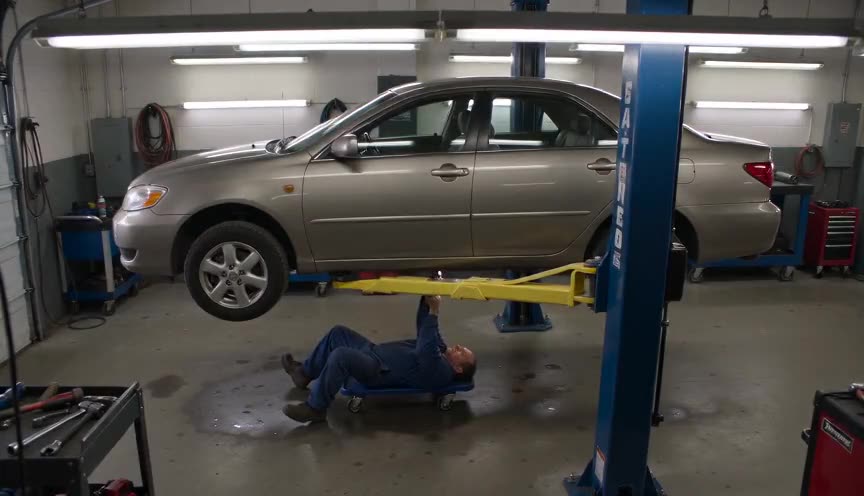
A high angle looks down at a moderate tilt, keeping faces and horizon visible, whereas an overhead shot removes the horizon entirely and reads the scene as flat shapes and lines.
In film
Gold Diggers of 1933 (1933)
Busby Berkeley's top shot turns a chorus line into a rotating kaleidoscope, an early textbook example of the overhead pattern shot.
The Grand Budapest Hotel (2014)
Wes Anderson repeats overhead inserts of desks, luggage and pastries to give the film its flat, symmetrical, storybook control.
The prompt
Say 'overhead top-down shot' or 'camera directly above, looking straight down at 90 degrees' so the model does not default to a tilted high angle or an outdoor drone view. Name what fills the frame, a table, a floor, a crowd, since the shot reads as flat shapes. Specify side lighting, because top light from a fixture the camera would otherwise see reads as flat and shadowless. Avoid asking for faces turned up to camera; hands, tools and objects hold the composition better than expressions at this angle.
The exact prompt that rendered the video on this page. Keep the description of the move, change the subject and the setting.
Overhead top-down shot of a bakery kitchen at 5 am, camera locked directly above a stainless steel worktable, looking straight down at 90 degrees. A middle-aged baker's hands shape rows of dough into round loaves, flour dusting the table in a fine layer, steam drifting faintly from a nearby proofing basket. Warm tungsten light falls in from the sides, casting soft shadows around each loaf. The frame stays static and the table fills the shot; only the hands and dough move, turning the routine task into a graphic pattern of circles and light. No text.
Common mistakes
Lighting from directly above
If the only light source is above the camera, the shot goes flat and shadowless; light from the sides instead so shapes still have volume.
Adding horizon or depth cues
Any wall, doorway or distant background breaks the flatness that makes the shot work; keep the frame filled with the floor or table plane only.
Actors looking up at the lens
A face turned up to a straight-down camera looks strange and self-aware; keep attention on hands, objects or the top of the head instead.
Frequently asked questions
What is an overhead top-down shot?
It is a shot filmed with the camera directly above the subject, pointed straight down at 90 degrees, so the scene reads as flat pattern and geometry rather than three-dimensional space.
How do you achieve an overhead shot without a drone?
Indoors, use a ceiling mount, an overhead dolly, a Russian arm, or a camera taped to a rig above a table; outdoors on a small scale, a pole cam or a short crane arm works well.
Why do directors use overhead shots for tables and desks?
Looking straight down turns objects into a flat, graphic layout, which is why cooking scenes, crime scenes and Wes Anderson's props all get this treatment: it reads instantly and looks deliberate.
Can AI video tools generate an overhead shot reliably?
Yes, if you state the angle explicitly, since models often default to a tilted high angle otherwise; on Imaginode, describing 'camera directly above, looking straight down' with side lighting gets a clean result.