Arc shot
Also calledArcing shot, Curved tracking shot
An arc shot moves the camera along a curved path around a subject while keeping it framed, revealing new sides of the person or object as the shot unfolds. It gives the viewer a sense of physical space and dimension that a static or straight-line shot cannot deliver.
What it tells
Directors reach for the arc shot when they want the audience to feel like they are physically moving around a moment, not just watching it. The curve adds weight and consequence: a slow arc around two people arguing suggests we are circling the truth of the scene, while a fast arc during action heightens disorientation and threat. It turns a flat frame into a three-dimensional space and gives otherwise static dialogue or reveal scenes a sense of momentum.
How it is shot
The camera travels on a curved track, a circular dolly rig, a gimbal, or a drone, pivoting around a fixed point (often the subject) rather than moving in a straight line. Radius and speed depend on intent: a slow 30 to 90 degree arc on a dolly track at eye level reads as contemplative, while a fast 180 to 360 degree arc on a gimbal or Steadicam during action reads as urgent. Focus is usually locked or handled by a focus puller since the distance to subject changes as the camera curves. A wide to normal lens, 24mm to 50mm, keeps the background legible as it swings past. Motorized robotic arms or circular dolly tracks give the smoothest, most repeatable arcs for VFX or product work.
When to use it
- Revealing a character's face and surroundings during a dramatic monologue or confession
- Building tension in a standoff by circling two opposing characters at a measured pace
- Showcasing a hero object or set piece from multiple angles in one continuous move
- Transitioning smoothly between two people in a conversation without cutting
Not to be confused with
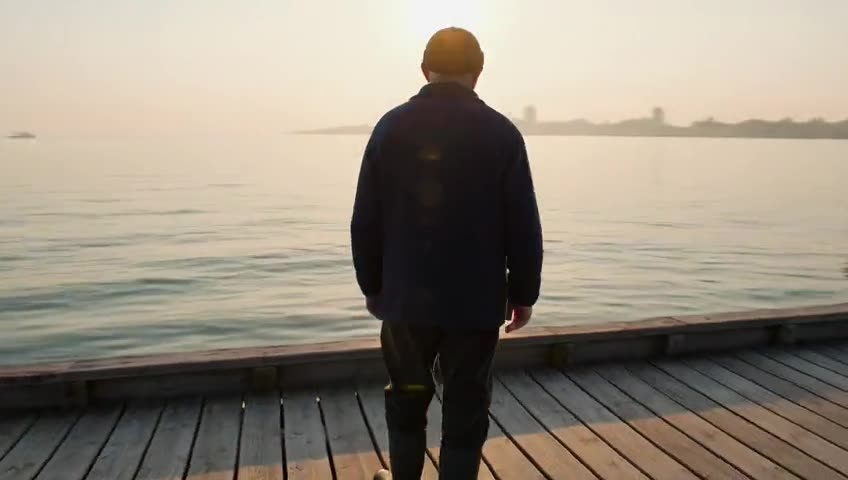
An orbit shot completes a full 360-degree circle around the subject, while an arc shot only travels part of that circle, often 30 to 180 degrees, before stopping or cutting.

A truck shot moves the camera laterally in a straight line alongside the subject, whereas an arc shot curves around a fixed point, changing the angle of view as it moves.
In film
Vertigo (1958)
In the hotel room kiss, the camera arcs around Scottie and Judy as the background shifts, visualizing memory, obsession, and disorientation.
The Matrix (1999)
During Neo's rooftop bullet dodge, the viewpoint arcs around his suspended body, making the impossible movement spatially clear and iconic.
The Avengers (2012)
In the Battle of New York, the camera circles the assembled heroes, turning the team reveal into a clear, dimensional group tableau.
The prompt
Name the pivot point explicitly (the subject stays centered) and state the arc's degree range and speed, since AI models often default to a straight pan or dolly instead of a true curve. Words like 'camera arcs around' or 'curved dolly path' work better than 'moves around.' Avoid vague terms like 'circles' alone, which some models render as a static pan with zoom. Keep the background description simple so the curved parallax reads clearly against it.
The exact prompt that rendered the video on this page. Keep the description of the move, change the subject and the setting.
Arc shot: the camera moves in a smooth 120-degree curved path around a seated woman in her forties reading at a mahogany desk in a Victorian library, pivoting so she stays centered in frame while tall bookshelves and a rolling ladder swing past in the background at different speeds, revealing the far side of the room. Warm lamp light, dust in the air, camera at eye level on a curved dolly track, steady unbroken motion, no cuts. No text.
Common mistakes
Confusing it with a pan
A pan rotates the camera in place from a fixed point, while an arc shot physically travels along a curve, so the background shifts with real parallax, not just rotation.
Losing focus mid-move
As the camera curves, the distance to the subject changes constantly, and locking focus at the start often leaves the subject soft by the end of the arc.
Arcing too fast for the content
A quick arc on a quiet dialogue scene reads as anxious or gimmicky, while a slow arc on a fast action beat drains urgency; match speed to the emotional register.
Frequently asked questions
What is an arc shot?
An arc shot is a camera move that travels along a curved path around a subject, keeping it roughly centered in frame while the background rotates past, giving the viewer a sense of three-dimensional space in a single continuous take.
How is an arc shot different from an orbit shot?
An orbit shot completes a full 360-degree circle around the subject, while an arc shot covers only part of that circle, often between 30 and 180 degrees, before stopping or cutting to another shot.
What equipment do you need for an arc shot?
A curved dolly track, a circular slider, a gimbal, a Steadicam, or a motorized robotic arm can all produce an arc shot; the choice depends on the desired smoothness, speed and repeatability of the move.
Can AI video tools generate an arc shot?
Yes, models like the ones used on Imaginode can produce a convincing arc shot if the prompt states the curved path, the pivot point and the degree range explicitly, since the default interpretation of movement is often a straight line or a simple pan.