Pan
Also calledPanning shot, Panoramic shot
A pan is a camera movement in which the camera rotates horizontally around a fixed vertical axis, left to right or right to left, while its base stays in one place. It lets the viewer's eye travel across a space or follow a moving subject without a cut.
What it tells
The pan mimics the natural motion of a head turning to follow interest, so it feels intuitive rather than constructed. Directors use it to connect two points in a single space, a face and what it looks at, a soloist and the crowd, without cutting away and breaking the room's continuity. Because the camera never leaves its spot, the pan keeps the audience anchored while still letting curiosity move. It builds anticipation as new information enters the frame gradually, and it can turn a static setup into a story of discovery, one glance at a time.
How it is shot
A pan starts with the camera locked on a tripod fitted with a fluid head, or on a motorized gimbal head for a perfectly even speed. The operator (or a technocrane style remote head) rotates the camera body horizontally around its vertical axis while the tripod legs stay planted, so there is no lateral drift like in a tracking shot. Speed is set by the pace of the subject: a slow pan of 3 to 8 degrees per second follows quiet observation, a fast pan up to whip-pan speed follows sudden action. Focal length matters: wide lenses (24 to 35mm) show more background sweep, while longer lenses (85mm and up) compress the pan and reveal parallax between foreground and background at a slower apparent rate.
When to use it
- To reveal the width of a room or landscape without cutting, keeping the audience in one continuous space.
- To follow a subject walking or performing across a stage, room, or street from a fixed camera position.
- To connect two characters or a character and an object in the same shot, building a visual link between them.
- To build suspense by slowly uncovering what is next to the subject before the audience expects it.
Not to be confused with

A whip pan is a pan pushed to extreme speed until the image blurs, used as a hard transition or comic beat; a standard pan stays slow enough to keep detail readable throughout the move.
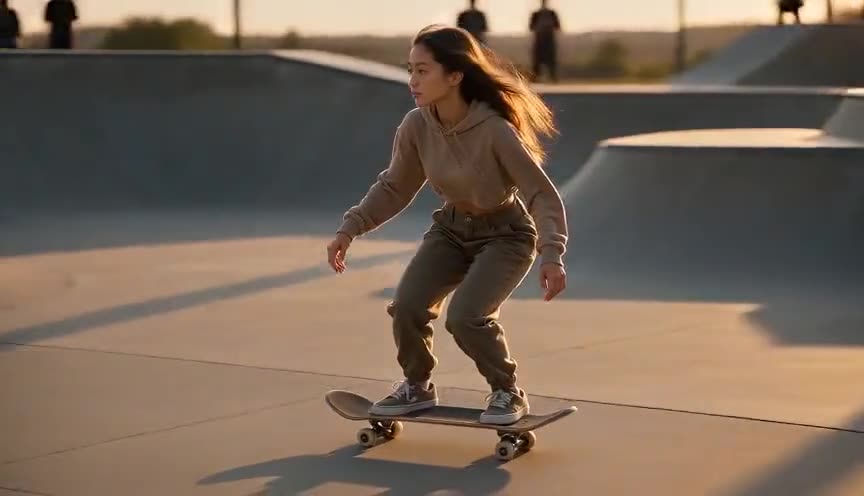
A tracking shot moves the camera's physical position alongside or with the subject, while a pan rotates in place from one fixed spot; tracking preserves distance and framing, a pan changes what's in frame as it sweeps.
In film
Rear Window (1954)
Hitchcock opens the film with a slow pan across the courtyard, introducing every neighbor and setting that becomes the stage for the entire story.
The Grand Budapest Hotel (2014)
Wes Anderson repeatedly uses whip pans, especially during hotel and prison sequences, snapping the camera between characters and actions for comic timing and precise spatial orientation.
The prompt
Name the movement directly: say 'the camera pans left to right' or 'pans right to left' and specify that it stays in one fixed position while only the angle changes. Give a steady speed cue like 'slow, even pan' or 'smooth continuous pan' rather than vague words like 'moves'. Describe what enters frame at the start and what it lands on at the end, since the model reads the pan as the path between those two anchors. Avoid mixing in 'zoom' or 'dolly' language, which pulls the shot toward a different movement entirely.
The exact prompt that rendered the video on this page. Keep the description of the move, change the subject and the setting.
Pan shot inside a dimly lit jazz club at night: the camera is locked on a tripod at head height and rotates smoothly and slowly from left to right, sweeping past a saxophonist mid-solo under a warm spotlight, across a haze of cigarette smoke, past a row of listening patrons at small round tables, ending on a double bass player leaning into his instrument. The camera's position never moves, only the horizontal angle changes, revealing the full width of the stage in one continuous sweep at a steady, even speed. No text.
Common mistakes
Drifting instead of rotating
The camera physically moves sideways or forward during the pan, turning it into a tracking shot and breaking the fixed-axis geometry that defines a true pan.
Uneven speed
Starting and stopping abruptly, or speeding up mid-move, makes the pan look mechanical and pulls attention to the camera instead of what it is revealing.
Panning too fast for the content
Pushing the speed toward whip-pan territory when the audience actually needs to read faces or details causes motion blur that hides the very thing the shot was meant to show.
Frequently asked questions
What is a pan in filmmaking?
A pan is a camera movement where the camera rotates left or right around a fixed vertical axis while its base stays in one spot, sweeping the frame across a space or following a moving subject without a cut. It is one of the oldest and most basic camera moves in film grammar.
What's the difference between a pan and a tilt?
A pan rotates the camera horizontally, left to right or right to left, while a tilt rotates it vertically, up or down. Both happen from the same fixed spot on the same tripod head, they just move on different axes.
How fast should a pan move?
Speed depends on story purpose: a slow pan of a few degrees per second suits quiet observation or landscape reveals, while a fast pan approaching whip-pan speed suits urgency or a quick reorientation. Match the speed to how much detail the audience needs to read.
Can AI video generators create a smooth pan?
Yes, if the prompt states the camera stays fixed and only rotates horizontally at an even speed; tools like those on Imaginode respond well when you name the direction, the speed, and what the pan starts and ends on.