Camera roll
Also calledRoll shot, Barrel roll shot, Rotating horizon shot
Camera roll is a camera movement that rotates the frame around the lens's optical axis, so the horizon line tips and spins while the subject stays fixed in the frame. It hijacks the viewer's sense of up and down, producing vertigo, disorientation, or the feeling of tumbling through space.
What it tells
Directors reach for a camera roll when they need the audience to feel unmoored rather than simply observe a character who is. A spinning horizon mimics vertigo, drunkenness, a blow to the head, or a fall, compressing subjective panic into a physical sensation the eye cannot argue with. Because the effect is disorienting by design, it is used sparingly and briefly, usually at a turning point where clarity would undercut the moment: a collapse, an entry into a dream, or the instant a character loses control of the situation.
How it is shot
On a physical set the camera sits on a rotating head, a gyro rig, or a rotating platform that spins around the lens axis rather than on a separate pan or tilt hinge. A motorized rig can complete a controlled 360-degree roll in 1 to 3 seconds; partial rolls of 90 to 180 degrees read as unease rather than chaos. The subject usually stays centered and lit from a fixed key so it remains legible while the background blurs into streaks. Some productions shoot the plate locked off and add the roll digitally in post with a stabilization tool, which gives editors control over speed and easing. A wide to normal lens, 18mm to 35mm, keeps enough of the frame's edges visible for the spin to register.
When to use it
- To show a character losing physical or mental balance, such as a fall, blow, or fainting spell.
- To mark the exact instant a scene tips into a dream, memory, or hallucination without cutting away.
- During an action climax when a vehicle or body tumbles and the audience should feel the spin.
- To punctuate a drug or alcohol sequence where the world itself seems to rotate around the character.
Not to be confused with
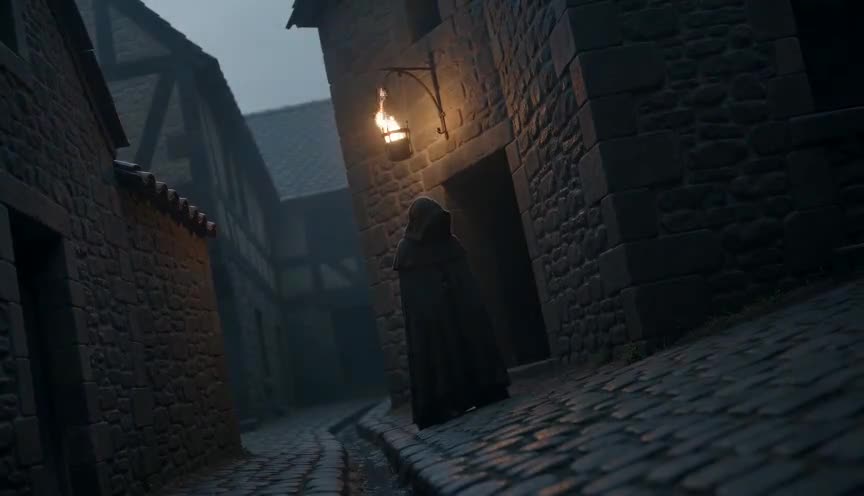
A Dutch angle is a static tilted frame held on one axis for the whole shot; camera roll is the motion of tilting or spinning through that axis, moving from level to skewed or all the way around.

A whip pan swings the camera rapidly left or right around its vertical axis to jump between subjects; camera roll spins around the lens's depth axis, tipping the horizon rather than reframing to a new subject.
In film
Inception (2010)
In the rotating hallway fight, the camera rolls with the corridor as Arthur and the projections tumble across walls and ceiling, making gravity feel unstable.
The Dark Knight (2008)
During the practical semi truck flip, a camera mounted to the vehicle rolls with the cab, spinning the horizon as the truck somersaults.
The prompt
Name the axis explicitly: say the camera rolls around its own lens axis, not that it pans or tilts, and state how far it turns (90, 180, or a full 360 degrees) and over how many seconds. Anchor one element, usually the subject, as staying centered and sharp so the model has a fixed point to spin around. Avoid vague words like dynamic camera or spinning shot, which models often render as an orbit around the subject instead of a roll of the frame itself.
The exact prompt that rendered the video on this page. Keep the description of the move, change the subject and the setting.
Camera roll: in a sunlit ballet rehearsal room with mirrored walls and a wooden barre, a lone dancer in a gray leotard spins en pointe at the center of the frame. The camera, mounted on a rotating gimbal, rolls a full 360 degrees around its own lens axis over two seconds, tilting the horizon line completely upside down and back while the dancer remains centered and in sharp focus. The mirrors and barre swing wildly around the frame's edges. No text.
Common mistakes
Confusing roll with orbit
Describing the movement as the camera circling the subject produces an orbit shot instead of a roll; the frame itself, not the camera's position, must rotate around the lens axis.
Rolling too fast to read
A full rotation completed in under half a second turns into an unreadable blur; most usable rolls need at least 1 to 2 seconds to register as a spin rather than a glitch.
Letting the subject drift off center
If the anchor point is not specified, the model often lets the subject slide out of frame during the spin, defeating the point of a fixed reference amid the chaos.
Frequently asked questions
What is a camera roll in film?
A camera roll is a shot where the camera rotates around its own lens axis, tipping the horizon line while the subject stays put in the frame. It creates the sensation of the world spinning rather than the camera simply changing its viewpoint.
How is camera roll different from a Dutch angle?
A Dutch angle is a fixed tilted frame held for the length of a shot, while a camera roll is the movement of getting there, or spinning all the way through and back to level. Many Dutch angle shots begin or end with a brief roll.
How long should a camera roll last?
Most usable rolls run 1 to 3 seconds for a partial turn and up to 3 or 4 seconds for a full 360-degree rotation. Faster spins tend to blur into an unreadable smear rather than a legible disorientation.
Can AI video models generate a camera roll shot?
Yes, models such as those on Imaginode can render a camera roll when the prompt names the lens axis explicitly and gives a rotation amount and duration, along with a centered subject to anchor the spin.