Whip pan
Also calledswish pan, flick pan, zip pan
A whip pan is a very fast horizontal pan, swung so quickly that the image blurs into streaks between two points. It jolts the viewer's eye, compressing travel time and signaling a sudden shift in attention or location.
What it tells
Directors reach for the whip pan when they want energy without cutting away, or when they want a cut that feels like a gasp. The blur mimics how a human head snaps toward a sound or a threat, so it reads as instinctive, not staged. It also collapses distance in one gesture, letting a scene jump from one character's reaction to another's action without breaking momentum. Comedies use it for punchlines, action films for quick reveals, westerns for the moment two rivals notice each other.
How it is shot
The operator whips the pan handle or gimbal yaw axis through 60 to 180 degrees in well under half a second, fast enough that motion blur erases most detail in the middle of the move. A wide to normal lens (18mm to 35mm) helps keep both start and end points recognizable despite the blur; longer lenses blur too aggressively and lose the destination. Shutter speed stays at a normal 1/48 or 1/50 for film-style streaking rather than strobing. On a tripod with a fluid head, the drag is loosened; on a gimbal or Steadicam, the operator rotates the whole rig. Two whip pans are often cut together at the peak blur, hiding the edit inside the streak.
When to use it
- To jump between two characters or actions in the same space without a formal cut.
- To land a comedic punchline the instant a character notices something absurd.
- To convey a sudden alarm, gunshot, or shout that yanks every head toward one direction.
- To hide a scene transition inside the blur, disguising a jump in location or time.
Not to be confused with
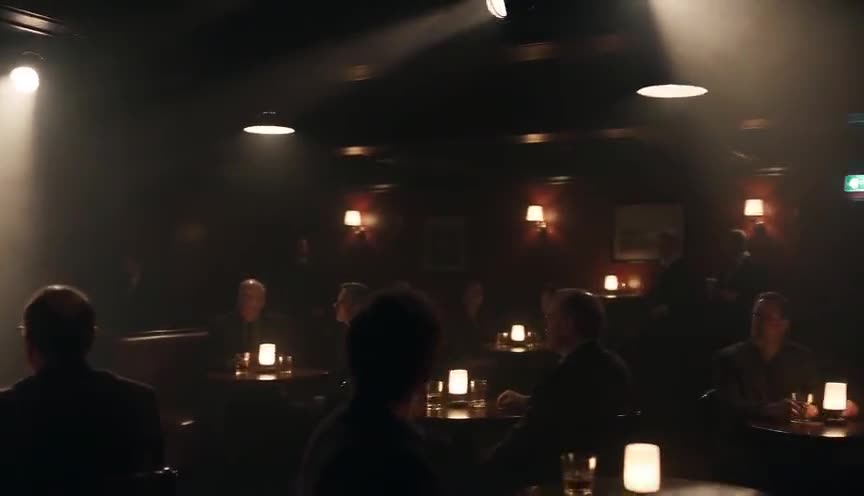
A standard pan turns smoothly and stays legible throughout, used to reveal or follow. A whip pan turns so fast the image blurs, sacrificing legibility for shock or speed; it reads as a jolt rather than a reveal.
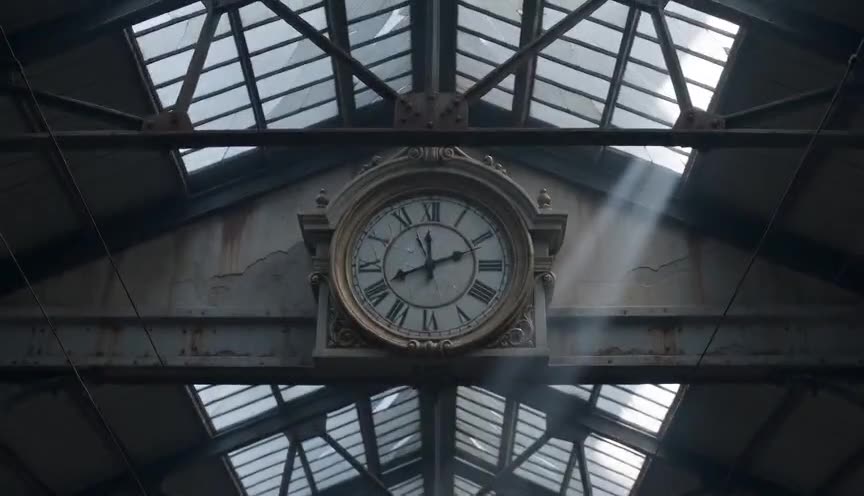
A whip tilt whips the camera vertically instead of horizontally, snapping from a face down to feet or up to a ceiling. Both share the same blur logic, but the whip pan moves attention sideways across a space instead of up and down.
In film
Kill Bill: Vol. 1 (2003)
Tarantino repeats fast whip pans between fighters as an homage to 1970s martial arts films, giving the editing a raw, kinetic pulse.
Shaun of the Dead (2004)
Edgar Wright uses whip pan transitions in comic montages, snapping between daily routines and locations while turning mundane actions into kinetic visual jokes.
The prompt
Name the move explicitly: 'fast whip pan' or 'camera snaps hard from A to B,' and give exact start and end subjects so the model knows what to blur between. Specify strong motion blur or streaking during the turn, and state that the camera holds still and sharp before and after the whip. Avoid vague words like 'quick pan' alone, they often render as a slow, smooth drift. Keep the rest of the scene static so the blur reads as camera motion, not subject motion.
The exact prompt that rendered the video on this page. Keep the description of the move, change the subject and the setting.
Whip pan across a rainforest river at midday. The camera starts locked on a weathered wooden canoe drifting near the near bank, holds steady and sharp for half a second, then snaps horizontally to the right in a fast blur, streaking the green canopy and brown water into motion lines, and lands sharply on a barefoot guide standing on a moss covered rock pointing downstream. The whip takes under half a second, the frame is crisp before and after the blur, water keeps flowing at normal speed, no camera shake once it settles. No text.
Common mistakes
Too slow a swing
Panning at normal speed and calling it a whip pan; without near instant rotation and blur, it just looks like an ordinary pan with no jolt.
Losing both endpoints
Using too long a lens or too extreme an angle change so neither the start nor end frame reads clearly, leaving the audience lost rather than surprised.
Shaky landing
Letting the camera keep drifting or wobbling after the whip instead of snapping to a rock steady stop, which kills the punch of the move.
Frequently asked questions
What is a whip pan?
A whip pan is a camera pan swung so fast, often in a fraction of a second, that the image blurs into streaks. It is used to jolt attention, jump between subjects, or hide a scene transition inside the blur.
How fast should a whip pan be?
Most whip pans complete their rotation in under half a second. The exact speed depends on the angle covered, but the key is that the middle of the move is unreadable blur while both ends stay sharp.
Can AI video models do a whip pan?
Yes, if you describe the camera motion, blur, and both endpoints explicitly rather than just saying 'fast pan.' Tools like Imaginode respond well to clear start and end subjects plus an explicit mention of motion blur.
What's the difference between a whip pan and a crash zoom?
A whip pan rotates the camera horizontally to blur between two points in space. A crash zoom stays pointed at one subject and rapidly changes focal length, punching the viewer closer without any lateral motion.