Lead room
Also calledLeading space, Look space, Nose room
Lead room is the empty space left in front of a subject on the side they are moving toward or looking at, rather than behind them. It reads to the eye as room to move or think, so the frame feels balanced instead of cramped.
What it tells
Directors use lead room because the eye reads open space as a promise: the subject has somewhere to go, or something to look at, and the frame lets us anticipate it with them. Crowding a moving subject against the frame edge feels abrupt and airless, almost accidental. Correct lead room keeps a walking, driving or glancing character comfortable in the shot, which lets the audience settle into the motion instead of noticing the composition at all.
How it is shot
The operator places the subject on one third of the frame, typically using the rule of thirds, and leaves the opposite third open in the direction of travel or gaze. As the subject moves, the camera pans, trucks or tracks at a matching speed so the gap ahead of them stays roughly constant rather than shrinking or vanishing. On a pan-tilt head this means riding the pan smoothly, often with framing marks taped to a monitor as a guide. For a static composition, the framing is simply locked with the offset built in from the first frame, checked against the lens focal length since a wider lens needs proportionally more lead space to read correctly.
When to use it
- Framing a character walking, running or driving toward an off-frame destination or goal
- Composing a profile shot of someone looking or speaking toward one side of the frame
- Tracking a moving vehicle, animal or crowd across the shot at a steady pace
- Setting up a two-shot where one person's attention pulls toward the empty side
Not to be confused with

Headroom is the vertical gap above a subject's head; lead room is the horizontal gap in the direction of movement or gaze. Both are framing offsets, but they solve different edges of the frame.
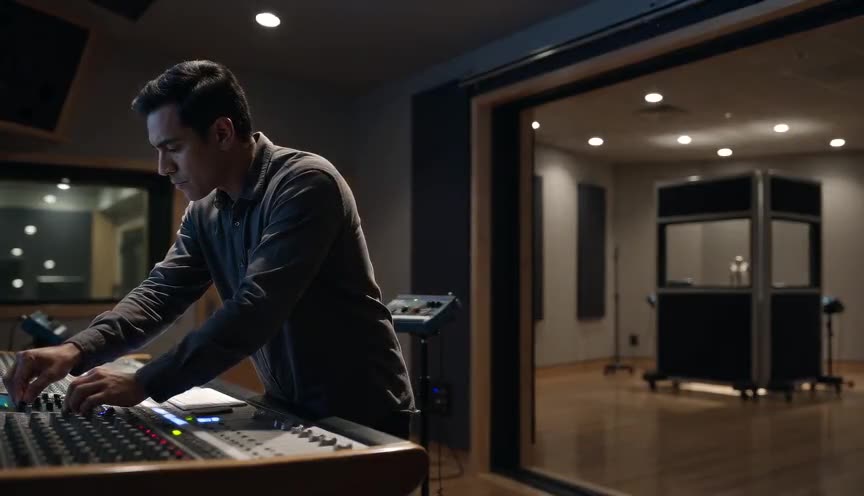
Short-siding deliberately removes lead room, crowding the subject against the frame edge they are facing to create tension or unease, the opposite intent of a comfortable, open lead room composition.
In film
Drive (2011)
Driving shots keep open frame space ahead of the car as it moves, sustaining forward momentum and a quiet, coiled tension.
Mad Max: Fury Road (2015)
Vehicle chase compositions frequently leave readable desert space in the direction of travel, helping speed, pursuit lines, and screen direction remain clear.
The prompt
Name the direction explicitly: state which third of the frame the subject occupies and which side stays empty, and tie it to the subject's motion or gaze so the model understands why the space exists. Describe the camera's job plainly, panning or tracking at the same speed as the subject so the gap holds steady, rather than just saying 'lead room,' which most models will not parse as a framing instruction. Avoid crowding the description with unrelated camera moves that fight the steady offset.
The exact prompt that rendered the video on this page. Keep the description of the move, change the subject and the setting.
Lead room: at a fishing harbor at dawn, a middle-aged woman in a rubber apron and boots walks steadily along a wooden dock toward a moored trawler, framed in the left third of the shot on a 35mm lens with open, empty space ahead of her on the right. As she walks rightward at a steady pace, the camera pans slowly at the same speed, keeping that empty space constant so she never nears the frame edge. Soft blue-hour light, still water, boats silhouetted in the background. No text.
Common mistakes
Letting the gap close
Panning slower than the subject's walk or drive lets them creep toward the frame edge, undoing the lead room and making the shot feel like a mistake rather than a choice.
Reversing sides on the cut
Cutting from a shot with lead room on the right to one with lead room on the left, without a clear turn or reveal, disorients the audience about which way the subject is heading.
Applying it to a static subject
Giving lead room to someone standing still with no gaze direction just looks like bad centering, since the empty space has nothing to justify it.
Frequently asked questions
What is lead room?
Lead room is the empty space left in front of a subject who is moving or looking toward one side of the frame, rather than behind them. It gives the motion or gaze somewhere to go and keeps the composition from feeling cramped.
How much lead room should I leave?
There is no fixed number, but a common guide is enough space that the subject's leading edge sits roughly on the frame's one-third line, with adjustment for lens width: wider lenses generally need a bit more room to read comfortably.
Is lead room the same as headroom?
No. Headroom is the vertical space above a subject's head, while lead room is the horizontal space ahead of their movement or gaze. A shot can need one, both, or neither depending on the subject's pose and action.
Can AI video tools generate lead room automatically?
Not reliably. Describe the subject's position in the frame, the direction they are facing or moving, and the empty space on that side explicitly in the prompt. Tools like Imaginode respond better to that spelled-out framing than to the term itself.