Pass-through shot
Also calledthrough shot, occlusion transition, obstruction wipe, reveal-through shot
A pass-through shot is a moving camera shot in which the lens travels through or past an obstruction, a doorway, a crowd, foliage, a passing vehicle, that briefly fills the entire frame and blocks the view, then reveals a new space on the other side. It hides a spatial or temporal jump inside one continuous move, so the transition feels seamless instead of cut.
What it tells
Directors reach for this move when they want to compress time or travel between spaces without breaking the spell of continuity. The brief blackout or blur reads as a heartbeat, a breath, a hidden edit, and the audience never consciously registers the jump. It gives a scene forward momentum, turns a hallway or a market alley into a piece of narrative machinery, and lets the filmmaker skip the boring parts of a journey while keeping the illusion of one unbroken shot.
How it is shot
The camera, usually on a Steadicam, gimbal or dolly, moves toward an object large enough to fill the frame edge to edge, a curtain, a wall corner, a passing truck, a cluster of extras. As the object crosses the lens, the operator keeps moving at a constant speed so the occlusion lasts only a fraction of a second, often 4 to 8 frames. Behind the scenes, this moment can hide a cut, a set change, a costume swap, or a jump forward in time, since the audience's eye has nothing to read during the blackout. A wide to medium lens, 24mm to 35mm, keeps the foreground object readable while it fills frame, and a steady, unhurried pace sells the illusion.
When to use it
- Compressing a character's journey through a crowded space into one unbroken visual beat
- Hiding a set change or time jump inside a single continuous camera move
- Building momentum as a character walks through a market, backstage area or corridor
- Transitioning between two scenes without cutting to black or using a dissolve
Not to be confused with
An invisible cut hides an edit anywhere in the frame using motion or matching action, while a pass-through specifically uses a foreground obstruction crossing the lens to mask the jump.
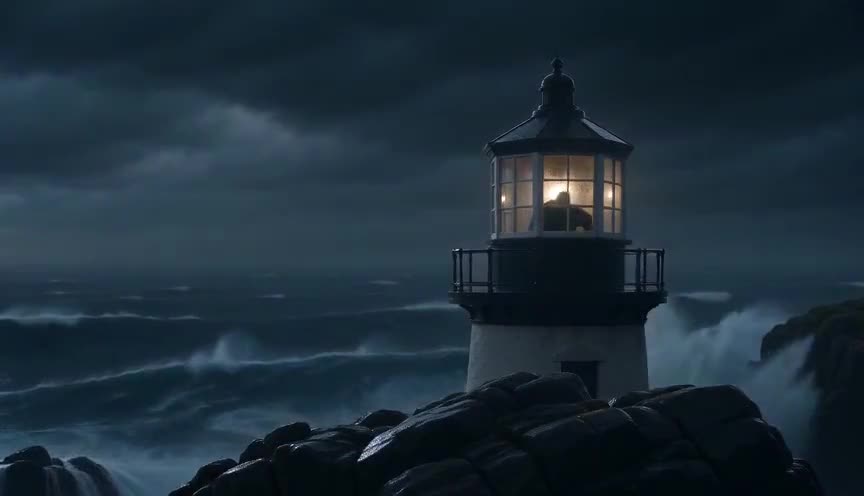
Match on action cuts between two shots on a continuing movement across an edit point, whereas a pass-through stays in one camera move and uses an object, not a cut, to bridge the change.
In film
1917 (2019)
The film's simulated single take repeatedly pushes the camera through trench walls, doorways and smoke to disguise hidden cuts and time compression.
Birdman (2014)
The camera weaves through theater hallways and crowds, passing behind walls and bodies at points that conceal invisible edits between shooting days.
The prompt
Name the obstruction explicitly, a curtain, a food stall's steam, a signboard, a cluster of people, since the model needs a physical object to move through, not just a blur. Specify a constant camera speed before and after the occlusion so the reveal reads as one move, and mention the lens (24mm to 35mm) to keep depth readable. Avoid vague words like 'transition' or 'cut to', describe the physical crossing instead, and keep the destination space visually distinct from the starting point so the reveal has payoff.
The exact prompt that rendered the video on this page. Keep the description of the move, change the subject and the setting.
Pass-through shot: the camera moves forward at a steady walking pace through a crowded night market alley in Taipei, passing directly through a hanging curtain of red paper lanterns and steam rising from a food stall that fully fills and blocks the lens for a half second, then the view opens onto a vendor grilling skewers under neon signs, the camera continuing forward without a cut, handheld but stabilized, 35mm lens, warm tungsten light, background crowd walking naturally. No text.
Common mistakes
Obstruction too thin
If the object crossing the lens does not fully fill the frame, the audience sees through the gap and the hidden cut or change becomes obvious instead of invisible.
Speed mismatch after the reveal
Changing the camera's speed or direction right after the occlusion breaks the illusion of one continuous move and calls attention to the trick.
Mismatched light or geometry on reveal
If the space behind the obstruction has a jarringly different color temperature or scale than expected, the seam shows even if the motion is smooth.
Frequently asked questions
What is a pass-through shot?
It is a moving camera shot where the lens travels through or past something that briefly blocks the frame entirely, then reveals a new space, often used to hide a cut or a time jump inside what looks like one continuous move.
Why do filmmakers use a pass-through shot instead of a normal cut?
It keeps the sense of unbroken continuity and momentum, letting a scene feel like one fluid journey rather than a series of separate shots, which strengthens immersion in long takes and chase scenes.
What equipment do you need for a pass-through shot?
A Steadicam, gimbal or smooth dolly track works best, since the operator needs to hold a constant speed through the occlusion; handheld can work for shorter, rougher versions in documentary style footage.
Can AI video generators create a convincing pass-through shot?
Yes, tools like the ones on Imaginode can render this if you describe the obstruction, the constant camera speed, and the destination space clearly, since the model needs explicit physical detail to sell the reveal.