Diagonal composition
Also calleddiagonal lines, diagonal framing, oblique composition
Diagonal composition arranges the strongest lines of a shot, a road, a staircase, a body, so they cross the frame at an angle rather than running horizontally or vertically. It injects energy and instability into an image, pulling the eye through the frame and signaling movement, imbalance or tension.
What it tells
Horizontal and vertical lines feel stable, at rest. A diagonal breaks that calm: it suggests a fall, a rise, a rush forward, or a world tilting off its footing. Directors reach for diagonals when a scene needs urgency, conflict or physical momentum, a chase, a confrontation, a character losing their balance in the story. Because the eye naturally follows a slanted line, it also works as a quiet way to steer attention toward a face, a door or a weapon without the audience noticing they were guided.
How it is shot
You build a diagonal by aligning an existing line, a road, a beam, a shoreline, a staircase, so it enters one corner of the frame and exits the opposite one, rather than sitting parallel to the frame edges. On set this often means repositioning the camera a few degrees off the obvious eye-level angle, choosing a lens between 24mm and 50mm so the line reads clearly without extreme distortion, and framing during blocking rehearsals so actors' bodies or props extend the line rather than break it. A wider aperture can soften the background so the diagonal itself, not clutter, carries the eye. In CG or AI generated shots, the same result comes from specifying the exact corners the line should touch and keeping the camera locked so the geometry stays legible for the full shot.
When to use it
- A character or vehicle needs to feel unstable, off balance or moving with urgency through the frame
- A landscape or architectural line, a road, a staircase, a fence, can be angled to add energy to an otherwise static wide shot
- You want to guide the eye toward a specific point in the frame without an obvious camera move
- A confrontation or power struggle between two characters benefits from visual tension instead of calm symmetry
Not to be confused with

A diagonal is a single slanted line pulling the eye through the frame, while triangular composition arranges three points into a stable shape. Triangles calm an image; diagonals unsettle it.
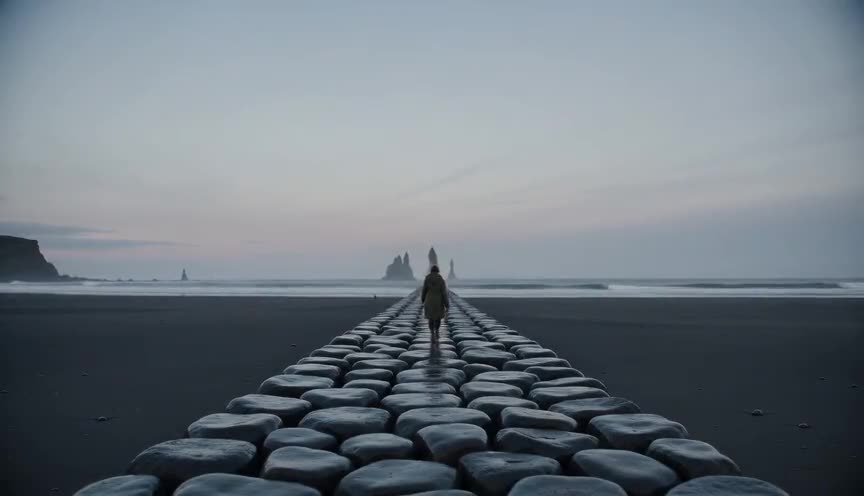
Leading lines is the broader technique of using any line to guide the eye toward a subject. Diagonal composition is one specific, high-energy version of that idea, chosen for tension rather than calm guidance.
In film
The Third Man (1949)
Carol Reed leans doorframes, staircases and shadows into steep diagonals to make postwar Vienna feel crooked and untrustworthy.
Citizen Kane (1941)
Gregg Toland's deep-focus frames repeatedly use diagonal staircases and ceilings to exaggerate scale and power between characters.
The prompt
Name the diagonal explicitly and describe which two corners the line connects, for example bottom left to top right, since AI models otherwise default to centered or horizontal framing. Mention the object that carries the line (a row of trees, a staircase, a road) and keep the camera locked or slow so the model does not drift back to a symmetrical composition mid shot. Avoid vague words like dynamic angle; describe the physical geometry instead, and specify that any movement in the shot stays aligned with the diagonal.
The exact prompt that rendered the video on this page. Keep the description of the move, change the subject and the setting.
Diagonal composition: a wide static shot of a vineyard in autumn, rows of grapevines cutting sharply from the bottom left corner of the frame to the top right corner, golden late afternoon light raking across the orange and rust colored leaves. A worker in a dark green jacket walks along the diagonal row, moving from close to the camera toward the vanishing point, staying aligned with the diagonal line the entire time. The camera does not pan, tilt or zoom, holding the frame locked so the diagonal geometry of the vine rows stays constant while only the worker's motion changes. No text.
Common mistakes
Line too subtle
A diagonal angled only 5 to 10 degrees from horizontal reads as a mistake, not a choice. Push the angle enough that the eye clearly registers a slant.
Competing diagonals
Two or three unrelated diagonal lines fighting in the same frame cancel each other out and confuse the read. Pick one dominant line and subordinate everything else to it.
No anchor point
A diagonal that runs off both frame edges with nothing at either end feels aimless. Give it a subject, a face, a door, a horizon point, where the eye can land.
Frequently asked questions
What is diagonal composition?
It is a framing choice where the dominant line of the image, a road, a body, a staircase, crosses the frame at an angle instead of running parallel to its edges. This creates a feeling of energy, movement or imbalance rather than the calm of horizontal or vertical lines.
Why do diagonals feel more dynamic than horizontal lines?
The eye reads horizontal and vertical lines as stable and at rest, matching gravity and the horizon. A diagonal breaks that expectation, so the brain reads it as motion or instability even in a still frame.
Can diagonal composition be combined with a Dutch angle?
Yes, and they often reinforce each other: a Dutch angle tilts the whole camera, which can turn an existing horizontal or vertical line into a diagonal, or exaggerate an already diagonal element in the scene.
How do I get diagonal composition from an AI video tool like Imaginode?
Describe the exact line and which two frame corners it connects, name the object that forms it, and specify that the camera stays locked so the model does not drift toward a centered, symmetrical frame partway through the clip.