Frame within a frame
Also calledFraming device, Internal frame, Natural frame
Frame within a frame is a composition technique where an element inside the scene, such as a doorway, window, arch or mirror, encloses the subject in a secondary border. It isolates the subject, adds depth, and can suggest confinement, observation or a story told within a story.
What it tells
Directors reach for a frame within a frame when they want the composition itself to carry meaning. A character boxed by a doorway can feel trapped, watched or set apart from the world around them, without a line of dialogue. The device also builds depth on a flat screen, separating foreground architecture from the subject and the background beyond. Used across a scene, it can turn ordinary rooms into a study of isolation, surveillance or memory, letting the set design do dramatic work that the actor and dialogue do not have to carry alone.
How it is shot
On set, the crew looks for an existing architectural frame: a doorway, window, arch, mirror, or even foliage, and positions the camera so that frame sits inside the outer edges of the shot. A wide or normal lens (24mm to 50mm) usually keeps enough of the frame in focus to read as a border, though a longer lens can compress it tighter around the subject. Depth of field matters: keeping the inner frame and subject sharp while letting the space beyond fall soft, or vice versa, strengthens the sense of layers. Lighting often separates the planes further, with the frame darker or brighter than the subject. The camera can stay locked off or drift slowly, but the inner frame should stay legible throughout the move.
When to use it
- When you want a character to feel isolated, trapped or watched inside their own environment.
- When staging a scene in a location with strong architecture like doorways, arches or windows.
- When you need to add depth to a flat composition without moving the camera closer.
- When hinting at voyeurism, surveillance or a story observed from outside the main action.
Not to be confused with
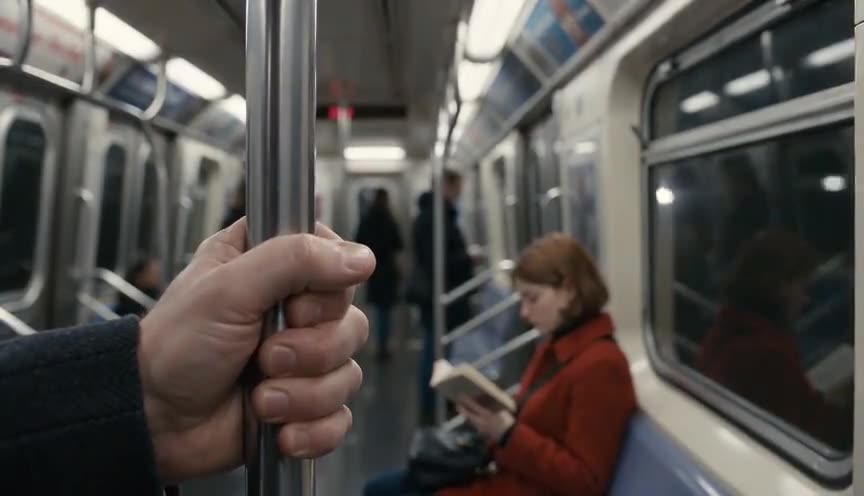
Layered depth arranges foreground, midground and background elements to build depth generally, while frame within a frame specifically uses an architectural border to enclose the subject inside a secondary frame.
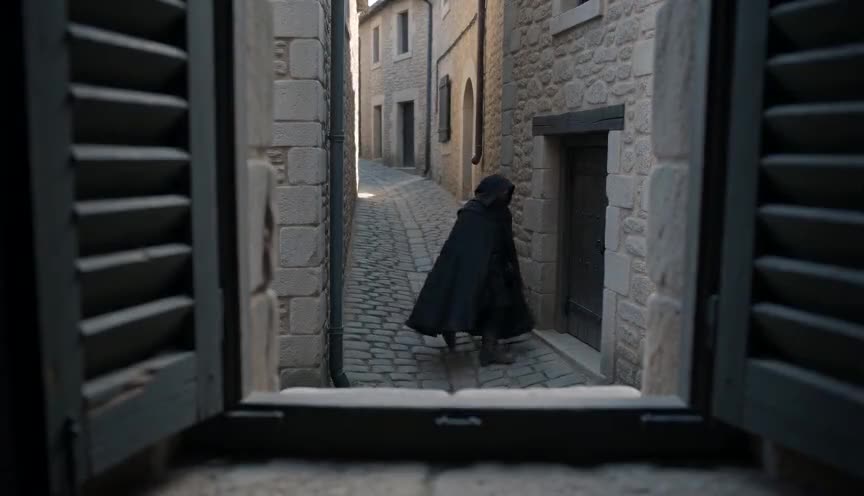
A voyeur shot implies a hidden or unseen observer watching the subject, often through a gap or opening, while frame within a frame is a broader compositional tool that does not always suggest someone is watching.
In film
Citizen Kane (1941)
Gregg Toland frames Kane through doorways and windows in deep-focus compositions that box him within the shot and mirror his isolation.
The Godfather (1972)
The famous final shot frames Kay through a doorway that closes on her, using the internal frame to confirm her exclusion from Michael's world.
The prompt
Name the inner frame explicitly (a doorway, window, arch or mirror) and place the subject inside it, then describe what lies beyond in a second layer of depth. State the lens (a 35mm or 50mm lens) and whether both frame and subject stay in focus or only one does. Avoid vague words like 'framed nicely'; instead describe the physical object doing the framing and its distance from camera. Keep the camera mostly static or slow-moving so the inner frame stays legible for the full four seconds.
The exact prompt that rendered the video on this page. Keep the description of the move, change the subject and the setting.
Frame within a frame: a static camera looks through a tall arched doorway of a Victorian library, the dark wooden arch filling the outer edges of the frame while a scholar in a tweed coat stands beyond it at a reading desk lit by a single brass lamp. The 50mm lens holds both the archway and the scholar in sharp focus, with rows of leather bound books receding into soft shadow behind him. Warm lamplight glows inside the doorway while the arch itself stays in cool shadow, deepening the sense of looking into another space. The camera holds perfectly still for the full shot. No text.
Common mistakes
Frame too shallow
Cropping the inner frame so tight that it fills the whole shot removes the outer layer and the depth effect disappears entirely.
Losing the border
Letting focus fall only on the subject and blurring the inner frame into an unreadable smear defeats the purpose of the device.
No motivation
Using a doorway or window purely for style without any reason tied to isolation, observation or story makes the shot feel decorative rather than meaningful.
Frequently asked questions
What is frame within a frame?
It is a composition technique that uses an element inside the scene, like a doorway, window or mirror, to create a border around the subject, adding depth and often a sense of isolation or observation.
Why do directors use frame within a frame so often in doorway shots?
Doorways and windows are everywhere on real sets, so they let filmmakers box a character and suggest confinement or distance without building anything extra.
Does frame within a frame require a specific lens?
No, but wider lenses like 24mm to 50mm generally keep more of the inner frame in focus, which helps the border stay legible against the subject and background.
Can AI video tools generate a frame within a frame shot?
Yes. Tools on Imaginode such as Seedance, Kling, Veo, Wan or Grok Imagine can render it if you name the inner frame object explicitly and describe the depth layers, since the model needs concrete physical detail rather than the term alone.