Aspect ratio switch
Also calledratio change, frame shape shift, letterbox switch
An aspect ratio switch is a change in the width-to-height shape of the frame during a single film or scene, moving for example from a wide 2.39:1 image to a boxier 4:3 or square 1:1 frame. It resets the viewer's sense of space and time, signaling a shift into memory, a different era, or a different emotional register without a line of dialogue.
What it tells
Directors reach for an aspect ratio switch when they need the frame itself to carry a change of state: past versus present, confined versus free, subjective versus objective. Because audiences read the shape of the image almost subconsciously, narrowing or widening it does emotional work that dialogue cannot. A boxed-in ratio can feel like a memory or a trap, while an expansion into widescreen can feel like release. It marks a turning point structurally, inside the image itself, rather than through a cut or a caption.
How it is shot
In camera, this is set by choosing a sensor mode or ground glass mask matched to the target ratio, then masking the extra image area with black bars, either baked into the recorded frame or added as a hard matte in post. Many productions shoot open-gate and reframe in the DI, animating the matte over one or two seconds or holding it as a hard cut between scenes. Timing carries the meaning: a slow slide of the bars feels like a breath, an instant snap reads as a jolt. The image inside the new ratio needs to be reframed and relit if necessary, since a 4:3 crop pulls tighter than a 2.39:1 frame and changes what sits at the edges of the shot.
When to use it
- Marking a jump between two time periods or eras within the same story, without a scene break.
- Signaling a character's subjective state, memory, dream, or breakdown by boxing in the frame.
- Revealing a shift from confinement to freedom, such as a character leaving a small room for open space.
- Distinguishing archival, found, or in-story footage from the main narrative's native frame shape.
Not to be confused with
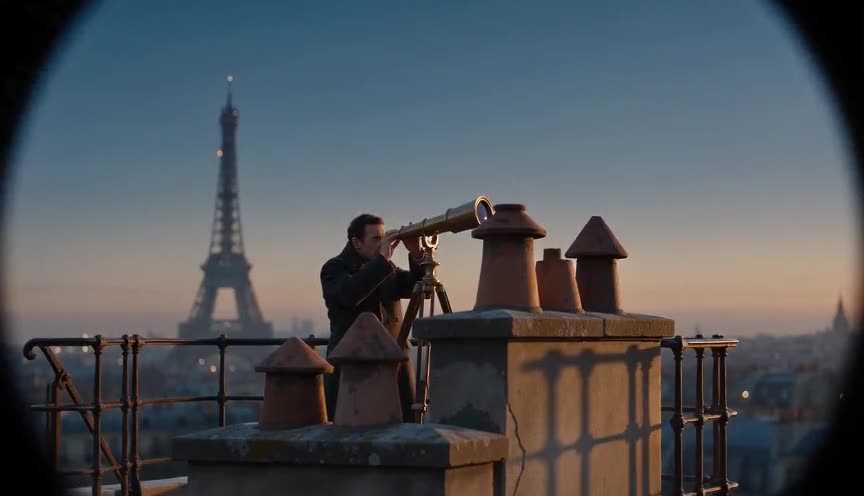
An iris transition uses a circular mask that opens or closes to move between scenes, while an aspect ratio switch changes the outer rectangle of the frame itself and can stay within one continuous shot.

A vignette darkens or softens the corners of a fixed frame, while an aspect ratio switch physically changes the frame's dimensions, adding or removing bars rather than shading the existing edges.
In film
The Grand Budapest Hotel (2014)
Wes Anderson assigns a different aspect ratio to each timeline, 1.37:1, 1.85:1, and 2.35:1, so the frame itself tells the audience which era it is in.
Mommy (2014)
Xavier Dolan shoots the film in a boxed 1:1 square and briefly widens it to full frame at a moment of hope, then closes it back down.
The prompt
Name the exact ratios involved, such as 4:3 to 2.39:1, and describe the bars as physical objects that slide, snap, or fade, since vague words like cinematic framing get ignored. State the timing in seconds and whether the subject's motion continues unchanged, so the model treats it as a frame event, not a scene cut. Avoid asking for multiple locations or a hard edit, since this is a single continuous shot with the mask changing inside it.
The exact prompt that rendered the video on this page. Keep the description of the move, change the subject and the setting.
Aspect ratio switch: a static camera holds a bakery counter at 5 am, warm tungsten light on a middle-aged baker dusting flour over dough, the frame boxed into a tight 4:3 with black bars on both sides. Two seconds in, the bars slide outward smoothly and evenly, widening the image to a full 2.39:1 frame that reveals the ovens, hanging trays, and steam drifting behind him. The baker's motion stays continuous and unchanged, only the frame's shape changes, in one unbroken shot. No text.
Common mistakes
Cutting instead of shifting
Using a hard cut to change ratio when a smooth reveal is called for loses the felt sense of the frame itself opening up or closing in.
No story motivation
Switching ratio at a random moment without tying it to a time jump, memory, or emotional beat, so the audience reads it as a technical glitch.
Ignoring the reframe
Keeping the same composition after squeezing or widening the frame, which crops subjects awkwardly or leaves empty space where the old edges used to be.
Frequently asked questions
What is an aspect ratio switch?
It is a change in the frame's width-to-height shape during a film or scene, for example from wide 2.39:1 to boxy 4:3, used to mark a shift in time, memory, or emotional state without dialogue.
Is an aspect ratio switch the same as letterboxing?
No. Letterboxing is a fixed presentation choice for the whole film, while an aspect ratio switch actively changes shape partway through, often more than once, to signal something happening in the story.
How long should the ratio change take on screen?
It depends on the intent: a slow slide over one or two seconds feels gentle, closer to a breath, while an instant snap feels abrupt and is often used for shock or comedy.
Can an AI video model generate an aspect ratio switch in one shot?
Yes, on platforms like Imaginode you can describe the starting ratio, the ending ratio, and how the bars move, and the model will render it as one continuous take rather than a cut between two clips.