Iris transition
Also callediris in, iris out, iris wipe
An iris transition is a scene change in which a circular or shaped mask closes down to a single point to end a shot, or opens outward from a point to begin one. It narrows the viewer's attention to one exact detail in the frame and marks the start or end of a scene with a soft, theatrical punctuation instead of a straight cut.
What it tells
Directors reach for the iris when a scene needs a wink of nostalgia, a fairy-tale close, or a moment of pure focus before the story moves on. Because the mask narrows to one point, it works like a spotlight, telling the audience exactly what to remember before the image disappears. Silent-film directors used it to end comedic beats and irises out on a punchline; Kurosawa used it to compress time between scenes. Today it signals old-world charm, chapter breaks, or a deliberately theatrical, storybook tone rather than a neutral transition.
How it is shot
Classically the iris was cut in-camera with an adjustable metal diaphragm called an iris vignetter mounted in front of the lens, closed by hand during the shot so the image shrank to a circle of light on the negative. Today it is built in post: a round or custom-shaped mask (matte) is keyframed from a single point to full frame, or the reverse, over roughly 0.5 to 2 seconds, with the edge softened 2 to 5 percent of the frame width to avoid a hard, digital line. The center point is chosen deliberately, an eye, a doorway, a prop, so the mask always closes or opens on the detail that carries the story. Everything outside the mask reads as solid black.
When to use it
- Ending a comedic or sentimental beat on one specific detail, the way silent comedies closed a scene.
- Opening a flashback or storybook segment to signal a shift into memory or fable.
- Compressing a scene change quickly, closing on one actor's eyes before the next scene opens elsewhere.
- Giving a period piece, a silent-film homage or a wedding video a nostalgic, old-fashioned chapter break.
Not to be confused with
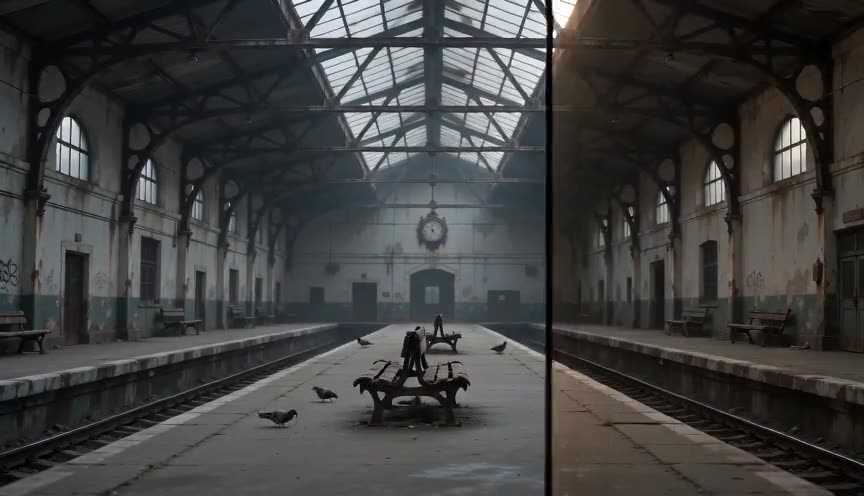
A wipe pushes one image off the frame with a moving edge, usually a line or shape sweeping across the screen; an iris always shrinks or grows from a single point and keeps the viewer's eye centered rather than sliding sideways.
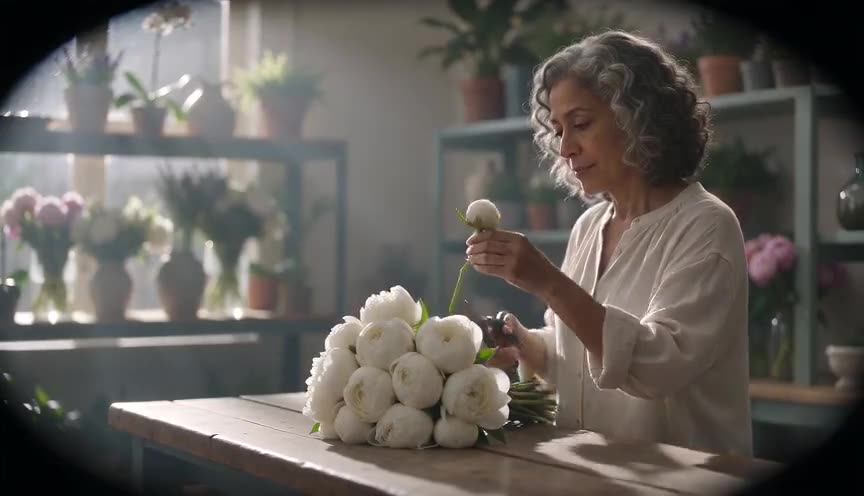
A vignette darkens the corners of a single continuous shot without ever fully closing to black; an iris is a transition between two shots, deliberately closing all the way down or opening all the way out.
In film
The Kid (1921)
Charlie Chaplin closes several comedic scenes with an iris-out centered on a single character, a hallmark of silent-era editing grammar.
Modern Times (1936)
The final road image closes with an iris-out around the Tramp and the Gamin, reviving silent-era punctuation for Chaplin’s closing image.
The prompt
Name the shape ('perfect circle', 'iris') and the motion ('opens from a point', 'closes to a point') explicitly, since models default to a simple cut or dissolve otherwise. State the timing in seconds and what fills the space outside the mask (solid black works best). Anchor the closing or opening point on a specific detail, an eye, an object, a face, so the mask has a clear target instead of drifting to the frame center by default. Avoid the word 'zoom', it reads as a camera move, not a mask.
The exact prompt that rendered the video on this page. Keep the description of the move, change the subject and the setting.
Iris transition on a Parisian rooftop at dusk: the frame begins fully black, then a perfect circular mask opens from the center over 1 second, revealing a wide static shot of a man in a wool coat adjusting an antique telescope among terracotta chimney pots, the Eiffel Tower faint in the haze behind him. The circle keeps widening until it fills the entire 16:9 frame by the second mark. After a brief hold, the same circular mask closes back down, shrinking steadily onto his eye at the telescope, the picture darkening to solid black by the final frame. No text.
Common mistakes
Calling it a zoom
An iris changes only the visible mask, the lens and framing never move; prompts that say 'zoom in' will trigger camera movement instead of a mask reveal.
No target point
Without naming the exact spot the circle closes on or opens from, the mask defaults to dead center and misses the story detail it should isolate.
Hard, jagged edge
A perfectly sharp mask edge looks like a video game reticle rather than an optical iris; describe a slightly soft or feathered edge instead.
Frequently asked questions
What is an iris transition?
It is an edit where a circular or shaped mask closes to a point to end a shot, or opens from a point to start one, focusing attention on a single detail while the rest of the frame turns black.
Why do old movies use the iris transition so much?
Early cameras and projectors made straight cuts feel abrupt, and the iris, borrowed from stage curtains and magic-lantern shows, gave silent films a familiar, theatrical way to open and close scenes.
Is the iris transition only for comedy or period films?
No. While it reads as vintage or storybook by default, it still works for any moment that needs a deliberate, centered close, a chapter break, a dream sequence, or a wedding highlight reel.
Can an AI video model generate an iris transition automatically?
Not reliably from a short prompt alone; on a platform like Imaginode you get the clearest result by explicitly naming the circular mask, its opening or closing motion, the timing, and the exact point it starts or ends on.