Shallow depth of field
Also calledShallow focus, Thin depth of field, Bokeh focus
Shallow depth of field is a focus technique that keeps the subject sharp while the foreground and background blur into soft shapes and light. It isolates what the viewer should look at and separates a person or object from a busy or distracting setting.
What it tells
Directors reach for shallow depth of field when they want the audience to feel close to a single person's experience, cutting away the noise of the world around them. The blur reads as intimacy, focus of mind, or emotional isolation, depending on what falls out of frame. It can make a crowded market feel like it belongs to one face, or turn a sterile hallway into a private, almost dreamlike space. Because it directs the eye without a cut or a move, it is one of the fastest ways to control attention inside a single shot.
How it is shot
Shallow depth of field comes from a wide aperture (f/1.4 to f/2.8), a longer focal length (50mm to 135mm), and distance between subject and background. Opening the iris lets less light pass but shrinks the zone of acceptable sharpness to inches or a few feet; a focus puller marks the subject's position and rides the lens ring to hold critical focus as they move. On set, the DP separates the subject from walls or set dressing by several feet so the background can melt into color and shape rather than resolve into detail. Fast primes, full-frame or larger sensors, and neutral density filters (to control exposure at wide apertures in bright light) are the standard tools, alongside a focus monitor for the puller to check sharpness in real time.
When to use it
- Isolating a character's face in a crowded or visually busy environment without moving the camera.
- Building intimacy in a dialogue scene by softening everything except the two speakers' eyes.
- Turning a cluttered set, like wires or equipment, into abstract color so it stops competing with the subject.
- Signaling a subjective, dreamlike or fevered state of mind through selective, narrow focus.
Not to be confused with
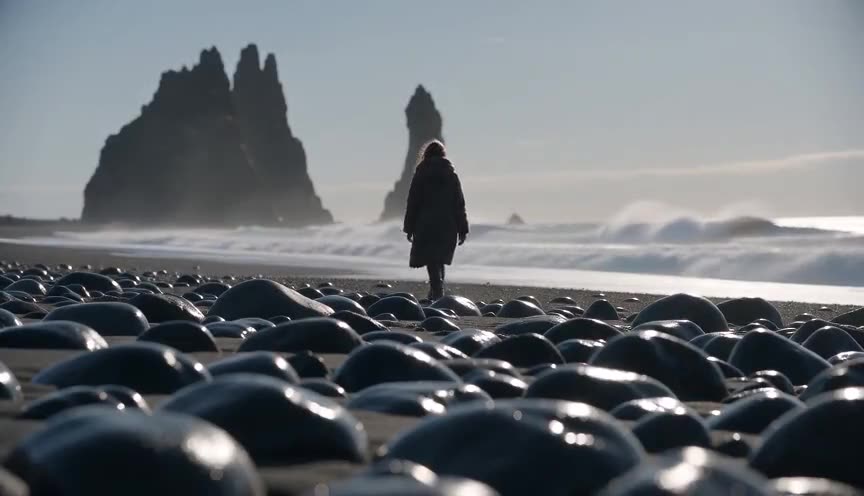
Deep focus keeps foreground, midground and background all sharp at once, the opposite goal of shallow depth of field, which isolates one plane and blurs the rest.

Bokeh describes the quality and shape of the out-of-focus light and highlights that shallow depth of field produces; shallow depth of field is the technique, bokeh is one of its visible results.
In film
Her (2013)
Uses shallow depth of field throughout to keep the protagonist sharp against warm, dissolved backgrounds, reinforcing his emotional isolation.
Drive (2011)
Frequently isolates the lead in shallow focus against smeared neon and streetlight bokeh, giving the character a detached, dreamlike quality.
The prompt
Name the lens and aperture explicitly (85mm at f/1.8, or wide open) and describe what should stay sharp versus what should melt into blur; AI models respond well to concrete distance cues like 'background four meters back turns into soft colored shapes.' Avoid vague words like 'blurry' alone, they can flatten the whole image instead of separating planes. Mention bokeh shape (circular, hexagonal) if it matters, and keep the subject's motion slow so the model does not lose focus tracking across frames.
The exact prompt that rendered the video on this page. Keep the description of the move, change the subject and the setting.
Shallow depth of field, an astronaut in a gray flight suit walks slowly toward the camera along a curved space station corridor, her face and shoulders held in sharp focus while the ribbed metal walls, blinking control panels and distant hatch dissolve into soft circular bokeh only a few feet behind her. The camera holds still at chest height on a locked tripod, framed with an 85mm lens wide open at f/1.4, cool blue-white overhead light skimming her cheekbones as she moves, background lights smearing into round glowing orbs. No text.
Common mistakes
Focus drift
The rack shifts off the subject mid-shot because the focus puller or AI model loses track of distance, leaving the face soft and the background sharp instead.
Too little separation
Placing the subject close to the wall or set dressing keeps everything in one focus plane, so the blur never appears even at a wide aperture.
Vague blur everywhere
Asking for 'blurry background' without specifying a focal length or aperture can make an AI model blur the whole frame, including the subject, instead of isolating one plane.
Frequently asked questions
What is shallow depth of field?
It is a focus technique where only a thin slice of the image, usually the subject, is sharp, while everything closer or farther away blurs into soft shapes. Photographers and cinematographers create it with a wide aperture, a longer lens, or distance between subject and background.
What aperture gives the shallowest depth of field?
Apertures around f/1.2 to f/2.8 on a fast prime lens produce the shallowest depth of field, especially on full-frame or larger sensors; the wider the iris opens, the thinner the zone of sharp focus becomes.
Can AI video generators produce shallow depth of field?
Yes, tools like the models available on Imaginode respond to explicit lens and aperture language (85mm, f/1.4, wide open) combined with a clear description of what stays sharp and what falls into blur behind or in front of the subject.
Does shallow depth of field work in wide shots too?
It is most visible in close-ups and medium shots where the subject fills more of the frame, but it can also separate a person from a distant background in a wide shot if the lens is long enough and the aperture wide enough.