Bullet time
Also calledTime slice, Matrix effect, Flo-Mo
Bullet time is a visual effect in which the action appears to freeze or slow to almost nothing while the camera keeps traveling around the subject, often completing a partial or full orbit. It drops the viewer inside a single suspended instant, letting them examine an impact, a gesture or a fall from angles a real-time camera could never reach.
What it tells
Directors reach for bullet time to isolate the one moment that matters and stretch it into an experience. It turns a punch, a bullet, a leap or a reveal into something the audience can walk around and study, giving the character an almost mythic power over time itself. Used sparingly, it marks a climax; the whole film slows down so this single instant can be seen properly.
How it is shot
Classic bullet time uses an array of dozens to hundreds of still or video cameras mounted in an arc or full circle around the subject, each firing a fraction of a second apart so their combined frames simulate one camera sweeping through frozen time. The subject either genuinely holds a pose or is captured at very high frame rate, then the sequence is slowed and interpolated in post to smooth the arc. Modern versions use a single camera on a motion-control or robotic arm making a fast pass, or full CG recreation of the environment, so the move can be repeated and refined without rebuilding a physical rig each time.
When to use it
- A single decisive action beat, like an impact or dodge, needs to be seen from every side.
- A character's power or control over a moment should feel superhuman or god-like.
- You want to reveal spatial detail around a subject that a normal pan or dolly would rush past.
- The story reaches a climax that justifies stopping everything else to study one instant.
Not to be confused with
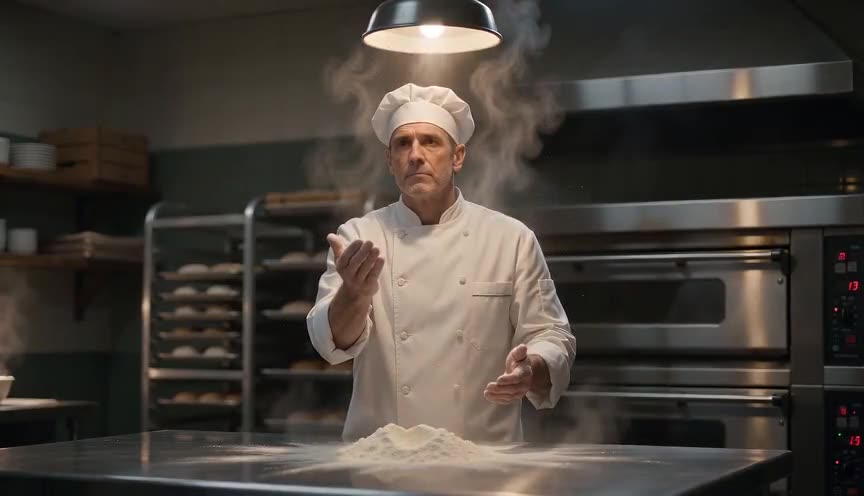
Freeze-frame stops both the action and the camera into one still image. Bullet time keeps the action frozen but the camera itself keeps traveling, so the frame still changes even though time does not.
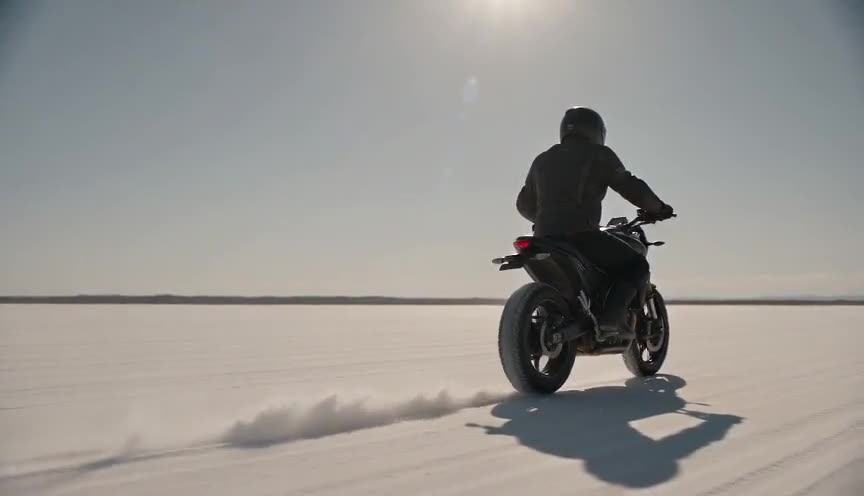
A speed ramp changes playback speed within a moving shot, easing from fast to slow or back, but time never fully stops. Bullet time simulates a true stop in time while the camera orbits through it.
In film
The Matrix (1999)
The rooftop dodge scene made bullet time famous, using a camera array to orbit Neo as he bends backward and bullets streak past him.
The Matrix Reloaded (2003)
Expanded the technique into 'Flo-Mo' during the burly brawl, blending virtual cinematography with CG doubles for longer, freer slow-motion orbits.
The prompt
Name the frozen instant explicitly: what pose, gesture or object is suspended, and what stays motionless in the background. Describe the camera's path in physical terms, an orbit of a stated number of degrees, at a stated speed, around a stated point, so the model does not default to ordinary slow motion. Avoid vague words like 'epic slow-mo'; instead say the subject and environment hold completely still while only the camera position changes.
The exact prompt that rendered the video on this page. Keep the description of the move, change the subject and the setting.
Bullet time at a night market in Taipei: a young woman spins to dodge a cup of tea knocked into the air, her body frozen mid-turn with the liquid suspended in droplets and her scarf frozen mid-flutter. The camera performs a fast 180-degree orbit around her at eye level, gliding smoothly through the frozen instant while the neon signs, paper lanterns and crowd behind her stay sharply lit but completely motionless. Only the camera moves, revealing her from front, side and back within the shot. No text.
Common mistakes
Freezing the subject but not the world
If the background keeps moving or breathing while the subject holds still, the illusion breaks and the shot looks like a rendering glitch rather than stopped time.
Confusing it with plain slow motion
Bullet time needs a genuinely suspended instant, not just a slowed-down action; real slow motion still has ongoing movement, which defeats the frozen-time effect entirely.
Overusing the effect
Bullet time only reads as special because it is rare. Repeating it across a scene or a film flattens the climax it is meant to create and turns spectacle into a tic.
Frequently asked questions
What is bullet time?
Bullet time is a visual effect where the action freezes or nearly stops while the camera continues moving around the subject, often in a full or partial orbit, letting the audience examine one instant from multiple angles.
How was bullet time originally filmed?
Studios built rigs of dozens to hundreds of still or video cameras arranged in an arc, fired in rapid sequence a fraction of a second apart, then stitched the resulting frames into one smooth camera move through frozen action.
Can AI video tools create bullet time?
Yes, if you describe the frozen pose and the camera's exact orbital path in physical terms. Platforms like Imaginode can render this in a single generated shot instead of building a physical multi-camera rig.
What is the difference between bullet time and slow motion?
Slow motion stretches ongoing movement over more time; bullet time simulates a true stop in time while the camera itself keeps traveling around the suspended moment.