Long take
Also calledoner, continuous take, unbroken take, plan-sequence
A long take is a single continuous shot that plays out without a cut, often lasting several minutes or an entire scene. It forces the viewer to stay inside the moment as it unfolds in real time, with no edit to soften a mistake or skip past dead air.
What it tells
Directors reach for the long take when they want the audience to feel the weight of duration itself: a fight that does not get the relief of a cutaway, a conversation that cannot hide behind reaction shots, a chase where the geography stays legible because the camera never leaves. The unbroken shot removes the safety net of editing, so tension, awkwardness or dread accumulate honestly. It also signals confidence: choreography, blocking and performance have to hold up start to finish, which is why long takes are often used as centerpiece sequences rather than everyday coverage.
How it is shot
A long take is planned like a piece of choreography before the camera rolls. The operator, often on Steadicam, gimbal or a wheelchair or dolly rig, rehearses a fixed path while actors, extras, doors and lighting cues hit precise marks on specific counts, sometimes guided by tape marks or earpieces. Focus pullers ride continuous focus by hand since there is no cut to reset it, and any hidden joins, a wall, a doorway, a whip pan, are built into the blocking so a digital stitch can be added later if the take cannot be done in one physical pass. Because a single flubbed line or missed mark ruins the whole take, crews rehearse for days and often shoot ten to thirty takes before one is usable.
When to use it
- Open or close a scene where uninterrupted geography matters more than fast rhythm.
- Follow a character through a complex space to keep tension and spatial logic intact.
- Showcase a rehearsed action sequence, dance or fight where the choreography is the point.
- Build dread or intimacy in a dialogue scene by denying the audience a cutaway.
Not to be confused with
An invisible cut hides an edit inside a shot so it looks like one continuous take. A true long take has no cut at all, hidden or not, so every flaw stays visible on screen.
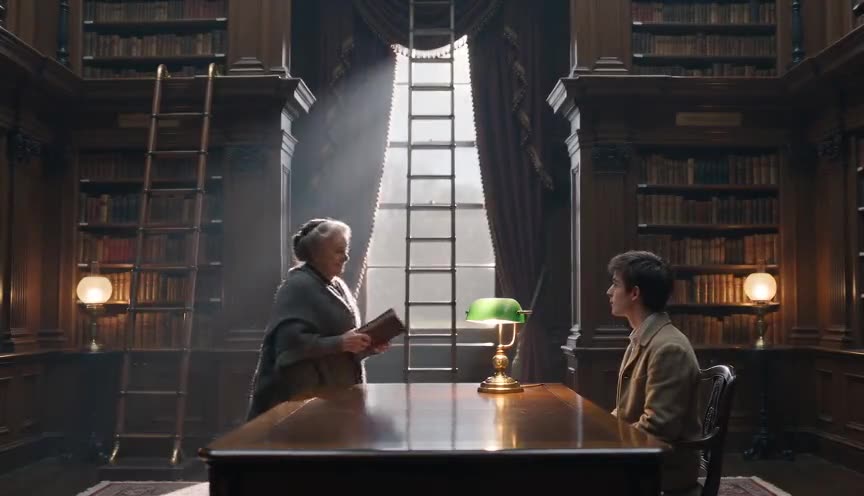
A master shot covers a whole scene from one angle to give editors coverage they can cut into pieces later. A long take is meant to be seen uncut, as the finished scene itself.
In film
Goodfellas (1990)
The Steadicam walk through the Copacabana kitchen runs over three minutes without a cut, immersing the audience in the character's rising status.
Children of Men (2006)
The ambush inside the moving car plays as one unbroken take, keeping the chaos and danger spatially continuous and unsettlingly real.
Rope (1948)
Hitchcock structured the whole film as a series of ten-minute takes, the length of a film reel, disguised to look like one continuous shot.
The prompt
Describe the long take as one continuous shot with a start point, a path and an end point, naming what the camera does throughout (walks, pans, holds) so the model does not insert a cut. Add a duration cue like 'never cuts' or 'single unbroken shot' and keep the action simple enough to sustain for four seconds: one movement, one subject, one line of blocking. Avoid multiple locations or costume changes, since there is no edit point to hide a jump, and avoid vague verbs like 'shows' that invite a cut.
The exact prompt that rendered the video on this page. Keep the description of the move, change the subject and the setting.
Long take, one continuous unbroken shot inside a snowy mountain cabin at dusk. A woman in a thick wool sweater stands at a frost covered window, then turns and walks slowly across the wooden floor toward a stone fireplace, feeding a log into the flames as snow keeps falling outside the glass behind her. The camera follows at a steady walking pace on a smooth handheld path, never cutting, staying at eye level the whole time, warm firelight rising on her face as she kneels by the hearth. No text.
Common mistakes
Hidden cuts
Splicing several clips together and calling it a long take breaks the whole point. If a cut is needed, that is coverage or an invisible cut, not a true long take.
Overcomplicated blocking
Cramming multiple location changes or costume swaps into one AI clip creates confusion, since there is no edit point available to hide the transition.
No motivation for duration
Holding the camera on one unbroken shot without a reason, such as tension, geography or choreography, makes the shot feel slow instead of deliberate.
Frequently asked questions
What is a long take?
A long take is a single shot that runs continuously, without a cut, often for several minutes or an entire scene, so the audience experiences time passing in real time alongside the characters.
How long does a long take have to be?
There is no fixed minimum, but filmmakers usually reserve the term for shots that run well past ordinary coverage, typically one to several minutes, long enough that duration itself becomes noticeable to the viewer.
Is a long take the same as a one-shot film?
No. A one-shot film like Birdman or 1917 is built from several long takes joined by hidden invisible cuts to look like a single shot spanning the whole movie. A long take is one real, uncut segment of that.
Can AI video tools generate a true long take?
Current models render short clips of a few seconds, so a true multi-minute long take has to be planned as a sequence of separate continuous-feeling clips on a tool like Imaginode. Describe one clear camera path per clip for the best result.