The birthday gift
The card of someone you know, with their real quirks as stats, costs thirty-eight credits and stays in a wallet far longer than a greeting card.
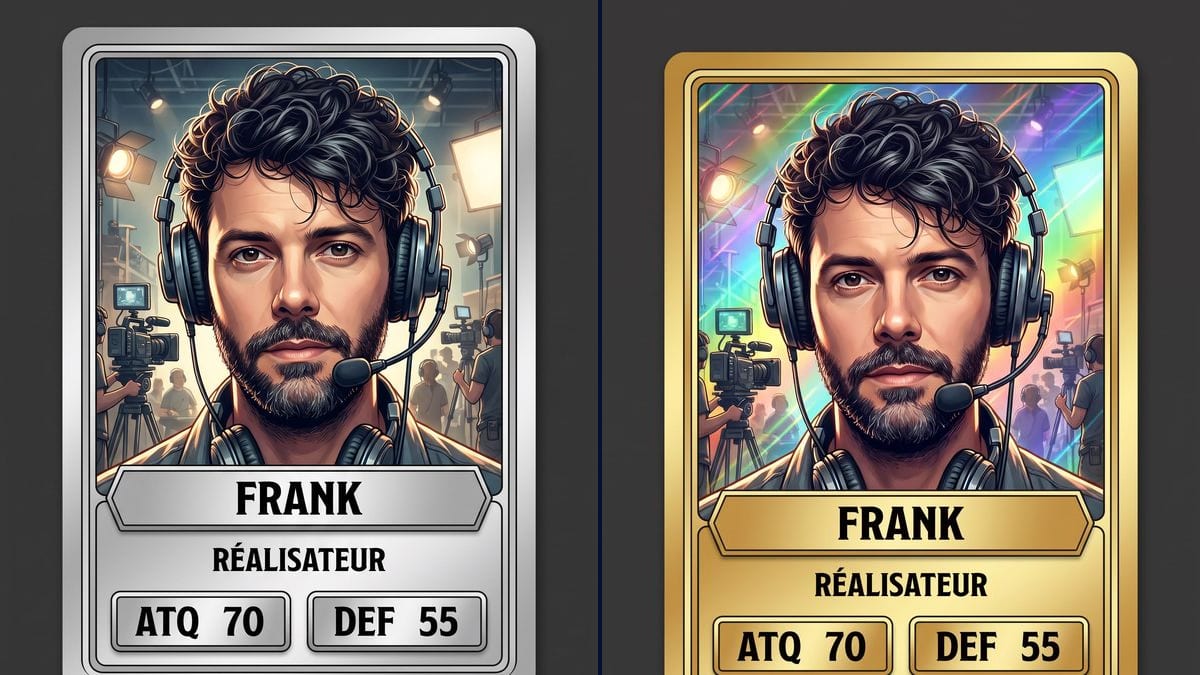
Your photo becomes a common card with frame, name and stats, then that card becomes the reference for the rare version, same frame and same text. Workflow visible here, no account needed.
Real workflow: a photo from the front, the common card with a silver frame, then the rare card with a gold frame and a holographic background. Both images come from the demo, the second starts from the first.
At a glance
Everybody has wanted to be on a trading card at some point. This workflow does it in two images: your photo becomes an illustrated portrait in a frame, with a name, a type and two stats, then the same card comes back as a rare version, gold frame and holographic background.
The hard part is the one of a SERIES. Two free generations give two card games that look nothing alike, and nobody collects that. The rare card therefore starts from the common one, wired into its image port, and its prompt lets only the frame colour and the portrait background change.
The second hard part is the text: name and stats are written between quotes, in few words, with a ban on writing anything else, the rule learned on the business card. Both cards cost thirty-eight credits.
These are the files of the workflow above, exactly as the models produced them, unretouched. The starting point is shown when there is one.
Starting point
Render
Players, clubs, teams and anyone looking for a personalised gift that gets kept, without knowing how to draw a card frame.
A sharp photo from the front of a single person, plus the name, the type and the two stats you want to read on the card.
Give a sharp photo from the front
The portrait is painted in an illustration style, but it is your face it has to paint: a blurry or profile photo gives a character that does not look like you.
Write the name and stats between quotes
A short name in capitals, a type line, two stats. And a ban on writing anything else: without it the model invents lore text and a set symbol.
Wire the common card into the rare one
The image port of the second node receives the first card. That cable is what keeps the frame, the portrait and the text while the rarity changes.
Change only the rarity
Frame colour, portrait background, maybe a foil shine. If you also change the pose or the layout, you no longer have a series but two unrelated cards.
The same canvas, tuned for different needs: each variation is two or three lines of prompt away.
The card of someone you know, with their real quirks as stats, costs thirty-eight credits and stays in a wallet far longer than a greeting card.
Every member gets a card in the same frame, and the set is handed out at a meeting, an offsite or a farewell. The series holds because every card starts from the first.
An amateur sports team or an association publishes its cards like the professionals, with the season's stats, and the kids really trade them.
A role playing hero or an indie game character becomes a presentation card, and the character sheet then keeps it identical across every visual.
A rare card sent as an invitation to a party or a launch gets kept, photographed and shown: it is an invitation that advertises itself.
The same workflow works with a portrait made by photo to pixel art instead of the photo, for a retro card that owns its grid.
This is the mistake that breaks the series: without the common card as a reference, the model redraws another frame, another banner and often another face. The two cards no longer belong together.
With no ban, the card gets covered in fake text, a fake set symbol and an invented number. Name, type, stats, and nothing else.
The model picks a face at random, or blends them. One photo per card, framed on a single person, from the front.
A banner that moves up or a box that changes shape shows immediately when the cards sit side by side. Rarity is the frame and the background, not the structure.
Yes: one card per person, each wired to the first card as a reference to share the frame. That is how you get a set rather than a pile of mismatched cards.
The card comes out in high resolution at 3:4, slightly wider than a standard game card: plan a small crop. It prints very well on an online custom card service.
Yes, they are words in the prompt: name, type, stats. Keep them short and in capitals, that is what an image model writes most cleanly.
Thirty-eight credits, nineteen per card on Nano Banana Pro. One more rarity, or one more card in the same series, costs nineteen credits.
Because it holds a dark background, short text and the structure of an image it is asked to reproduce all at once: the three measurements made in September 2026 on the business card, location scouting and scene coverage.
On both demo cards, letter for letter. It is not guaranteed on a long or accented word: proofread before printing, it is the cheapest check in the project.
3:4 in 2K, flat and straight on, no perspective, so it can be printed. A card photographed in a hand can be asked for in the prompt, but it cannot be printed.
No, and the demo prompt does not: the card shows you or someone who gave their consent, with an invented name and stats. A card game brand remains a brand.
Make your own trading card with AI
Use this workflowFree account, no card required. The workflow opens pre-filled in your canvas.
 Nano Banana Pro
 GPT Image 2.5 Flare
 Seedream 5 Pro