The holiday memory
The village where you spend the summer, as a vintage poster to frame: a nicer keepsake than a photo, for nineteen credits and without searching for a poster that does not exist.
A photo of a place becomes two travel posters, vintage and minimalist, with its name written on it, the place recognisable. Workflow visible here, no account needed.
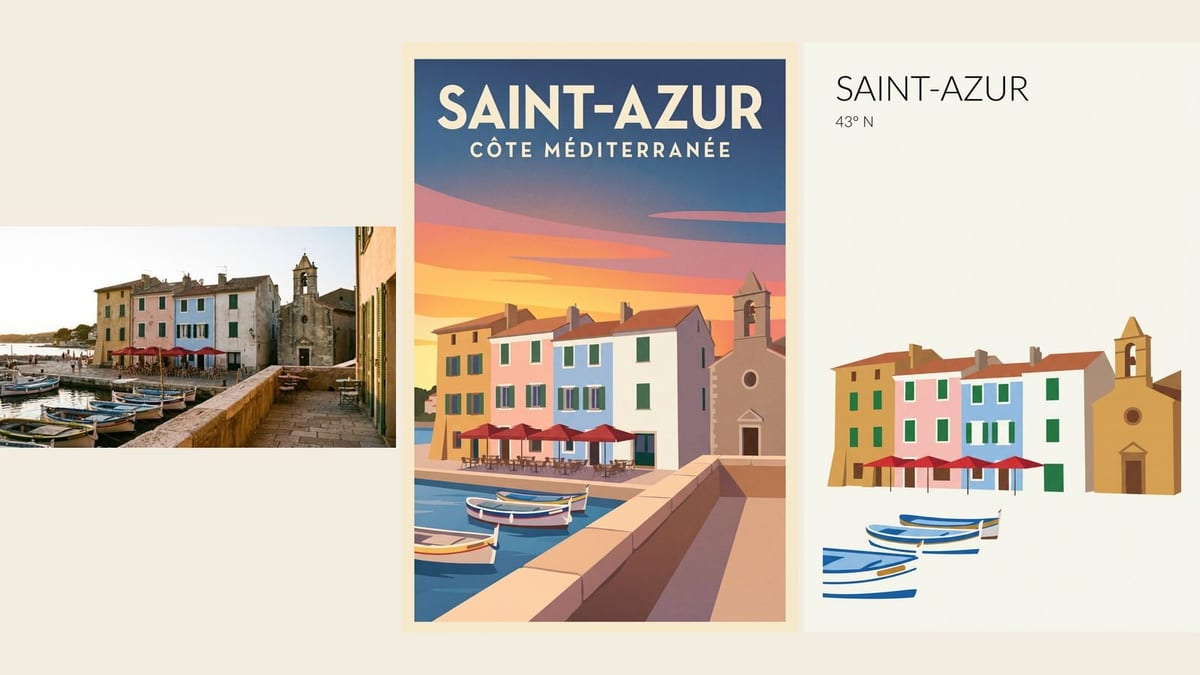
Real workflow: the photo of a small Mediterranean harbour, then a vintage sunset poster and a minimalist poster, the four facades and the bell tower recognisable. The name SAINT-AZUR is invented.
At a glance
A travel poster of your town, your holiday village or your wedding venue gets kept and framed, where a photo stays in the phone. This workflow starts from a photo of the place and makes two posters: a vintage one in flat colours and gradients, and a modern minimalist one, with the name written on it.
The hard part is likeness. A generic village poster is worth nothing: the prompt names the facades, their colours, the bell tower and the harbour as the photo shows them. The text is one short name and one line, between quotes.
The style is described by its means, never by the name of a poster artist or a brand: the poster is an original design. For an event poster, see the poster; for the same place as a scale model, the miniature diorama. The two posters cost thirty eight credits.
These are the files of the workflow above, exactly as the models produced them, unretouched. The starting point is shown when there is one.
Starting point
Render
Travellers, couples getting married, tourist offices, hotels and shopkeepers who want a poster of a place that matters to them.
A sharp photo of the place, the list of what makes it recognisable, and the name to write on the poster.
Pick a photo that says the place
A view where the spot is recognisable: a square, a harbour, a monument, a street. A tight shot of a detail does not make a travel poster.
Name what makes the place
The buildings, their colours, a bell tower, a bridge, the sea: the prompt lists them, which makes the poster recognisable.
Describe the style by its means
Flat colours, gradients, paper grain, geometric type, a limited palette. Never an artist's or a brand's name: the poster must be original.
Write the name between quotes
The place's name and one line, in short capitals. Any other word is forbidden, otherwise the model adds a fake travel company or a date.
The same canvas, tuned for different needs: each variation is two or three lines of prompt away.
The village where you spend the summer, as a vintage poster to frame: a nicer keepsake than a photo, for nineteen credits and without searching for a poster that does not exist.
The wedding venue, a château or a beach, as a minimalist poster with the place's name and the date: a gift for the couple, or decoration for the hall.
A town with no poster gets a series, vintage for the shop, minimalist for social media, from its own photos.
The poster of the place hung in the rooms and sold at reception: an object guests take home and that brings them back.
Your own street or neighbourhood as a poster, in the style of the room: a personal decoration you will not find in any shop.
Several places in the same town in the same minimalist poster, for a consistent series to hang side by side or sell in a shop.
With no list of buildings and colours, the poster shows any Mediterranean village. Name what people should recognise.
Copying the style of an existing artist or company raises a rights issue. Describe the means: flat colours, gradients, type.
A travel poster carries a name and one line. A whole sentence reads badly from afar and multiplies typos.
A minimalist poster lives on its emptiness. Measured on the demo: without a prompt, a grey smudge crept in. Require a flat background.
The posters come out in 2K at 2:3. For a print of 50 cm or more, run them through the sharpener before printing.
Yes, a public place can be drawn freely. Describe its monuments and its light; what must not be copied is an existing poster of that city.
Yes, they are words in the prompt: the name stays, the line is translated. One poster per language costs nineteen credits.
Thirty eight credits, nineteen per poster on Nano Banana Pro. A third version, another style or another language, costs nineteen credits.
Because it keeps the structure of a place while changing style completely, and writes a short name without mistakes, on a light background as on a coloured sky.
On the demo, yes: the four coloured facades, the bell tower, the parasols and the boats are on both posters, in the same order.
2:3 in 2K, the classic format of a vertical poster. A landscape format can be set in the node if the place is very wide.
The poster is an original drawing from your photo. Just check the rights on the starting photo, and do not imitate an existing poster.
Make a travel poster of your town with AI
Use this workflowFree account, no card required. The workflow opens pre-filled in your canvas.
 Nano Banana Pro
 GPT Image 2.5 Sunburst
 Seedream 5 Pro