The three-book family saga
The novelist follows the Marlows from 1890 to the present. The classic tree opens each book, and she redoes it every volume with the generation that has just appeared, so readers never lose the thread.
Your novel's family across three generations, as a sepia oak with medallions or a clean modern chart, with your names written letter for letter. Workflow visible here, no account needed.
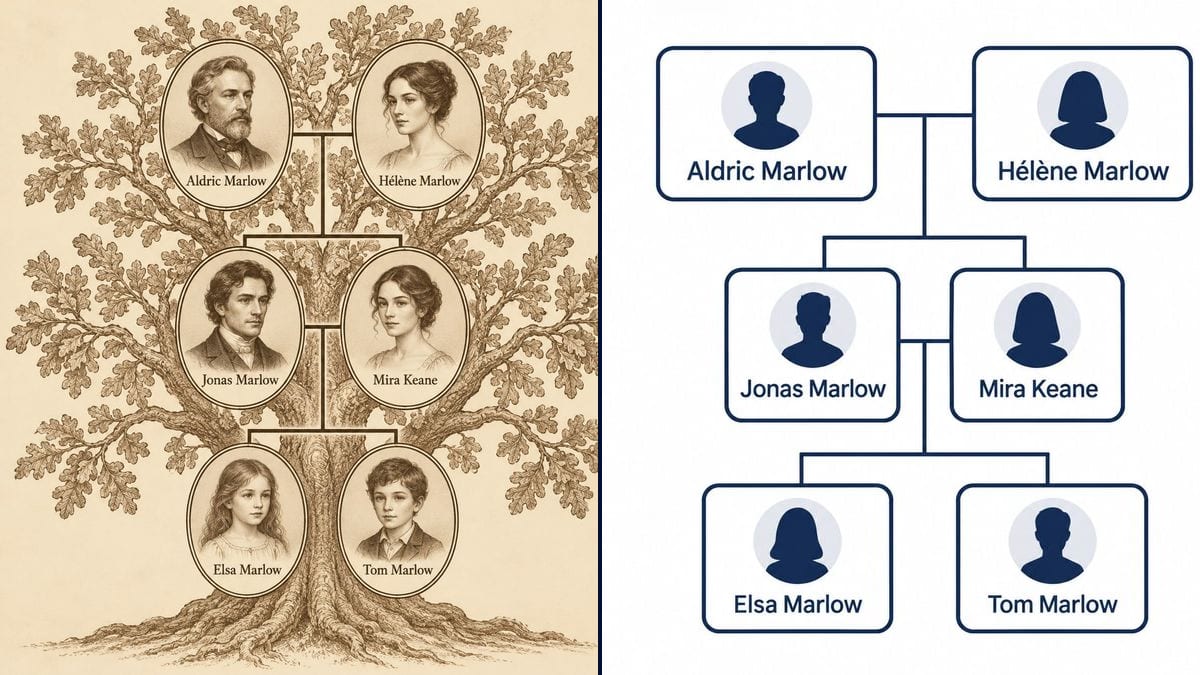
Real workflow: the Marlow family over three generations, first in oval medallions hung on a large sepia oak with engraved portraits, then in navy boxes with silhouettes. All six names are right, but Mira Keane is linked to Aldric and Hélène as if she were their daughter.
At a glance
A family saga means three generations, second marriages and cousins readers mix up by chapter twelve. The author keeps the tree in a notebook or a spreadsheet, the copy editor asks who fathered whom, and the reader flips back to check. This workflow draws the tree of YOUR fictional family in two versions: a sepia oak with medallions for the book, a clean chart for the series bible or the pitch pack.
The hard part is the links as much as the names. Sunburst writes all six names letter for letter, accents included, but it draws the lines its own way: in the demo, the daughter-in-law ends up hanging from the grandparents like one of their children. So the prompt has to say who married whom, not just who belongs to which generation.
To give everyone a face, see character sheets; for the family's arms, the coat of arms. Both trees cost six credits.
These are the files of the workflow above, exactly as the models produced them, unretouched. The starting point is shown when there is one.
Render
Family saga and fantasy novelists, writers building a series bible, editors and copy editors.
The names by generation in quotes, who married whom, whose child is whose, and the style you want.
List by generation
Top to bottom, two to four names per generation. Past ten people, make one tree per branch of the family.
Say who married whom
"Mira Keane, Jonas's wife", "Elsa and Tom, children of Jonas and Mira". Without those links written out, the model joins the boxes however it likes.
Pick the style
Sepia oak for a historical saga or a printed book, clean boxes for a series bible or a working document.
Check names and lines
Every name, then every line: where does it start, where does it land? A wrong link in a printed book stands out as much as a typo.
The same canvas, tuned for different needs: each variation is two or three lines of prompt away.
The novelist follows the Marlows from 1890 to the present. The classic tree opens each book, and she redoes it every volume with the generation that has just appeared, so readers never lose the thread.
A writer developing a family drama drops the clean chart into the characters section of his bible. Producers see at a glance who inherits what and why the two brothers stopped speaking.
In a fantasy novel, three houses fight over a throne through marriages. One tree per house, all in the same style, lets the author check the line of succession before writing the coronation chapter.
The editor wants a character summary before copy editing. The modern tree, sent with the manuscript, saves a dozen emails asking "is she the aunt or the cousin?".
In one scene, a framed family tree hangs on the living room wall. The prop maker prints the classic version large, with the names from the script, and the frame reads on camera.
A bookseller runs an evening on an ensemble novel with a big cast. She prints the tree on A4 for everyone, and the talk is about the story instead of who's who.
Giving only the generations lets the model join boxes at random. In the demo, the daughter-in-law became the grandparents' daughter. Name every couple.
Fifteen cousins across three generations and the names shrink until they're unreadable. Make one tree per branch, or keep the characters that matter to the plot.
The classic style may draw faces in the medallions. They won't look like your characters and can clash with the cover: ask for "medallions without portraits" if you don't want them.
An accent, a hyphen, a particle: "de Valmont" and "De Valmont" aren't the same name. Copy each name exactly as it appears in the manuscript.
In the demo, yes: "Aldric Marlow", "Hélène Marlow", "Jonas Marlow", "Mira Keane", "Elsa Marlow" and "Tom Marlow" are exact on both trees, accent included.
Not quite in the demo: Mira Keane, who married Jonas, gets the line from the grandparents as if she were their daughter. Spell out the marriages in the prompt and check every line.
Yes: add them in quotes under each name, "Aldric Marlow, 1891-1962". The more text, the more proofreading, digit by digit.
Six credits, three per tree on GPT Image 2.5 Sunburst at medium quality. One more tree, for another branch of the family, costs three credits.
Because it spells correctly on a light background, and a family tree is mostly a page of names. It's also the cheapest model in the catalogue, so rerendering when a line goes astray costs very little.
The prompt asks for 4:3, but both demo trees came out almost square, slightly taller than wide, around 1225 x 1284. That sits well on a portrait book page.
Yes: add a generation to the prompt with its names in quotes. Keep few people per row, or the boxes shrink.
Yes, for your own novel. If you publish through Amazon KDP, disclose AI-generated images; see also the rules on commercial use.
Make a family tree for your novel's characters with AI
Use this workflowFree account, no card required. The workflow opens pre-filled in your canvas.
 GPT Image 2.5 Sunburst
 Nano Banana 2.1
 Recraft V4.1