The family piece to modernise
Grandmother's chest of drawers, solid but dated: two colours tried before sanding it, so you can keep it without it clashing in the living room.
Your old furniture repainted two ways, colour and handles included, without changing its shape. To choose before sanding. Workflow visible here, no account needed.
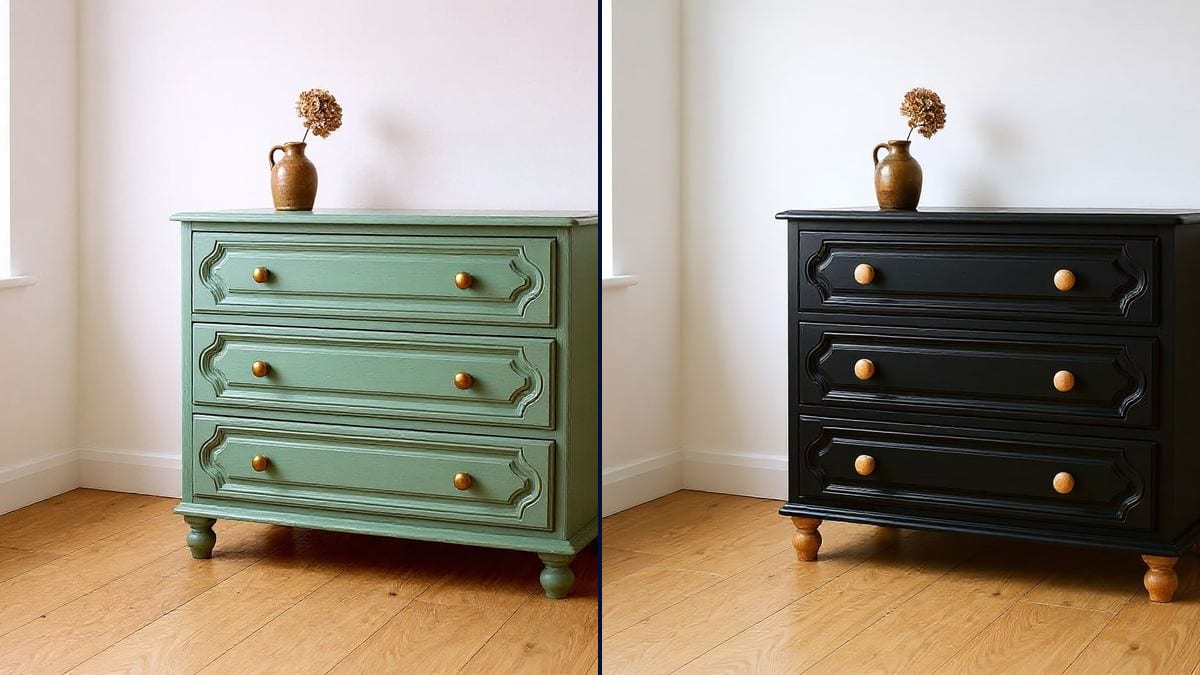
Real workflow: a 1970s chest of drawers in orange varnished pine, then the same repainted sage green with brass handles and matte black with oak knobs. Mouldings and legs don't move.
At a glance
A furniture makeover means a weekend of sanding and painting, and a colour you've only seen on a swatch. This workflow starts from a photo of your piece and shows it repainted two ways, handles included, before you buy a single tin.
The hard part is keeping YOUR piece. A model that rebuilds the picture redraws the mouldings or changes the legs. Flux Kontext repaints and swaps the hardware while leaving the shape, the room and the light as they were.
For the walls around it, see the paint colour test; for a whole kitchen, the kitchen makeover. Both makeovers cost twelve credits.
These are the files of the workflow above, exactly as the models produced them, unretouched. The starting point is shown when there is one.
Starting point
Render
DIY lovers, flea market hunters, professional upcyclers and second-hand furniture sellers.
A straight-on photo of the whole piece, the shade wanted and the hardware to fit.
Photograph the piece
Whole, straight on, in daylight, against a clear wall. The model keeps that framing and light.
Describe the paint
The shade as a greyish colour, the finish matte or satin: "greyish sage green, not mint". The legs can stay wood.
Change the hardware
Brass handles, oak knobs, black cup pulls: often what modernises an old piece most.
Protect what sits on top
Name the vase or lamp and say they keep their colour, or they take the paint too.
The same canvas, tuned for different needs: each variation is two or three lines of prompt away.
Grandmother's chest of drawers, solid but dated: two colours tried before sanding it, so you can keep it without it clashing in the living room.
A sideboard bought for twenty euros at a car boot sale: you see what it will look like repainted before spending the weekend stripping it.
The maker shows a client three finishes on a photo of the piece before taking it on, and sells the transformation before doing it.
The piece repainted in the same range as the walls tried with the paint colour test, for a room that holds together.
A photo of the made-over piece shows its potential in a resale listing, with a before and after that makes people want it.
An old chest of drawers repainted in a soft colour for a nursery, tried with the handles before buying the paint.
"Green" comes out mint or neon. Describe a greyish colour, as on a paint chart: greyish sage, storm blue, dusty terracotta.
The vase or lamp on the piece can take the paint. Name them and say they keep their colour.
A half-visible or angled piece repaints badly. Photograph it whole and straight on.
Adding drawers or changing the silhouette makes another piece. A makeover keeps the shape and changes the finish.
No: mouldings, drawers, legs and size stay those of the photo. Only the paint and handles change.
Yes: ask for stripped, natural light wood or a wax finish instead of paint, with the same sentence about the shape.
Yes, on any piece photographed whole and straight on: chair, sideboard, bedside table, wardrobe.
Twelve credits, six per makeover on Flux Kontext. A third colour on the same photo costs six credits more.
Because it repaints while keeping the shape pixel for pixel, measured on car and wall colours: you see YOUR piece.
In the demo, yes: same mouldings, same drawers, same turned legs, in the same place, in both versions.
The format of your photo, here 4:3. A vertical photo stays vertical.
It's a simulation: compare with a painted sample on the piece, in the same light, before buying the full tin.
Plan a furniture makeover with AI before you paint
Use this workflowFree account, no card required. The workflow opens pre-filled in your canvas.
 Flux Kontext
 Nano Banana Pro
 GPT Image 2.5 Sunburst