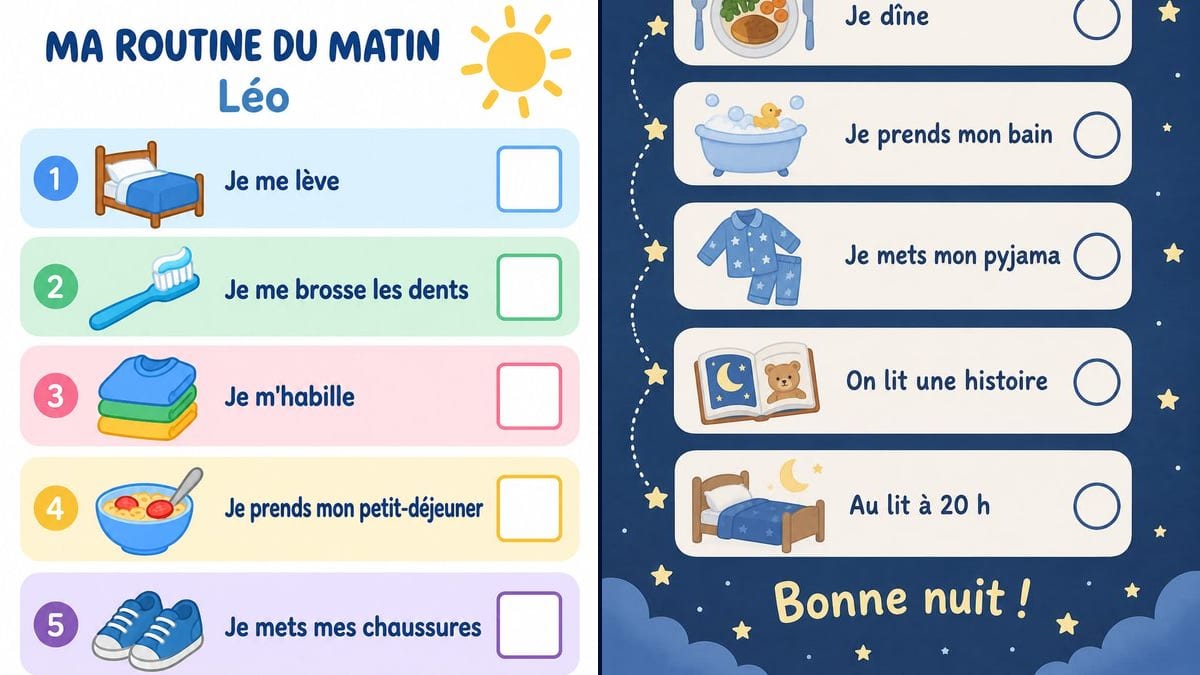
School-day mornings
Léo always stalls somewhere between his cereal bowl and his shoes. The chart is taped at his eye level by the front door, so he can see that shoes come after breakfast and the school bag after that, without anyone repeating it.
A morning routine and a bedtime routine to print on A4, with your child's name, their steps in order and a picture for each one. Workflow visible here, no account needed.
Real workflow (demo in French): a morning routine for Léo on white with a yellow sun, six numbered steps in pastel boxes from bed to school bag, each with its picture and a square to tick, then a bedtime routine for Mila on a starry navy sky with a moon, five steps from dinner to bed and "Bonne nuit !" (good night) at the bottom.
At a glance
Every morning, the same question ten times over: "Have you brushed your teeth?" With a routine chart on the wall, you stop having to ask. Your child looks at the sheet, sees what comes next, does it and ticks it off. This workflow starts from your steps, in the order they happen in your house, with your child's name at the top. You get two A4 charts: the morning routine, from getting out of bed to picking up the school bag, and the bedtime one, from dinner to lights out.
For a child who can't read yet, the pictures do the work. The prompt asks for one big pictogram per step that makes sense without reading: a bed, a toothbrush, a bowl, pyjamas. The words still matter for the grown-up and for a child starting to sound things out, so they have to be right. Every step goes in quotation marks, no other words allowed, and GPT Image 2.5 Sunburst copied them all correctly on the first try, accents included. The demo is in French: replace the lines with whatever your child does, in your own language.
For household jobs and stars to earn, the chore chart is the better fit; to map out the family week, the weekly planner; to count down to Christmas, the advent calendar. Both charts cost six credits.
These are the files of the workflow above, exactly as the models produced them, unretouched. The starting point is shown when there is one.
Render
Parents of preschool and primary-age children who are tired of repeating every step of the morning and bedtime, childminders, and nursery or reception teachers setting up classroom routines.
Your child's name and the steps of their routine in order, each in quotation marks, plus the object to draw for a step if you want a specific one.
List the steps in order
Five to seven, no more, in the order they happen at home. One action per step: "I get dressed" and "I put my shoes on" are two lines, not one.
Write them the way your child talks
"I brush my teeth" rather than "Teeth". In the first person, your child reads their own sentence. Put each step in quotation marks, and spell the name exactly as it's written, accents and all.
Name the picture if you need to
The prompt lists one object per step: bed, toothbrush, bowl, shoes. If your child has a shower rather than a bath, write "a shower" so the picture matches their own bathroom.
Print it and laminate it
The render has the proportions of an A4 sheet, so it prints full page. Laminated, it takes a dry-erase marker and is ready again the next morning. For crisper lines, switch the node to high quality.
The same canvas, tuned for different needs: each variation is two or three lines of prompt away.
Léo always stalls somewhere between his cereal bowl and his shoes. The chart is taped at his eye level by the front door, so he can see that shoes come after breakfast and the school bag after that, without anyone repeating it.
Navy sky, a moon, five steps. The chart hangs in her bedroom and Mila ticks the pyjamas circle before she picks a story. "Au lit à 20 h", in bed at eight, is printed on the sheet, which saves renegotiating bedtime every night.
Days without school have a different morning. A third chart with "I play in my room" where the school bag was keeps the rest of the order the same: get up, teeth, clothes.
Print an extra copy for the suitcase. In a room they don't know, on holiday or at their grandparents', your child finds the same pictures and the same steps as at home.
The older one showers, the younger one has a bath; one reads alone, the other listens to a story. Duplicate the node, change the name and the steps, and each child gets a routine with their own pictures.
Arriving in the morning breaks down into steps too: "I hang up my coat", "I wash my hands", "I say hello". Put the class name where the child's name goes and pin the sheet up by the coat pegs.
Past seven, the pictures shrink and your child loses their place halfway down the sheet. Keep it to five to seven steps; if the routine runs longer, split it over two charts.
"I wash and get dressed" gets one picture for two jobs, and your child can't tell which one they've done. Keep it to one action per step, so each step gets its own picture.
Once "in bed at 8" is up on the wall, it's the rule as far as your child is concerned. Write the time you actually keep, or leave the time off and just write "Bedtime".
Without them, the model rewords a step or slips in an extra one. Quote every line and keep the "No other words" sentence at the end of the prompt.
In the demo, yes, first time: "petit-déjeuner", "lève", "dîne", "à 20 h" and "Bonne nuit !" are all right. One quirk on the bedtime chart: the I's in "ROUTINE" and "SOIR" have a small decorative dot on top, so they look like an İ. Read every line before you print.
For you now, and for them later. They follow the pictures and the colours; the words are for the adult helping out and for a child who's starting to recognise words. If you want a chart with no words at all, write "no text" and keep only the numbers.
A routine follows one part of the day in order, from getting up to leaving for school or from dinner to bed, and starts again every day. A chore chart lists small jobs across the week, often with a reward at the end. That's a different page.
Six credits, three per render on GPT Image 2.5 Sunburst at medium quality. One more routine, for weekends or a second child, costs three credits.
The prompt asks for 3:4, and Sunburst returns 1055 by 1491 pixels. That's almost exactly the shape of an A4 sheet, so the chart fills the page with no white bands. High quality gives crisper lines on paper and costs more.
Not in the demo. The prompt asked for steps linked by a dotted path; Sunburst drew it down the left edge, winding between stars without touching the boxes. If it matters to you, run the render again or describe the path more precisely, for example "a dotted line running from each box to the next one".
Yes, the prompt names one object per step in brackets. Swap "a bathtub" for "a shower", or add a teddy for bedtime. For a whole page your child can colour in, see the printable colouring page.
No. On the morning demo each step has its number in a coloured circle, as asked; the bedtime prompt doesn't ask for numbers and Sunburst didn't add any. For a child who can already count, numbers help them find their place.
Make a printable routine chart for kids with AI
Use this workflowFree account, no card required. The workflow opens pre-filled in your canvas.
 GPT Image 2.5 Sunburst
 Nano Banana 2.1
 Seedream 5 Pro