The blended family
The kids switch houses every other week. The fridge planner shows who picks up whom from school, Wednesday judo and the dentist, so both homes are looking at the same sheet of paper.
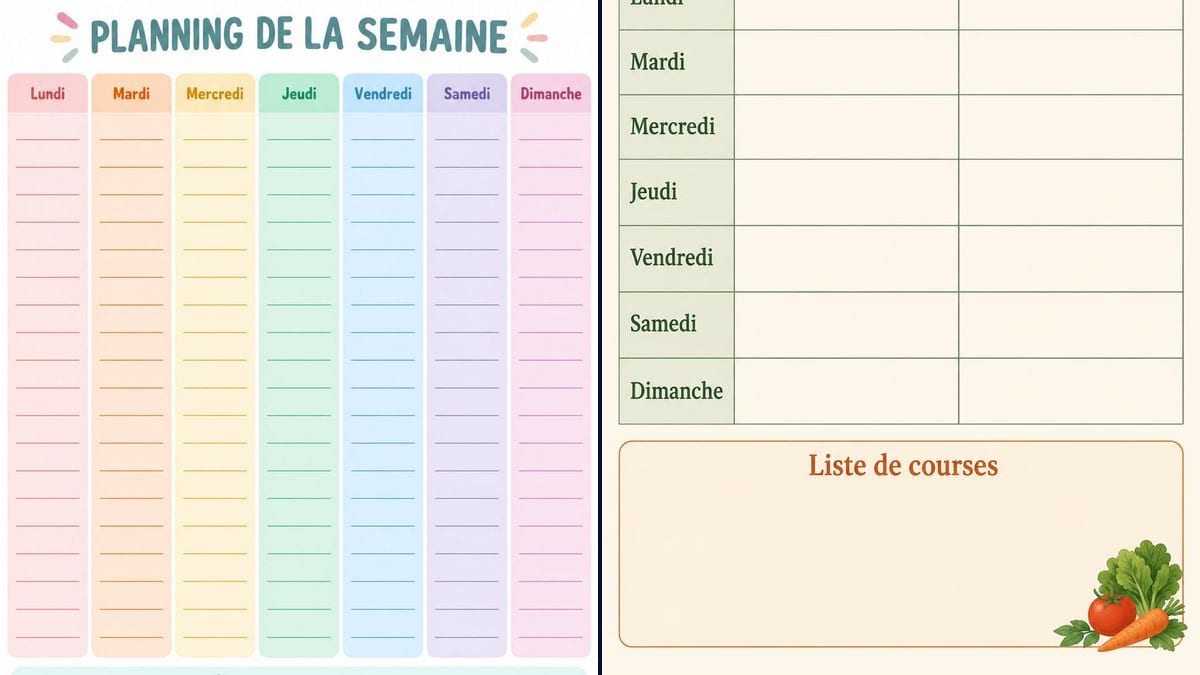
A family planner in seven pastel columns and a lunch and dinner meal plan with a shopping list, blank and ready to print on A4. Workflow visible here, no account needed.
Real workflow (demo in French): two blank A4 sheets. A weekly planner with seven lined pastel columns and a notes box at the bottom, and a meal plan laid out as a lunch and dinner table on cream, with drawn vegetables and a shopping list box.
At a glance
The planner on the fridge is usually a sheet found online with someone's logo in the corner, headings that don't fit the family, or a grid redrawn by hand every Sunday. This workflow makes two blank A4 sheets, a week in columns and a meal table with its shopping list, to print as many times as you like.
The hard part is keeping the sheet empty. An image model likes to fill space: it slips invented appointments and dishes into the boxes, in fake text. The prompt lists every word allowed and asks for empty lines. GPT Image 2.5 Sunburst sticks to it and spells the days correctly, for three credits a render.
To label the kids' things for school, see the school name labels; for the jars in the cupboard, the homemade jam label. Both planners cost six credits.
These are the files of the workflow above, exactly as the models produced them, unretouched. The starting point is shown when there is one.
Render
Families organising the week, parents planning meals, flatshares, childminders and teachers.
The layout, columns or a table, and the headings in quotes: title, days, sections and the bottom box.
Choose the layout
Seven columns for a family schedule, a days-by-meals table for food. Describe it in one sentence, with the number of rows or columns.
Name every heading
The title, the days, the columns, the bottom box: each one in quotes. "Activities", "Homework", "Snack" if that is what your household needs.
Insist on blank boxes
"Empty lines to write in" and "no other words": without those two phrases, the model fills the boxes for you.
Print a stack
One sheet a week, on A4 or Letter. Or laminate it and use a dry-wipe marker so it lasts.
The same canvas, tuned for different needs: each variation is two or three lines of prompt away.
The kids switch houses every other week. The fridge planner shows who picks up whom from school, Wednesday judo and the dentist, so both homes are looking at the same sheet of paper.
Sophie fills in the meal table in ten minutes with the kids, copies the ingredients into the shopping list at the bottom, and heads to the market on Monday with the sheet folded in her bag.
She looks after four children on different hours. One column per day, one line per child, and parents can see arrival times, naps and planned meals at a glance when they drop off.
Four flatmates, one kitchen. The meal plan says who cooks which night, the shopping list fills up through the week, and nobody buys a third bag of pasta nobody needed.
After seeing a dietitian, Mark plans the week's meals on the sheet and tapes it inside the cupboard door. He sees what he decided before he opens the fridge and starts improvising.
A primary teacher prints the planner large for the classroom wall: the days in colour, trips and workshops written in marker, and the pupils know what is coming up this week.
Without "empty lines" and "no other words", the model invents appointments and dishes in the cells, often in unreadable fake text. Then the sheet is no use.
Meals, activities, homework, chores, mood and weather on one page: the boxes get too small to write in. One sheet, one job.
List all seven days one by one, in order. "The days of the week" on its own lets the model decide, and it may stop at Friday.
A dark column background makes handwriting impossible to read. Keep to light pastels, as in the demo, or plain white.
In the demo, yes: only the heading, the days, the columns and the bottom box are written, with no mistakes. The lines and cells are ready for a pen.
Yes: ask for four lines per day, say, and give "Lea", "Tom", "Dad", "Mum" in quotes as row labels.
Yes, but the pastels turn into very pale greys. For a mono printer, ask for thin black lines on white instead.
Six credits, three per render on GPT Image 2.5 Sunburst at medium quality. A third sheet, a homework planner for example, costs three more.
Because it spells correctly on a light background and respects the instruction to add nothing, which matters more than anything on a sheet meant to be filled in. It is also the cheapest model in the catalogue.
Portrait. The prompt asks for 3:4 and Sunburst returns 2:3, which prints on A4 with a thin margin at the sides.
Yes: describe a grid of five weeks by seven days and give the month's name. More cells means smaller cells; on A4, the weekly layout is easier to write in.
Not inside the image. Change the prompt and rerun the node for three credits. That is why every heading sits in quotes: you can swap it in a second.
Make a printable weekly planner with AI
Use this workflowFree account, no card required. The workflow opens pre-filled in your canvas.
 GPT Image 2.5 Sunburst
 Nano Banana 2.1
 Recraft V4.1