Volumetric light
Also calledgod rays, light shafts, crepuscular rays, sunbeams
Volumetric light is the visible glow of a light beam as it scatters off particles suspended in the air, such as dust, haze, fog or smoke. It turns invisible air into a tangible, three-dimensional shape, adding depth, mood and a sense of scale to a scene.
What it tells
Volumetric light lets a director make the invisible visible: it turns ordinary air into something you can almost touch, and that physical presence carries emotional weight. A shaft of light falling through a window can suggest revelation, memory or divine presence, while smoky beams in a warehouse read as menace or mystery. Because it isolates a subject inside a defined column of light, it draws the eye without a cut, and its slow, drifting particles give a shot a sense of stillness and reverence that flat lighting cannot.
How it is shot
To get true volumetric light on set you need a hard directional source, particles to scatter it, and a camera angle that lets the beam travel toward or across the lens. Crews fill the air with a haze machine, then aim a hard fresnel, HMI or the sun through a window, a gobo or shutters so the beam stays narrow and defined. Backlighting or three-quarter backlighting works best, since light traveling toward the lens reveals the haze, while front light washes it out. Cinematographers often underexpose the ambient scene slightly so the beam reads as the brightest element, then let smoke drift through frame for texture without excess motion blur.
When to use it
- Use it to make a shaft of sunlight through a window feel sacred, nostalgic or revealing in an interior scene.
- Reach for it in a smoky bar, forest or warehouse to give depth and atmosphere to an otherwise flat wide shot.
- Use it when a character needs to look isolated or chosen, standing inside a single defined column of light.
- Bring it into a car headlight beam at night or a spotlight on stage to sell fog, dust or rain as present.
Not to be confused with

Gobo lighting shapes a beam into a pattern of shadow and light on a surface, using a cutout or textured mask; volumetric light is about making the beam itself visible in haze, with or without a pattern.
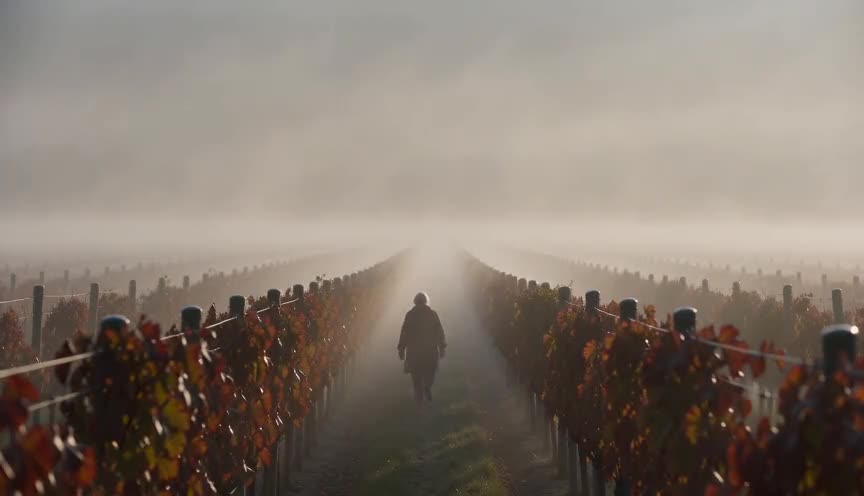
Atmospheric haze is the particulate medium (fog, smoke, dust) that a light source scatters off; volumetric light is the visual result, the actual visible beams and shafts that haze makes possible.
In film
Blade Runner 2049 (2017)
Interiors and exteriors are filled with thick, backlit shafts of light through dust and haze to give the world scale and mood.
Blade Runner (1982)
Smoke, rain, and hard backlight make beams from windows, spinners, and neon signs appear as solid shapes in the dystopian city.
Citizen Kane (1941)
The smoky projection room turns the projector beams into bright, sculptural shafts, making the screening space feel deep and atmospheric.
The prompt
Name the source of the beam (a window, a lattice screen, a doorway), the medium that scatters it (dust, haze, smoke, fog) and the direction (backlight or three-quarter back light works best). Words like 'visible light shafts', 'hazy air', 'dust motes drifting' and 'backlit beam' push the model toward the effect; vague terms like 'atmospheric' or 'cinematic lighting' alone often produce nothing but a soft glow. Keep the light source and beam angle fixed across the shot so the model does not drift the direction of the light mid clip.
The exact prompt that rendered the video on this page. Keep the description of the move, change the subject and the setting.
Volumetric light: in a Moroccan riad courtyard, thick columns of golden sunlight pour through the ornate carved wooden mashrabiya screen overhead, cutting sharp diagonal shafts through the hazy air thick with fine dust. A middle-aged woman in a flowing caftan crosses slowly through the courtyard, her silhouette breaking and reforming across the beams as she walks. The camera is locked on a low tripod, framing the tiled floor and carved arches, holding perfectly still while the light shafts remain fixed, and only the dust drifting inside them and her unhurried steps mark the passage of the four seconds. No text.
Common mistakes
Forgetting the particles
Asking for 'light rays' without haze, dust or smoke gives the model nothing to scatter off, so the beam disappears into a flat highlight.
Front lighting the beam
Placing the source behind the camera instead of behind the subject kills the effect, since scattered light only reads clearly when it travels toward the lens.
Overusing it everywhere
Filling every scene with god rays turns a striking accent into wallpaper and dulls the sense of revelation the technique is meant to create.
Frequently asked questions
What is volumetric light?
Volumetric light is the visible glow of a light beam scattering off particles suspended in the air, such as dust, haze, fog or smoke, so the beam itself becomes a shape you can see rather than just an area lit on a surface.
Why is it called 'god rays'?
The nickname comes from paintings and early photography of sunlight breaking through clouds in defined shafts, an image long associated with divine or heavenly light, and the term stuck for any strong, visible light beam.
Do I need real smoke to get volumetric light on set?
You need some particulate in the air, whether that is haze from a fogger, dust kicked up naturally, or steam and smoke; without particles to scatter the light, even a hard, directional source will not show a visible beam.
Can AI video models generate volumetric light reliably?
Yes, tools available through platforms like Imaginode render convincing volumetric light when the prompt names the beam, the particle medium and the backlight direction explicitly, since vague lighting language alone rarely triggers the effect.