Aerial shot
Also calledDrone shot, Helicopter shot, Sky shot
An aerial shot is any shot filmed from above the ground, typically from a drone, helicopter, or plane, that shows a subject or landscape from a height no handheld rig or crane can reach. It gives the viewer a sense of scale, geography, and detachment, turning people and buildings into small elements within a larger pattern.
What it tells
Directors reach for the aerial shot when they need to place a story in the world before they place it in a face. It answers the question of where and how big, setting up geography, isolation, or the sheer size of an event. Because the camera floats free of the ground, it also carries a feeling of surveillance or fate, as if some larger force is looking down on the characters below.
How it is shot
The camera is mounted on a drone, helicopter skid, or fixed-wing plane, and stabilized on a gyroscopic gimbal so wind and vibration do not show up in the frame. A wide to medium lens, roughly 16mm to 35mm equivalent, keeps enough of the landscape in frame while still reading depth in the foreground. Altitude usually ranges from 20 to 150 meters, high enough to reveal layout but low enough that human scale still registers. Flight paths are planned in advance, often flown twice, once for the pilot's line and once with a camera operator on a second controller adjusting tilt and pan independently, so the move stays smooth and deliberate rather than accidental.
When to use it
- Opening a film or sequence by establishing a city, coastline, or terrain before any character appears
- Showing the true scale of an event, disaster, or crowd that ground-level shots cannot contain
- Revealing a character's isolation by pulling the camera away and up from them
- Bridging two locations in a montage without cutting through traffic or crowds on the ground
Not to be confused with
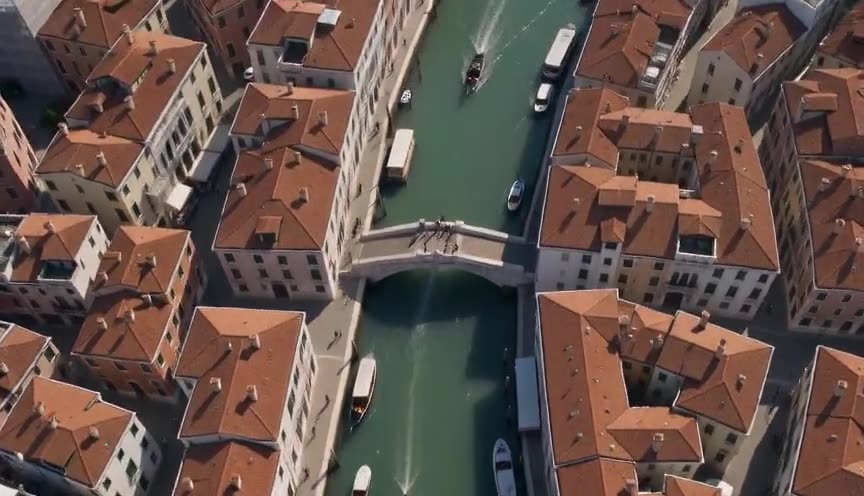
Bird's-eye view is an angle, camera pointed straight down, which can be shot from a crane, building, or drone. Aerial shot is a camera position in open air and often keeps the horizon in frame instead of looking directly down.

A crane up rises a few meters on a mechanical arm anchored to the ground, staying close to the subject. An aerial shot flies free in open air at far greater height, sacrificing intimacy for geography and scale.
In film
Apocalypse Now (1979)
Helicopter-mounted aerial shots follow the gunship assault along the coastline, giving the attack a terrifying, godlike scale.
The Shining (1980)
The opening aerial shot tracks a car along winding mountain roads, making the family look small against an indifferent landscape.
Koyaanisqatsi (1982)
Extended aerial footage of cities and highways turns human infrastructure into abstract, rhythmic patterns from above.
The prompt
Name the altitude and the flight direction so the model does not default to a static hover, and specify a wide lens to keep the sense of geography readable. Describe what stays level, the horizon, and what changes, the forward or lateral drift, since aerial shots read as controlled and smooth rather than shaky. Avoid vague words like 'from above' alone; give a clear subject on the ground for scale, and mention weather or light (fog, low sun) to anchor the mood.
The exact prompt that rendered the video on this page. Keep the description of the move, change the subject and the setting.
Aerial shot of a small fishing harbor at dawn, drone camera flying forward at a steady altitude of about eighty meters, wide lens capturing the curved stone breakwater, rows of moored wooden boats, and pale morning light reflecting off calm water. The camera glides smoothly north along the coastline, tilting slightly downward to reveal a middle-aged fisherman untying ropes on a wooden dock, horizon staying level throughout the move. Thin fog drifts low over the rooftops in the distance. No text.
Common mistakes
Flying too high
If the altitude climbs so much that people and boats disappear into dots, the shot loses emotional connection and becomes pure map, not story.
Unstabilized footage
Skipping a gimbal or letting wind shake the frame turns a deliberate aerial move into shaky, amateur footage that fights the sense of scale it is meant to deliver.
Confusing it with bird's-eye view
Pointing the camera straight down at every altitude collapses depth and horizon, giving up the geography and layering that makes an aerial shot distinct from an overhead angle.
Frequently asked questions
What is an aerial shot?
An aerial shot is a shot filmed from above the ground using a drone, helicopter, or plane, showing landscape or subjects from a height that ground-based rigs cannot reach. It is used to establish scale, geography, or isolation.
How high does a drone need to fly for an aerial shot?
Most narrative aerial shots sit between 20 and 150 meters. Lower altitudes keep human scale readable while still lifting the camera above rooftops and trees; higher flights favor pure landscape over intimacy.
What is the difference between an aerial shot and a bird's-eye view?
Aerial shot describes the camera's position, up in open air, often flying and moving. Bird's-eye view describes the angle, looking straight down, and can be shot from a crane or tall building without ever leaving the ground.
Can AI video tools generate a convincing aerial shot?
Yes, models like Seedance, Kling, Veo, Wan, and Grok Imagine, available on Imaginode, can render a believable aerial shot if the prompt states altitude, flight direction, lens width, and what stays level in frame.