Car mount shot
Also calledCar rig shot, Vehicle mount shot, Hood mount shot
A car mount shot uses a camera physically rigged to a moving vehicle, so the camera travels with the car at the exact same speed and vibration. The frame stays locked on the driver or passenger while the world outside streams past, sealing the viewer inside the vehicle with them.
What it tells
Directors reach for this shot to trap the audience in a confined, moving space with a character who cannot escape the conversation, the memory, or the decision in front of them. The static relationship between camera and face, against a blurring or gliding background, turns small gestures into major beats and makes silence feel loaded. It is the grammar of the road movie, the confession, and the getaway.
How it is shot
A suction mount, clamp arm, or hostess tray attaches the camera to the hood, door, window frame, or roof, so it shares the vehicle's motion exactly. Lenses run from 24mm to 50mm depending on how much cabin and background must read in frame. Shutter speed sits near 1/50 at the shooting frame rate to keep background motion blur natural rather than strobing. A second unit or process trailer often tows the car so the actor can perform without steering. Exposure is set for the brighter exterior through the glass, sometimes with a bounce card for fill inside the cabin.
When to use it
- A dialogue scene needs claustrophobic intimacy while the car keeps moving through traffic or a chase.
- A character drives alone and the scene needs their unguarded face with the city or road behind them.
- A getaway or pursuit needs the audience to feel every bump and swerve from inside the vehicle.
- A transition scene compresses distance and time by keeping the character static while scenery streams past.
Not to be confused with
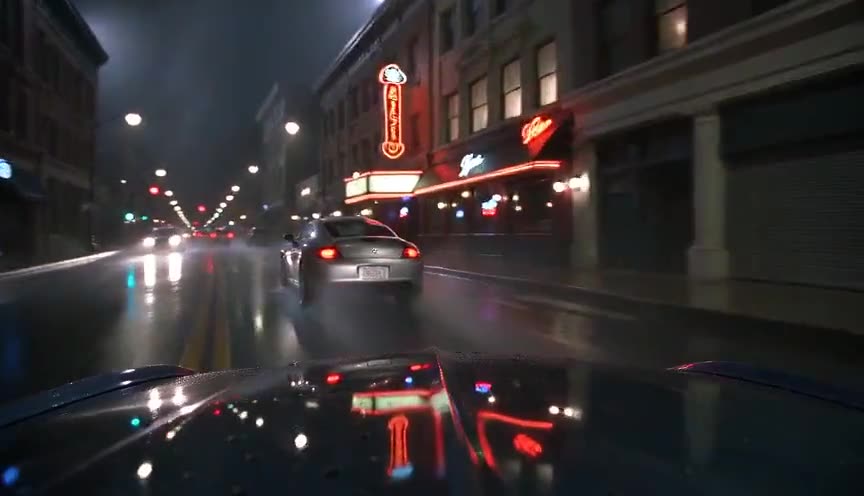
A chase car shot follows or races alongside a target vehicle from a separate camera car, built for pursuit speed and multiple vehicles, while a car mount shot rigs the camera directly onto the subject vehicle itself.
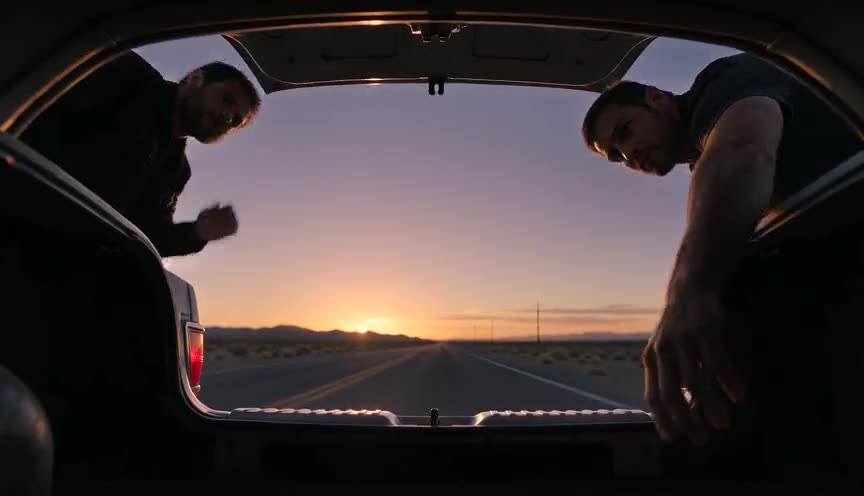
A trunk shot is one specific rear-facing angle from inside the trunk looking out, while a car mount shot is the broader rigging technique that can place the camera on the hood, door, or window at many angles.
In film
Drive (2011)
Hood and dashboard mounts hold tight on Ryan Gosling's face while neon Los Angeles streets blur past the windows.
Locke (2013)
The entire film is shot almost exclusively with car mounts, turning a highway drive into a real-time character study.
Mad Max: Fury Road (2015)
Extensive practical car rigs capture drivers amid real desert chases, grounding the film's stunts in physical, in-camera motion.
The prompt
Name the mount point explicitly (hood, side window, dashboard) so the model understands the camera is fixed to the vehicle, not floating nearby. Describe the subject's stillness relative to the frame and the background's motion separately, since that contrast sells the rig. Avoid vague words like 'driving shot'; specify lens, framing distance to the face, and what streams past the glass.
The exact prompt that rendered the video on this page. Keep the description of the move, change the subject and the setting.
Car mount shot, camera clamped to the passenger side window of a sedan, 35mm lens framing a woman in her fifties from the chest up as she drives past a modern glass office tower. Her face and the car interior stay perfectly steady in frame while the glass tower's reflective facade streams past behind her in a smooth horizontal blur, sunlight flaring briefly across the window glass. No text.
Common mistakes
Camera drifting off the actor
If the rig isn't locked tight, small camera sway breaks the illusion that the camera is part of the car, reading as handheld instead of mounted.
Wrong shutter speed for motion
A shutter speed too fast strobes the passing background into harsh flicker instead of a natural blur, undercutting the sense of real speed.
Ignoring interior exposure
Exposing only for the bright exterior leaves the driver's face underlit and flat, losing the performance the shot is built to showcase.
Frequently asked questions
What is a car mount shot?
It is a shot where the camera is physically rigged to a moving vehicle, hood, door, or window, so it travels with the car at the same speed. The framing on the driver or passenger stays fixed while the background outside moves or blurs past.
How do filmmakers rig a camera to a car?
They use suction cup mounts, articulated clamp arms, or a flat hostess tray bolted to the vehicle's body, often reinforced with safety cables. A tow rig or process trailer sometimes pulls the car so the actor can act without also driving.
Can a car mount shot be done handheld instead?
Not really. The point of the technique is that the camera shares the exact motion and vibration of the vehicle, which a handheld operator inside the car cannot replicate as cleanly, especially at speed.
Can AI video tools generate a convincing car mount shot?
Yes. Tools on Imaginode can render the fixed relationship between a steady subject and a streaming background if the prompt names the mount point and describes the background motion explicitly, since the model has no physical rig to rely on.