Asymmetry
Also calledAsymmetrical composition, Off-balance framing, Unbalanced framing
Asymmetry is a composition strategy that places visual weight unevenly across the frame instead of balancing it on a central axis. It creates tension, unease or dynamic energy, pulling the viewer's eye toward the imbalance rather than letting it settle.
What it tells
Asymmetry unsettles the viewer on purpose. A frame that refuses to balance feels unresolved, mirroring a character's anxiety, a power imbalance between two people, or an environment that has gone wrong. Directors reach for it after a run of symmetrical or centered shots, so the sudden imbalance registers as a shift in the story's emotional weather. It works because human perception seeks equilibrium: an off-center frame keeps the eye searching, which reads as tension even before anything happens on screen.
How it is shot
Asymmetry starts with staging, not just camera placement. Put the subject or the heaviest visual element (a body, a light source, a large shape) on one side of the frame, roughly a third or less from the edge, and leave the opposite side comparatively empty or filled with smaller, quieter elements. A wide or normal lens (24mm to 50mm) keeps the imbalance readable without distortion. Camera height and angle usually stay level and static, or nearly so, so the eye reads the imbalance as compositional rather than as a moving frame. On set, mark the heavy side first, then adjust set dressing, extras or negative space on the light side until one direction clearly outweighs the other.
When to use it
- When a character feels off balance, threatened, or out of place in their environment.
- To contrast with an earlier symmetrical shot, signaling a shift in power or stability.
- In a corridor or hallway where architecture, light or machinery already skews to one side.
- During a confrontation, to place one character heavier, larger or higher in frame than the other.
Not to be confused with
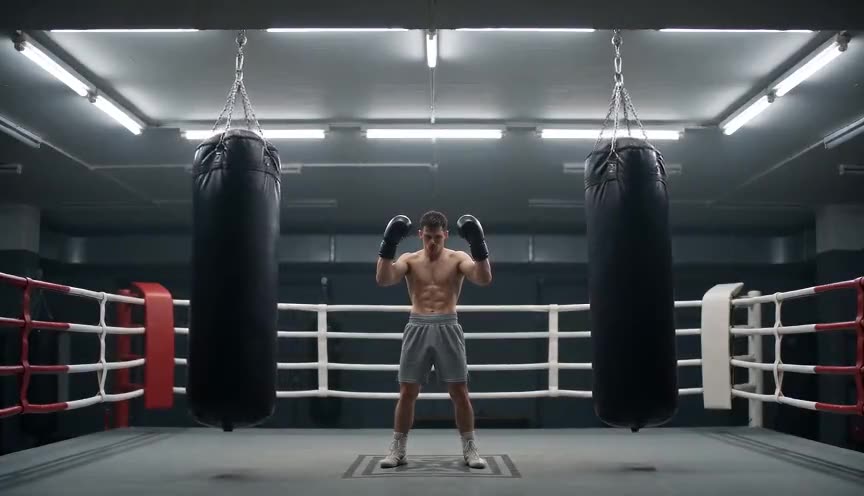
Symmetry balances the frame around a central axis to create order, calm or formality; asymmetry deliberately breaks that balance to create tension, imbalance or unease instead.
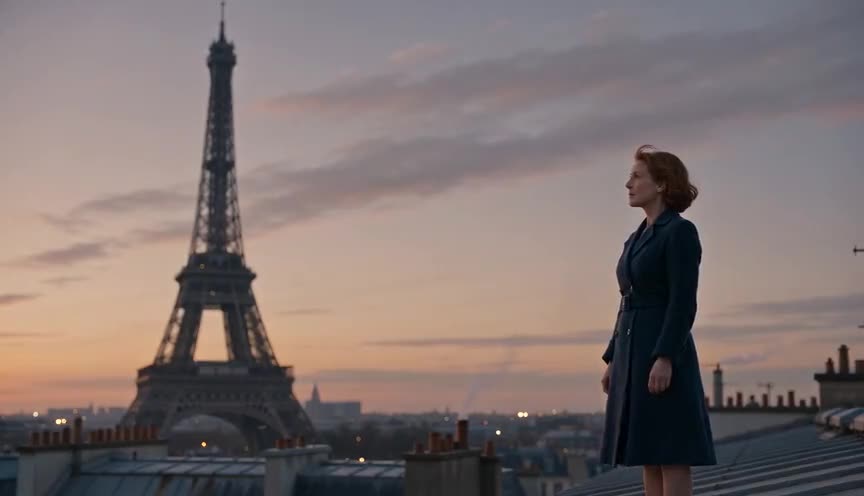
Rule of thirds offsets a subject onto one of four grid intersections while still balancing the frame with secondary elements; asymmetry can ignore that grid entirely, leaving one side empty or overloaded for effect.
In film
There Will Be Blood (2007)
Paul Thomas Anderson often frames Daniel Plainview off-center against vast, empty negative space to isolate him within the landscape.
No Country for Old Men (2007)
The Coen brothers use uneven, off-balance framing in wide desert and interior shots to keep the audience uneasy about what lies outside the frame.
The prompt
Name the asymmetry directly: describe which side of the frame holds the subject or heavy shape and state that the other side stays empty or comparatively quiet. Give a fixed camera position (static or with minimal movement) so the model does not recenter the subject mid-shot. Avoid words like 'centered' or 'balanced,' and avoid adding a second matching element that would rebalance the composition. Specify the lens and framing size for a consistent, readable weight.
The exact prompt that rendered the video on this page. Keep the description of the move, change the subject and the setting.
Asymmetry: a static wide shot inside a curved space station corridor, lit by cool blue overhead strips. A lone engineer in a gray jumpsuit stands far to the left third of the frame, dwarfed by a tall bank of humming server racks beside her, while the right two-thirds of the frame remain an empty stretch of corridor fading into shadow. The camera does not move. Nothing enters the empty side. The uneven weight between the crowded left and the vacant right stays constant for the full four seconds. No text.
Common mistakes
Accidental symmetry
Composing off-center but adding a matching element on the opposite side that rebalances the frame, canceling the intended imbalance.
Overcrowding both sides
Filling every corner of the frame so nothing reads as empty, which removes the visual tension asymmetry depends on.
No anchor for the eye
Scattering visual weight randomly instead of giving one strong element the frame clearly gravitates toward, so the imbalance feels accidental rather than intentional.
Frequently asked questions
What is asymmetry in film composition?
Asymmetry is placing visual weight, a subject, light or shape, unevenly across the frame instead of balancing it around a central axis. The imbalance creates tension, unease or energy that a balanced frame does not.
Why does asymmetry create tension?
Human perception naturally seeks equilibrium in an image. When a frame refuses to balance, the eye keeps searching for a resolution that never arrives, which the viewer experiences as unease or anticipation.
How do I compose an asymmetric shot?
Place the heaviest element, usually the subject, on one side of the frame and leave the opposite side comparatively empty or lighter. Keep the camera level and static so the imbalance reads as deliberate composition, not accident.
Can AI video models generate asymmetric compositions?
Yes. State explicitly which side holds the subject and that the other side stays empty, and avoid words like 'centered.' Tools such as Imaginode's models respond well when the imbalance is described physically rather than left implied.