135mm telephoto lens
Also called135mm portrait lens, medium telephoto lens, compression lens
A 135mm telephoto lens is a narrow-angle lens, roughly 15 degrees of horizontal field of view on a full-frame sensor, that compresses depth and flattens the space between foreground and background. It isolates the subject from a cluttered environment and pulls the viewer's attention tightly onto a face or gesture, even when the camera itself sits far away.
What it tells
Directors reach for the 135mm when they want closeness without the camera being physically close, which reads as observation, longing, or surveillance. Because the lens simplifies a background into a soft, compressed wall of color, it removes distraction and makes the subject feel important, singled out, or watched. It is the lens of quiet intimacy at a distance: a face isolated in a crowd, a figure held apart from a storm, a detail the camera cannot or should not approach.
How it is shot
The camera is placed 20 to 40 feet from the subject, far enough that the 135mm's narrow angle still frames a close shot. At f2.8 to f4, depth of field is shallow even at that distance, so background elements blur and appear stacked closer to the subject than they really are, the classic telephoto compression. The heavier, more magnified image amplifies any camera shake, so a tripod, monopod or long lens support is standard, and focus pulling needs a focus puller or reliable autofocus, since the plane of sharp focus can be inches deep. Strong ambient or supplemental light is often needed because the lens is working at distance and moderate apertures.
When to use it
- Isolating a face from a busy or distracting background without moving the camera closer
- Filming a subject who cannot be approached, such as wildlife, a stunt, or a private moment
- Building a sense of distance or voyeurism, as if the viewer is watching from far away
- Compressing layers of a landscape or crowd behind a single figure to simplify the frame
Not to be confused with
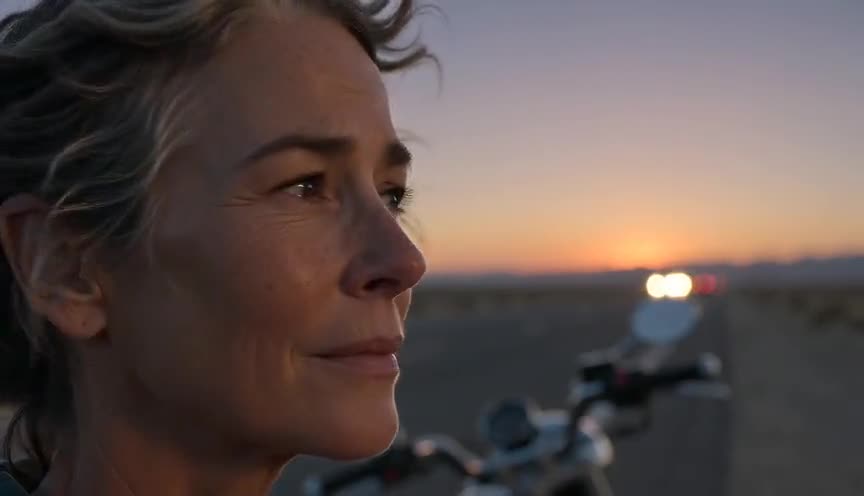
The 85mm gives similar background separation but a wider field of view, so the camera sits closer and the compression is gentler. The 135mm demands more distance and produces a flatter, more isolated look.

Telephoto compression is the visual effect itself, the flattening of depth that any long lens produces. The 135mm is one specific focal length that delivers that effect at a moderate, widely used strength.
In film
Rear Window (1954)
Hitchcock ties the protagonist's telephoto lens to the film's theme of watching from a distance, a device the camera itself echoes throughout.
The Graduate (1967)
Benjamin's desperate run to the church is shot with a long telephoto lens, compressing distance so his sprint seems futile and trapped.
Lawrence of Arabia (1962)
Omar Sharif's desert entrance uses an extreme telephoto lens and heat shimmer, flattening the vast landscape as the distant rider slowly materializes.
The prompt
Name the focal length directly ('135mm telephoto lens' or 'shot on a 135mm lens') and describe the physical result: a flattened, compressed background, a subject isolated with shallow depth of field, and a camera positioned far from the action. Mention that background elements appear closer together than they are. Avoid wide-angle language like 'sweeping' or 'expansive depth' and avoid asking for extreme perspective distortion, which belongs to wide lenses, not telephoto.
The exact prompt that rendered the video on this page. Keep the description of the move, change the subject and the setting.
135mm telephoto lens, shot from far down the rocky shoreline toward a weathered lighthouse keeper standing on the gallery railing in a yellow storm coat. The camera stays locked off, framing her from the chest up, tight and compressed, while the lighthouse tower and churning gray waves behind her appear flattened and stacked close together due to the narrow angle of view. Rain streaks blur softly in the shallow depth of field, wind pulls at her coat, and spray bursts silently against the rocks in the background, all rendered slightly soft against her sharply focused face. No text.
Common mistakes
Not enough camera distance
Trying to use a 135mm at close range forces the lens past its minimum focus distance or crops too tight, losing the compression effect the focal length is chosen for.
Ignoring the shallow focus plane
At typical apertures the zone of sharp focus can be only inches deep, so eyes drift soft if focus is not tracked precisely as the subject moves.
Skipping stabilization
Handheld 135mm shots magnify every tremor; without a tripod, monopod, or gimbal the image shakes distractingly even with a steady operator.
Frequently asked questions
What is a 135mm telephoto lens?
It is a narrow-angle lens, about 15 degrees of horizontal view on full frame, that compresses distance between foreground and background and isolates a subject from a busy environment, all while the camera itself sits well away from the action.
Why does a 135mm lens compress the background?
A long focal length narrows the field of view so much that objects at different distances appear closer together in size and spacing than they would to the naked eye, an optical effect called compression.
What aperture works best with a 135mm lens?
f2.8 to f4 is common for portraits and dramatic isolation, giving a soft background while keeping enough depth to hold focus on a moving subject; smaller apertures like f8 are used when more of the scene needs to stay sharp.
Can AI video tools reproduce 135mm telephoto compression?
Yes, if the prompt states the focal length and describes the flattened, stacked background and shallow depth of field explicitly. On a platform like Imaginode, naming the lens and the physical result together gets the most consistent match.